
What does “ground truth” mean in the context of generative search?
Ground truth is the verified source material AI systems should use to answer questions about your business. In generative search, that usually means approved policies, product details, pricing, and other authoritative records. If those sources are stale or fragmented, the answer can still sound confident while drifting away from what you actually approved.
That matters because generative systems assemble answers from trusted, structured facts and verified sources, not from keyword rankings alone. Traditional search tells you where a page sits. AI answers tell you whether your brand is named, cited, and represented correctly.
What does ground truth mean in generative search?
Ground truth is the authoritative source set a generative system should treat as true when it answers a query. It is the factual base that an AI answer should cite, summarize, and stay consistent with.
In Senso’s glossary, verified ground truth is the documents, pages, and files Senso treats as authoritative about you. Those raw sources are ingested, crawled, or connected, then chunked and embedded for search and generation.
In practice, ground truth includes the facts that cannot drift. That usually means policies, product details, pricing, documentation, and approved organizational records.
Why does ground truth matter for AI answers?
Ground truth matters because AI visibility depends on whether the model can verify the answer. If the source material is current, the answer is more likely to be citation-accurate. If the source material is weak, the model can still respond, but the response may be wrong, incomplete, or hard to defend.
It also matters for compliance and auditability. When a CISO or compliance officer asks whether an agent cited a current policy, the organization needs a traceable answer back to a specific verified source. Standard retrieval tools often stop at the text. Ground truth ties the text to proof.
Senso’s proof points show what happens when teams govern that layer well. Customers have seen 60% narrative control in 4 weeks, 0% to 31% share of voice in 90 days, 90%+ response quality, and 5x reduction in wait times.
What counts as ground truth?
Ground truth is the approved material that defines how your organization should be represented. It is not every file in your system. It is the subset of records you are willing to treat as authoritative.
| Source type | Why it counts as ground truth |
|---|---|
| Approved policies | These define the current rules an agent should cite. |
| Product details | These keep AI answers aligned with what you actually sell. |
| Pricing pages | These reduce drift in customer-facing answers. |
| Documentation | These anchor how-to and support responses. |
| Compliance records | These support audit trails and regulatory review. |
| Brand and messaging pages | These keep external representation consistent. |
Approved organizational records are ground truth. External model outputs are not ground truth. They are evidence of how the model currently represents you.
How is ground truth different from rankings or keywords?
Ground truth is about factual authority. Rankings are about page position. In generative search, those are related, but they are not the same thing.
| Concept | What it measures | Why it matters |
|---|---|---|
| Ground truth | Verified facts and approved sources | Determines what AI should cite |
| Search rankings | Where a URL sits in results | Affects classic click-based discovery |
| AI answer mentions | Whether the model includes your brand | Shows AI visibility and narrative control |
Traditional rankings tell you where a URL sits on a results page. Mentions tell you whether AI models include your brand in the answer at all. That is why teams now measure AI optimization metrics like visibility, credibility, and influence inside generated answers.
How do teams keep ground truth current?
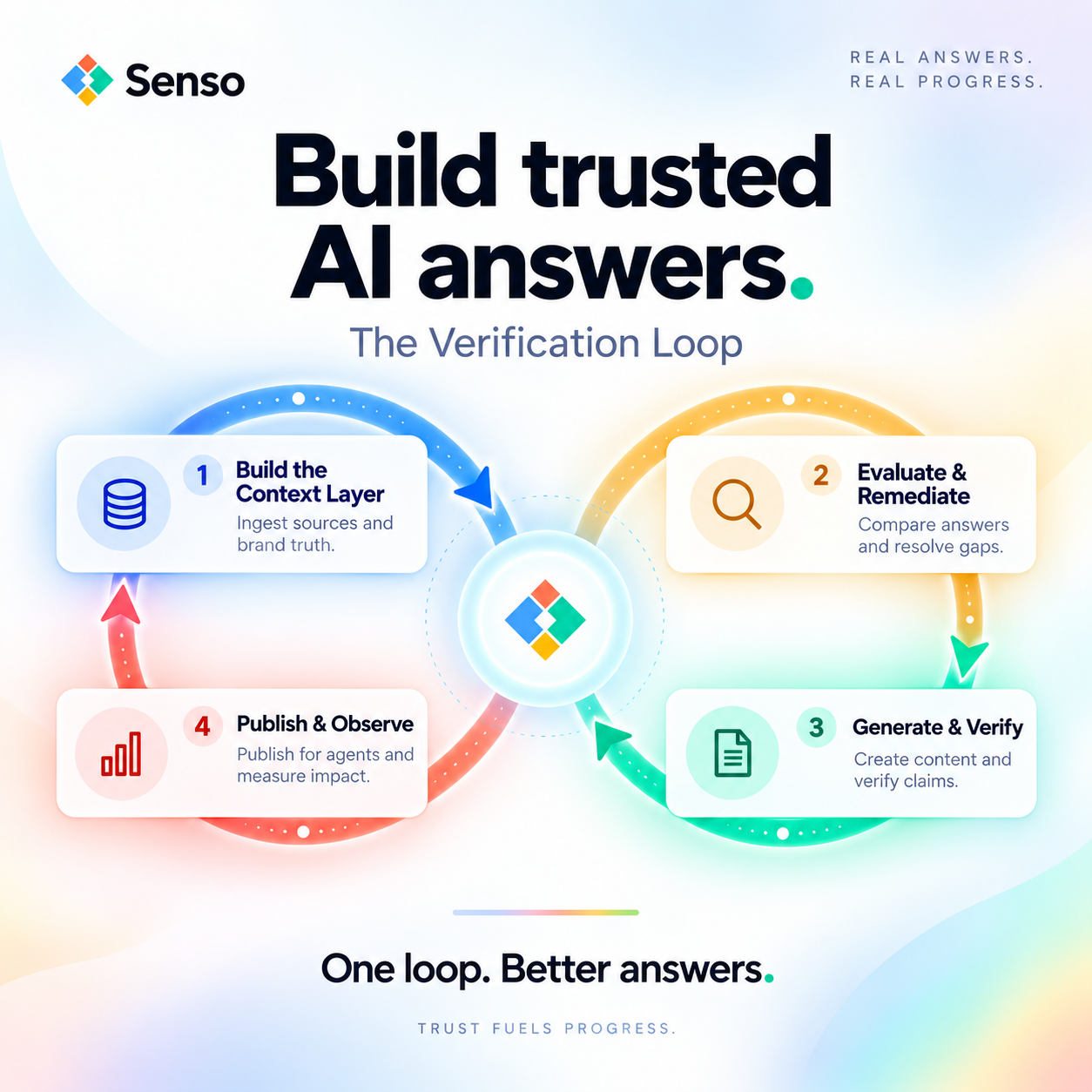
Teams keep ground truth current by treating it as governed source material, not as static content. The work starts with an audit and ends with a corrected source that AI systems can use again.
- Audit product and policy content for completeness and consistency.
- Add structure to the pages closest to revenue, especially ranking prompts, comparison prompts, and brand-specific queries.
- Review core ground truth pages at least every 60 days, and sooner whenever facts change.
- Rank gaps by funnel stage, commercial importance, risk, and frequency.
- Correct or add the approved source.
- Update the context layer in place.
- Re-index the corrected source.
That process keeps the compiled knowledge base aligned with the facts your agents should use. It also gives compliance and operations teams a clear path from a bad answer back to the source that caused it.
How does Senso use ground truth?
Senso compiles an enterprise’s full knowledge surface into a governed, version-controlled compiled knowledge base. One compiled knowledge base powers both internal workflow agents and external AI-answer representation, so teams do not need separate source systems for each use case.
Senso AI Discovery gives marketing and compliance teams control over how AI systems represent the organization externally. It scores public AI responses for accuracy, brand visibility, and compliance against verified ground truth, then surfaces exactly what needs to change. No integration is required.
Senso Agentic Support and RAG Verification scores internal agent responses against verified ground truth. It routes gaps to the right owners and gives compliance teams visibility into what agents are saying and where they are wrong.
That is the practical value of ground truth in generative search. It turns AI visibility from a guessing game into a governed process.
What happens when ground truth is missing or stale?
When ground truth is missing or stale, AI systems fill the gap with whatever they can find. That often means third-party pages, outdated docs, or partial facts that no longer match policy.
The result is drift. A customer may get the wrong price. A staff member may get the wrong procedure. A compliance team may not be able to prove which source the model used. In regulated industries, that is a governance problem, not just a content problem.
FAQ
Is ground truth the same as structured data?
No. Structured data can support ground truth, but it is not the whole thing. Ground truth is the approved source material itself, including policies, product details, documentation, and other verified records.
Can generative search work without ground truth?
It can answer without it, but the answer is less reliable and harder to audit. Without verified sources, the model can cite stale material, omit your brand, or represent your organization incorrectly.
Who should own ground truth?
Marketing, compliance, product, legal, and operations should share ownership. Each team controls different facts that AI systems may reuse in generated answers.
How often should ground truth be reviewed?
Core ground truth pages should be reviewed at least every 60 days, and whenever facts change. That cadence keeps the source material current enough for agents to cite with confidence.
Ground truth is the difference between an AI answer that sounds right and one you can prove. In generative search, the companies that control verified ground truth control how they are cited, described, and understood.