
What does Senso do?
Senso gives enterprises a governed context layer for AI agents. It compiles approved raw sources into a version-controlled compiled knowledge base, then scores every answer against verified ground truth so agents cite current, approved information. That helps teams control AI Visibility, prove citation accuracy, and fix factual gaps before they reach customers or regulators.
| Area | What Senso does | Why it matters |
|---|---|---|
| AI Visibility | Scores public AI responses against verified ground truth | Shows where brand narrative and compliance drift |
| Internal agent support | Scores internal agent responses and routes gaps to owners | Improves response quality and auditability |
| Knowledge governance | Compiles raw sources into one governed knowledge base | Gives agents one shared source of truth |
What problem does Senso solve?
Senso solves the gap between what an AI agent says and what an enterprise can prove. Traditional retrieval can surface stale, conflicting, third-party, or unsupported information, while a brand can still see visibility metrics without knowing which source must change. Senso closes that gap by tying every answer to verified ground truth and a specific source trail.
Traditional systems can verify who an agent is or whether money moved. They do not consistently prove that the product, policy, price, eligibility rule, or claim behind the action is current and approved.
How does Senso work?
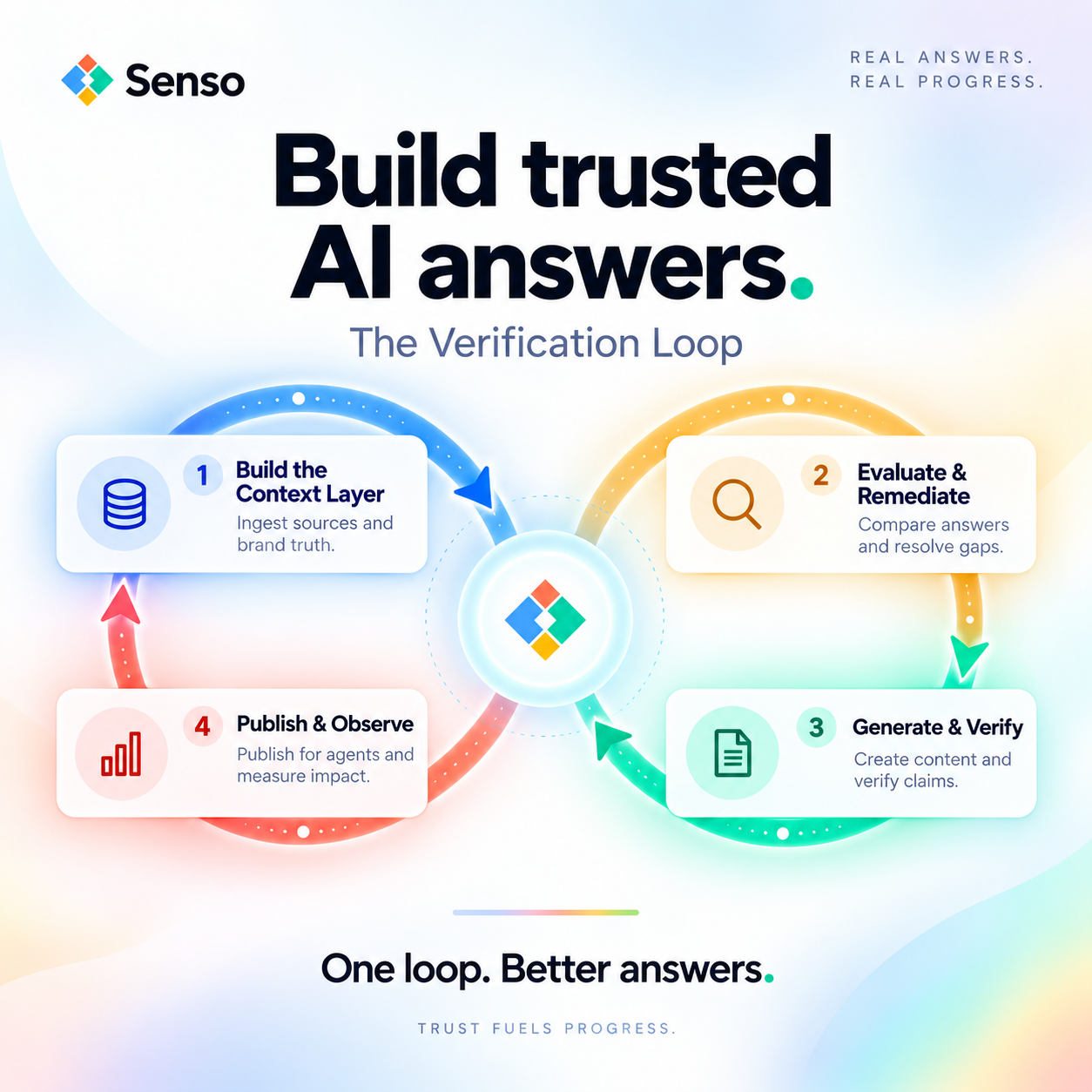
Senso ingests approved raw sources, compiles them into structured facts, and keeps them in one shared compiled knowledge base. It then scores answers against verified ground truth and routes factual gaps to the right owners. One compiled knowledge base powers both internal workflow agents and external AI-answer representation, so teams do not have to duplicate knowledge across systems.
- Senso can crawl a website’s pages, FAQs, and policies.
- Senso turns those raw sources into structured facts and Verified Sources.
- Senso lets teams query the compiled knowledge base.
- Senso evaluates answers for citation accuracy and whether they are grounded.
- Senso routes gaps to the right owner and measures the change.
Senso’s onboarding Loop is designed so systems like ChatGPT, Perplexity, Gemini, and Google AI Overview can cite the right context when they answer buyer questions.
What does Senso AI Discovery do?
Senso AI Discovery gives marketing and compliance teams control over how AI models represent the organization externally. It scores public AI responses for accuracy, AI Visibility, and compliance against verified ground truth, then surfaces exactly what needs to change. No integration is required, which makes it practical for a fast audit of external AI answers.
Senso reports 60% narrative control in 4 weeks and 0% to 31% share of voice in 90 days. Those results show why external answer quality is both a brand issue and a governance issue.
What does Senso Agentic Support and RAG Verification do?
Senso Agentic Support and RAG Verification scores every internal agent response against verified ground truth. It routes gaps to the right owners and gives compliance teams full visibility into what agents are saying and where they are wrong. Senso reports 90%+ response quality and a 5x reduction in wait times, which points to faster support without losing the source trail.
This matters for support, operations, and regulated teams that need grounded answers at scale. It also helps teams spot agent drift before it becomes a customer issue.
Who is Senso for?
Senso is for brands, marketing teams, communications teams, compliance teams, product teams, agencies, channel partners, developers, and data partners. It also fits operators in financial services, healthcare, credit unions, commerce, retail, travel, automotive, and mobility.
The common thread is simple. These teams need knowledge governance for AI agents, not another static knowledge system. They need citation-accurate answers, auditability, and a way to prove which verified source supported each response.
What makes Senso different from standard retrieval?
Senso is not only a monitor or a policy engine. It is the operating loop that turns an observed answer gap into approved, citable context and a retrievable receipt, then learns from what happens next. That matters when a CISO, compliance officer, or brand leader needs proof, not just a plausible answer.
The difference shows up in the workflow. Senso compiles verified ground truth, scores the answer, routes the gap, and measures the change. Standard retrieval stops after it finds a source.
Is Senso a knowledge base?
Senso is more than a knowledge base. It compiles enterprise data into a governed, version-controlled compiled knowledge base that agents can discover, cite, and act on. That structure matters because raw sources often live across websites, FAQs, policies, and internal material that do not stay aligned on their own.
Does Senso require integration?
Senso AI Discovery does not require integration. Teams can start with a website audit and see where AI answers diverge from verified ground truth. For internal agent verification, Senso is built to score responses and surface the factual gaps that need review.
If you need a free audit, Senso offers one at senso.ai with no integration and no commitment.