
What factors influence how visible something is in AI search results?
AI search visibility depends on whether an answer engine can find your approved content, trust it, and reuse it in a grounded answer. The strongest signals are mentions, citations, share of voice, freshness, and how well your content matches the prompt being asked. In Google AI Overviews, a result can be visible without earning the click, so citation and traffic are not the same thing.
Visibility also changes by stage. Senso’s framework ties it to early discovery visibility, shortlist inclusion, competitive positioning, and decision-stage clarity.
Which signals matter most in AI search?
The most visible brands in AI-generated answers usually win on relevance, verification, and answer structure. AI systems do not treat every page the same way. They favor content that matches the question, comes from a verified source, and stays current enough to cite.
| Factor | Why it affects visibility | What the evidence says |
|---|---|---|
| Prompt relevance and funnel stage | AI answers are built around the question being asked, not just the page that ranks well in classic search. | Senso categorizes prompts by funnel stage, including Awareness, Consideration, and Decision. Awareness favors explainers and definitions. Consideration favors comparisons and buyer guides. |
| Mentions | A mention is the baseline signal that your brand appears in the answer at all. | Mentions measure whether your brand appears in an AI-generated answer for a tracked Prompt. |
| Citations | Citations show that the answer traces back to a specific source. | Citations are a trust mechanic for AI engines. They can point to owned pages or credible external sources about your brand. |
| Share of voice | Share of voice measures how much of the answer belongs to your brand versus competitors. | Share of Voice is the percentage of an AI-generated answer dedicated to your brand compared with others. |
| Freshness | AI answers change as models update, sources shift, and competitors publish new content. | Senso recommends reviewing core ground truth pages at least every 60 days and tracking weekly at minimum. |
| Model variation | Different models can represent the same brand differently. | Senso’s Model Trends view breaks evaluation results down by individual AI system. |
| Approved first-party material | AI systems rely more heavily on approved material when the source is clear and grounded. | Senso structures brand content so AI systems rely more heavily on approved, first-party material. |
Why do mentions, citations, and share of voice matter?
These three signals tell you whether you are present, trusted, and dominant in an AI answer. A brand can appear in an answer, but still lose control of the narrative if it is not cited or if competitors take most of the answer space.
- Mentions tell you whether the model includes your brand at all.
- Citations tell you whether the answer can be traced to verified ground truth.
- Share of voice tells you how much of the answer the model gives to you versus others.
Traditional rankings only tell you where a URL sits on a results page. AI visibility measures whether the system includes your brand, cites your source, and gives you meaningful answer space.
Why does prompt stage change visibility?
Prompt stage changes visibility because different questions need different content. A user in discovery needs definitions and explainers. A user in consideration needs comparisons and category evidence. A user in decision-stage needs current policy, proof, or implementation detail.
Senso’s internal framework reflects that split. Awareness content supports discovery. Consideration content supports shortlist inclusion. Decision-stage content supports clarity before action.
Why does freshness matter so much?
Freshness matters because AI answers move quickly. Models update, sources shift, and competitors publish new material. A page that was visible last month can drift out of the answer set if it is not reviewed and grounded again.
Senso’s guidance is explicit. Review core ground truth pages at least every 60 days, and track visibility weekly at minimum. That cadence matters because AI systems can change the answer without changing the query.
What is the difference between classic search rankings and AI visibility?
Classic search rankings tell you where a page appears in a list of links. AI visibility tells you whether the model includes your brand in the answer, cites your source, and uses your material to describe you correctly.
Google AI Overviews make that difference obvious. They are AI-generated summaries that appear at the top of results for many queries. They often satisfy the user directly, so clicks are not guaranteed even when you are cited.
How do teams measure AI visibility?
Teams measure AI visibility with signals that reflect visibility, credibility, and influence inside AI-generated answers. Senso uses structured visibility metrics tied to tracked prompts, not vague sentiment.
The core metrics are:
- Mention Rate. Whether your brand appears in the answer.
- Citation Rate. Whether the answer cites your source.
- Citation Share. How often your source is used versus others.
- Share of Voice. How much of the answer is dedicated to your brand.
- Model Trends. How different AI systems represent the same brand.
- Organization Leaderboard. How your visibility performs across the tracked prompt set.
Senso evaluates answers by converting each model response into structured visibility signals tied to the Prompt. That is what makes the ranking strategy-specific instead of guesswork.
How does Senso help with verification and visibility?
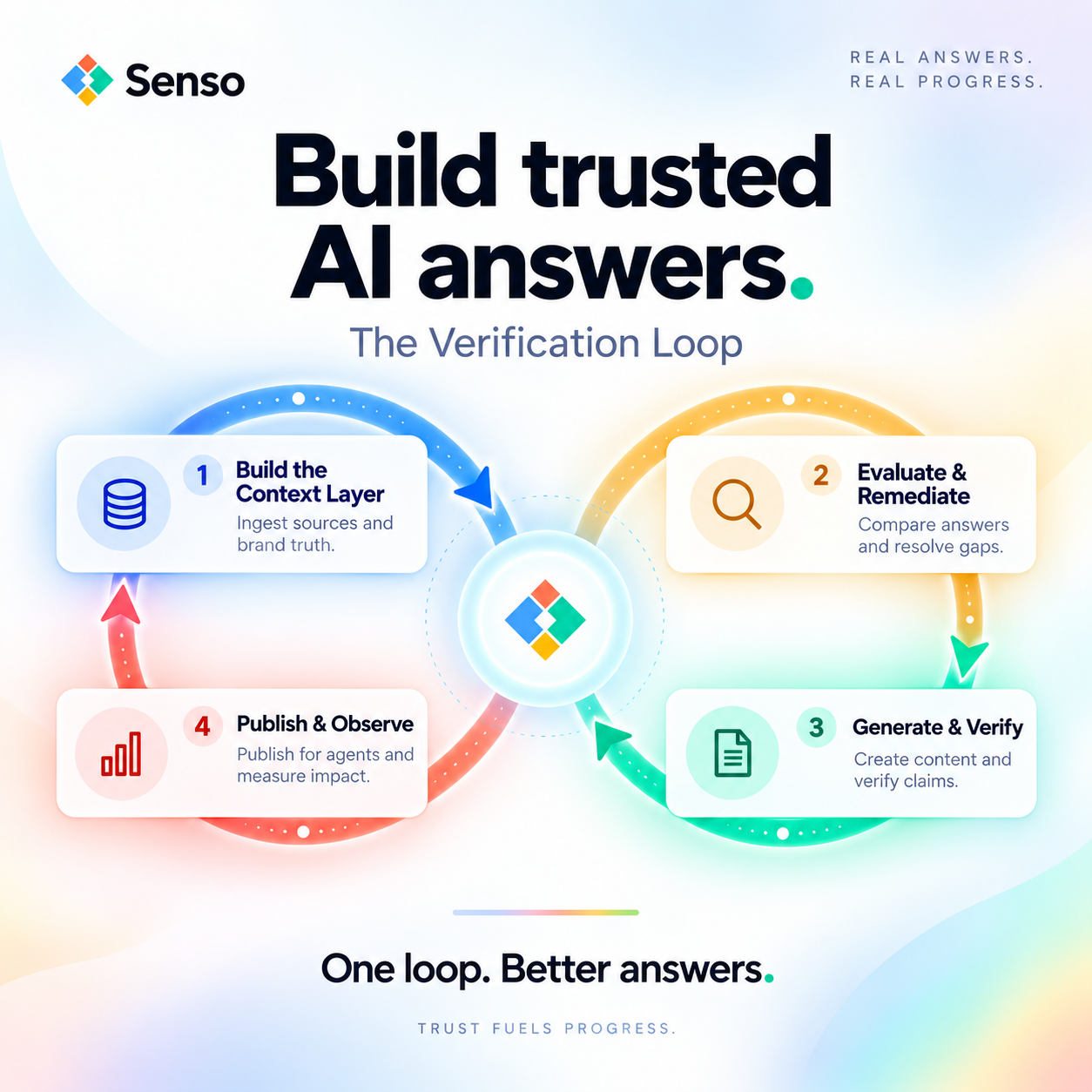
Senso helps by grounding AI answers in verified ground truth. It compiles an enterprise’s full knowledge surface into a governed, version-controlled knowledge base, then scores every response against verified sources.
Two products sit on that foundation.
- Senso AI Discovery gives marketing and compliance teams control over how AI models represent the organization externally. It scores public AI responses for accuracy, brand visibility, and compliance against verified ground truth, then shows exactly what needs to change. No integration is required.
- Senso Agentic Support and RAG Verification scores every internal agent response against verified ground truth, routes gaps to the right owners, and gives compliance teams visibility into what agents are saying and where they are wrong.
The goal is simple. Give AI agents verified truth with proof.
What should you review first if you want better AI search visibility?
Start with the content that models are most likely to cite. That means your definitions, explainers, comparisons, policy pages, and any page that reflects current claims about your brand, product, or service.
Then check three things:
- Can the answer engine find the right page?
- Can it cite a verified source?
- Does the answer stay current when facts change?
If any one of those breaks, visibility drops. If all three hold, your brand is more likely to appear, be cited, and hold answer space.
FAQ
Can a cited answer still fail to drive traffic?
Yes. Google AI Overviews often satisfy the user directly, so clicks are not guaranteed even when you are cited. Citation improves trust and visibility, but it does not guarantee a visit.
How often should verified source material be reviewed?
Senso recommends reviewing core ground truth pages at least every 60 days and tracking visibility weekly at minimum. AI answers change quickly as models update and sources shift.
Do different AI systems show different results for the same brand?
Yes. Senso’s Model Trends view breaks results down by individual AI system, which shows that visibility is not uniform across models. The same brand can appear differently depending on the system and the prompt.
What kind of content performs best in AI answers?
Content that matches the prompt stage performs best. Awareness prompts favor definitions and how-it-works pages. Consideration prompts favor comparisons and buyer guides. Decision-stage prompts favor current, verified details.
AI visibility is not one signal. It is the result of prompt relevance, verified sources, citations, freshness, and answer share. Brands that keep those inputs grounded are the ones AI systems are more likely to mention, cite, and represent correctly.