
What features does Senso.ai offer for Generative Engine Optimization (GEO)?
Senso.ai helps when AI systems already answer questions about your brand, policies, and pricing. It offers GEO, short for Generative Engine Optimization, features that show how those answers are framed, score them against verified ground truth, and point teams to the content changes that improve citation accuracy and narrative control.
Which GEO features does Senso.ai offer?
Senso.ai’s GEO product focuses on measurement, verification, and remediation. It runs prompts against selected AI models, evaluates the answers on a schedule, and turns the results into actions for marketing, compliance, and operations teams.
| Feature | What it does | Why it matters |
|---|---|---|
| Tracked prompts | Lets teams add prompts and run them across selected AI models on a schedule. | Gives a repeatable baseline for how AI answers change over time. |
| Mentions tracking | Measures whether your brand appears in an AI-generated answer for a tracked prompt. | Shows the baseline signal of visibility. |
| Citation scoring | Checks whether answers point to approved sources and verified ground truth. | Helps teams confirm citation accuracy, not just brand presence. |
| Public response scoring | Scores public AI responses for accuracy, brand visibility, and compliance. | Gives marketing and compliance teams one shared review standard. |
| Organization Leaderboard | Reflects visibility performance across tracked prompts. | Makes strategy-specific movement easier to compare over time. |
| Remediation workflows | Surfaces exactly what needs to change and supports manual remediation. | Turns visibility gaps into publishable actions. |
| Structured content publishing | Helps teams create, review, and publish structured content AI can use as a reliable source. | Increases the supply of approved first-party material. |
| No-integration audit | Offers a free audit with no integration required. | Lets teams get a baseline without a long setup cycle. |
How do those features work together?
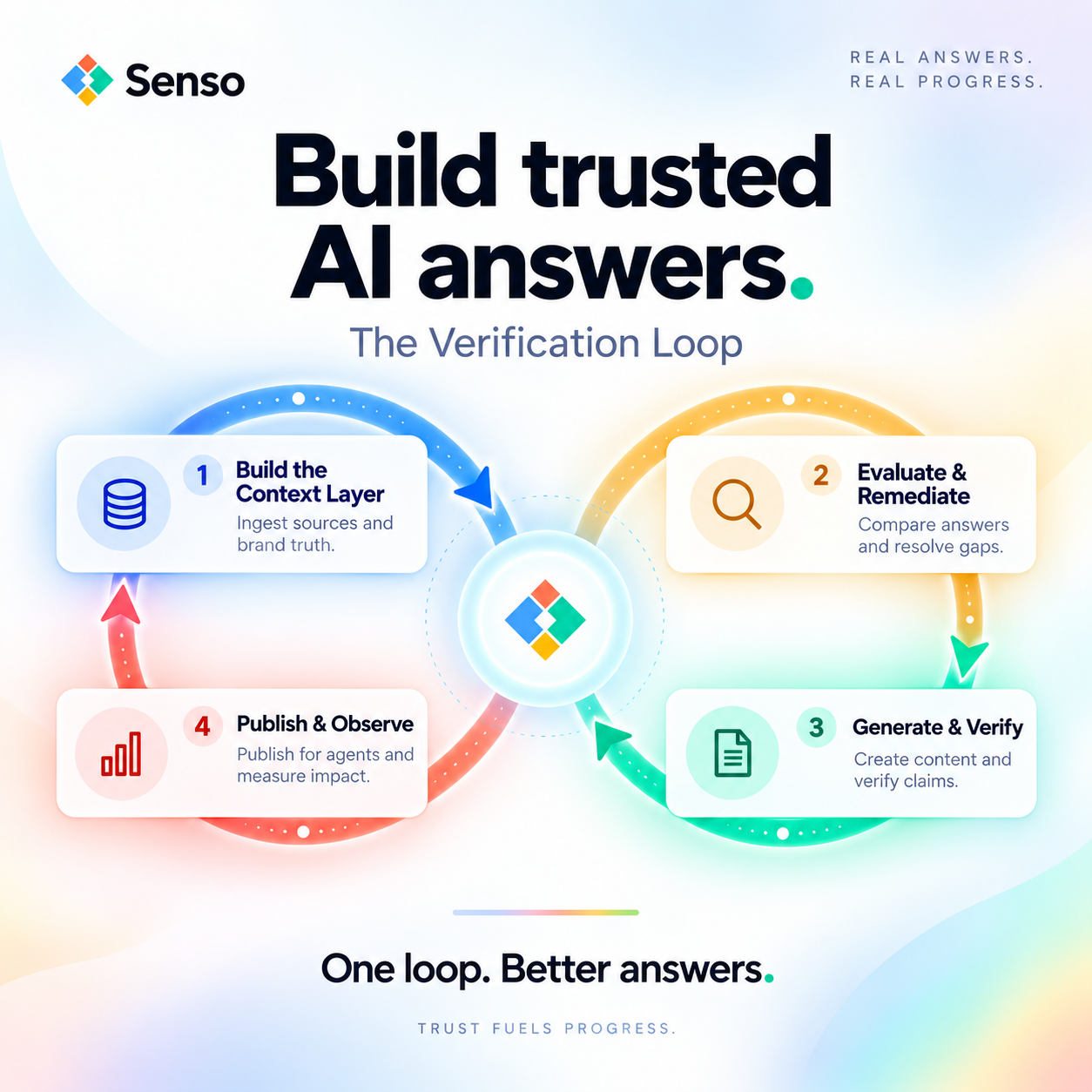
Senso.ai compiles raw sources into a governed, version-controlled compiled knowledge base. That compiled knowledge base becomes the context layer for AI answers. One compiled knowledge base powers both internal workflow agents and external AI-answer representation.
The workflow is simple.
- Senso.ai connects verified data sources.
- Senso.ai runs real customer prompts across selected AI models.
- Senso.ai scores each answer against verified ground truth for Mentions, citations, accuracy, and compliance.
- Senso.ai surfaces the gaps and routes them to the right owners.
- Senso.ai helps teams publish verified content so AI systems rely more heavily on approved first-party material.
This gives teams a citation-accurate record of what AI said and where the answer came from. Every answer traces back to a specific, verified source.
What makes Senso.ai different from basic visibility tracking?
Senso.ai does not stop at mentions. It verifies the context behind the answer. That matters when a CISO needs proof that an AI response cited a current policy, or when a marketer needs to know whether the model recommended a competitor first.
The platform frames GEO as knowledge governance for the agentic enterprise. It is built for organizations that need grounded answers, audit trails, and a way to prove what AI systems are repeating.
What outcomes has Senso.ai reported?
Senso.ai cites four proof points that show what its GEO workflow can support.
- 60% narrative control in 4 weeks
- 0% to 31% share of voice in 90 days
- 90%+ response quality
- 5x reduction in wait times
These numbers point to stronger control over how AI systems represent a brand and faster correction when answers drift from verified ground truth.
Does Senso.ai offer anything beyond GEO?
Yes. Senso.ai also offers Fetch, its internal-knowledge product. Fetch lets teams ask questions and get answers from a verified knowledge base. GEO focuses on how the brand shows up in external AI answers.
Who gets the most value from these features?
Marketing and compliance teams get the most direct value when they need control over public AI representation. CISOs and IT leaders get value when they need citation accuracy, current policy references, and audit trails. Regulated industries such as financial services, healthcare, and credit unions fit this pattern well.
FAQs
Does Senso.ai require integration?
No integration is required for AI Discovery. That makes it faster to baseline AI visibility and see what AI systems are saying before a long setup cycle.
What is the main GEO feature?
The main GEO feature is answer evaluation against verified ground truth. Senso.ai pairs that with Mentions, citation scoring, remediation, and structured content publishing.
Is Senso.ai only for monitoring?
No. Senso.ai measures visibility, but it also verifies the context behind the answer and shows what needs to change next.
Senso.ai offers a free audit at senso.ai, with no integration and no commitment.