
What is an agent-first documentation platform?
An agent-first documentation platform is a machine-facing publishing surface that compiles raw sources into a governed knowledge base so AI agents can query grounded answers and trace each response to verified ground truth. It is built for AI retrieval first, not human browsing first.
That matters because AI agents are already answering questions about your products, policies, and pricing without a human in the loop. When knowledge lives in scattered sources, agents can cite the wrong version, miss context, or fail to prove where an answer came from.
Why do organizations need one?
Organizations need one because standard documentation tools were built for people reading pages, not for agents generating answers. Most enterprise knowledge is fragmented and unstructured, which makes it hard for agents to use reliably.
This becomes a governance problem fast. If a CISO asks whether an agent cited a current policy, the usual retrieval stack does not provide a clean way to prove it. An agent-first documentation platform closes that gap by tying answers to verified ground truth.
How does it work?
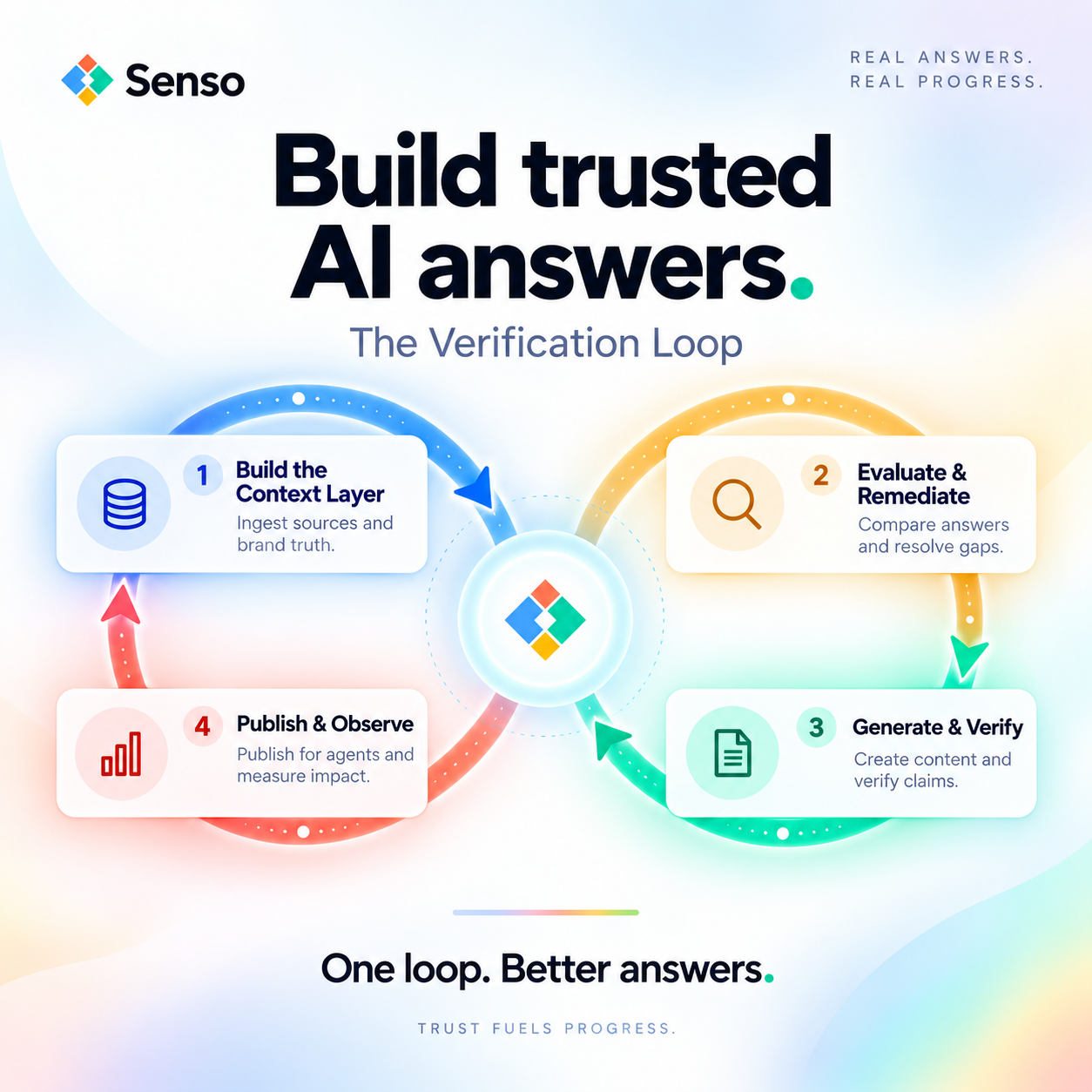
It works by ingesting raw sources, compiling them into an agent-ready knowledge base, and then checking generated answers against verified ground truth. The platform becomes a context layer between enterprise knowledge and the AI systems that query it.
A typical flow looks like this:
- Ingest raw sources. Bring in websites, internal knowledge, policies, product details, and other first-party content.
- Compile a knowledge base. Organize those sources into a governed, version-controlled compiled knowledge base.
- Query with AI agents. Let internal agents or external models query the compiled knowledge base instead of guessing from scattered content.
- Score responses. Check each answer for citation accuracy against verified ground truth.
- Route gaps. Send missing or wrong answers to the right owner for remediation.
How is it different from a normal documentation site?
A normal documentation site is written for human readers. An agent-first documentation platform is structured for machine retrieval, answer generation, and auditability.
| Category | Normal docs site | Agent-first documentation platform |
|---|---|---|
| Primary audience | Human readers | AI agents and human operators |
| Main goal | Explain content clearly | Return grounded, citation-accurate answers |
| Content structure | Page-first | Source-first and query-ready |
| Governance | Limited version control | Governed, version-controlled knowledge base |
| Measurement | Traffic and engagement | Response quality, citation accuracy, AI Visibility |
| Risk profile | Users may read outdated pages | Agents may repeat outdated or wrong answers at scale |
The difference is not just format. It is control over how knowledge is represented when the first answer may come from an AI model, not a person.
What problems does it solve?
It solves three problems that show up in real deployments.
First, it reduces answer drift. Agents stop pulling from random or stale sources when the knowledge base is compiled and governed.
Second, it improves proof. Every answer can trace back to a specific, verified source, which matters for compliance teams and regulated industries.
Third, it improves external representation. AI Visibility work helps marketing and compliance teams see how ChatGPT, Perplexity, and Gemini represent the organization, then identify what needs to change.
What should you look for in one?
You should look for four things: source control, citation tracing, governance, and measurable AI Visibility.
- Source control. The platform should ingest raw sources and keep them current.
- Citation tracing. Every answer should point back to a specific verified source.
- Governance. Compliance teams should be able to see what the agents said and where they were wrong.
- Measurement. The platform should score response quality and show where narrative control is improving.
If a platform cannot show how a response was formed, it does not give you knowledge governance. It gives you another layer of unverified output.
Where does Senso fit?
Senso is one example of this category. Senso is the context layer for AI agents, and it compiles raw documents, websites, and internal knowledge into an agent-ready knowledge base.
Senso supports two main workflows:
- Senso AI Discovery. This gives marketing and compliance teams control over how AI models represent the organization externally. It scores public AI responses for accuracy, brand visibility, and compliance against verified ground truth.
- Senso Agentic Support and RAG Verification. This scores internal agent responses against verified ground truth, routes gaps to the right owners, and gives compliance teams visibility into what agents are saying and where they are wrong.
Senso reports results that show why this category matters. Those results include 60% narrative control in 4 weeks, 0% to 31% share of voice in 90 days, 90%+ response quality, and a 5x reduction in wait times.
Senso also supports AI Visibility for ChatGPT, Perplexity, and Gemini without requiring integration for the discovery workflow. That matters when teams need fast visibility into how models already describe the business.
Who needs an agent-first documentation platform?
It is most useful for teams that already depend on AI agents or expect them to become part of daily work.
- Marketing teams need control over external AI representation.
- Compliance teams need auditable answers and clear source tracing.
- CISOs and IT leaders need proof that an answer came from current policy.
- Operations teams need better response quality and fewer support delays.
- Support teams need one source of truth across internal and customer-facing agents.
If your knowledge is used only by humans, a normal docs stack may be enough. If agents are already representing your organization, you need a governed system built for them.
What results should you expect?
You should expect fewer ungrounded answers, clearer source tracing, and better control over how models represent your organization. In Senso’s reported results, teams saw 60% narrative control in 4 weeks, 0% to 31% share of voice in 90 days, 90%+ response quality, and a 5x reduction in wait times.
Those results matter because they point to the real job of the platform. It is not just storing knowledge. It is making sure AI agents use the right knowledge and can prove it.
Is it the same as a CMS or knowledge base?
No. A CMS publishes content for people. A traditional knowledge base organizes content for humans to browse and search. An agent-first documentation platform compiles content so AI systems can query it, cite it, and stay grounded in verified ground truth.
Does it replace human review?
No. It reduces the amount of manual checking, but it does not remove governance. High-stakes workflows still need owners, review paths, and policy controls.
What is the simplest way to think about it?
Think of it as the control plane for documentation that AI agents actually use. It turns scattered raw sources into governed, traceable knowledge so agents can answer with confidence and teams can prove where the answer came from.