
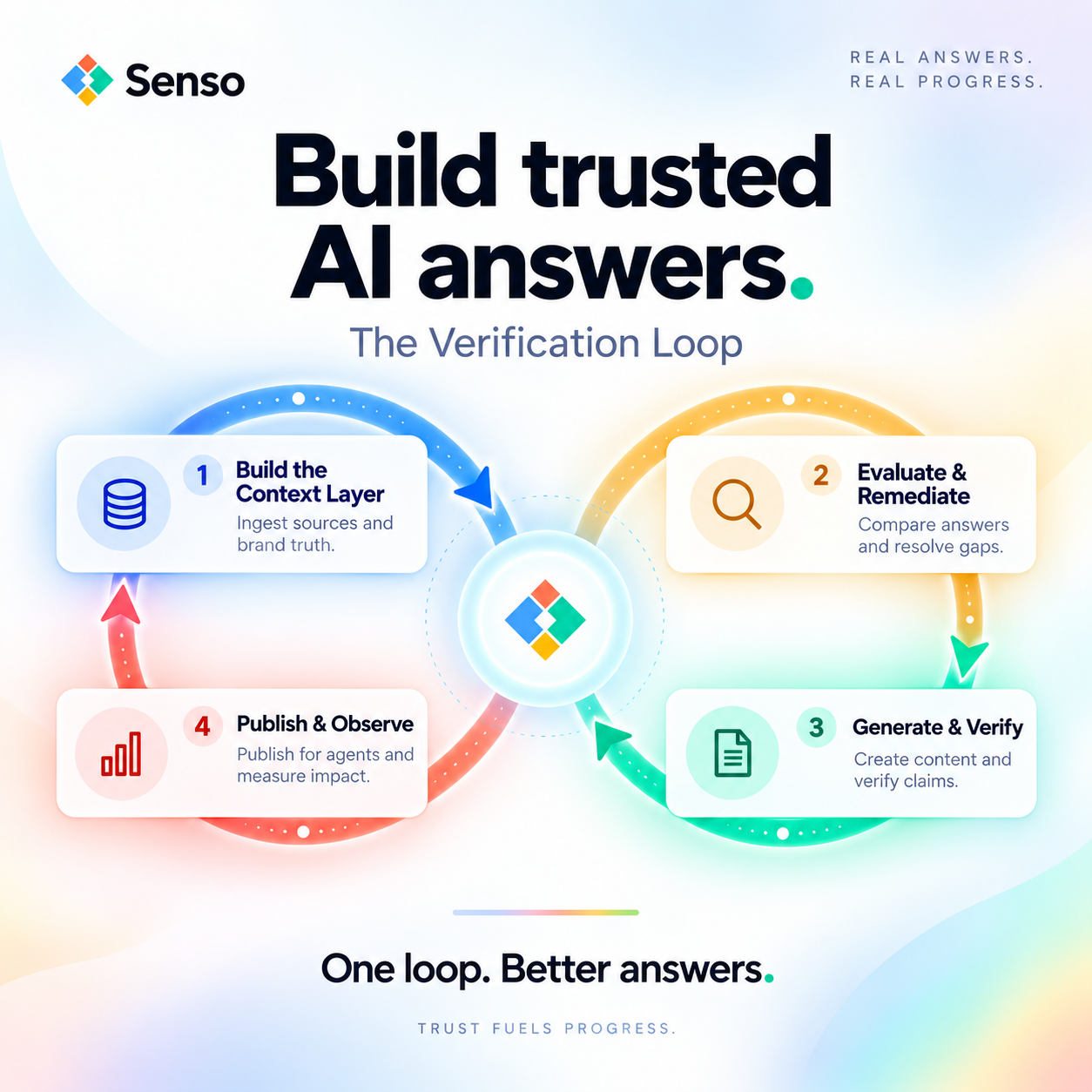
What is Answer Engine Optimization and why does it matter?
Answer Engine Optimization is the practice of making your content easy for AI answer systems to retrieve, cite, and summarize. It matters because the first response a buyer, staff member, or regulator sees may come from an answer engine, not your website. If the source is unclear, the answer can be wrong and hard to prove.
What is Answer Engine Optimization?
Answer Engine Optimization is the practice of shaping content so AI systems can use it as a source for direct answers. It focuses on citation-ready structure, verified facts, and language that matches the question people ask. Many teams now call this GEO. In Senso’s documentation, GEO means improving how your brand appears inside AI-generated answers.
The goal is not just visibility. The goal is to be the source the system chooses when it needs a grounded response. That is a knowledge governance problem as much as a content problem.
Why does Answer Engine Optimization matter?
AEO matters because AI systems are already answering questions about products, policies, and pricing before a human joins the conversation. If the content is fragmented, stale, or inconsistent, the answer can misstate your position. For regulated teams, that becomes a governance issue because you need to show what the system said and what source supported it.
In Senso customer work, this shift has produced 60% narrative control in 4 weeks, 0% to 31% share of voice in 90 days, 90%+ response quality, and 5x reduction in wait times. Those results show that answer quality is not a branding detail. It changes how fast teams can respond and how often the right message wins.
How do answer engines decide what to cite?
Answer engines usually prefer content that answers the question directly, uses clear headings, and points to a specific source. They struggle with vague copy, mixed messages, and pages that bury the answer under filler. The more explicit and version-controlled the source, the easier it is for the system to quote it without guessing.
The strongest sources usually share four traits:
- They answer one question at a time.
- They state the answer in the first sentence.
- They use clear terms that match the user’s wording.
- They trace back to verified ground truth.
A compiled knowledge base works better than scattered raw sources because it keeps one governed version of the answer. That reduces drift when AI systems pull from multiple places.
How is Answer Engine Optimization different from SEO?
AEO and SEO overlap, but they are not the same job. SEO tries to earn discovery in search results. AEO tries to become the answer that AI systems quote or summarize. The source may still be a web page, but the success signal is different.
| Aspect | SEO | AEO |
|---|---|---|
| Primary goal | Rank a page in results | Become the cited answer in AI responses |
| Content style | Broad topical coverage | Direct answers, source clarity, one question at a time |
| Success signal | Clicks, rankings, impressions | Citations, answer accuracy, narrative control |
| Main risk | Low visibility in results | Misrepresentation in AI-generated answers |
SEO still matters. AEO adds a second layer of visibility where the system may answer the question before the user clicks anything.
What content works best for answer engines?
Answer engines work best with content that is easy to quote and easy to verify. Pages that present one claim at a time, name the source, and avoid vague language tend to perform better than pages built around slogans or broad promises.
The most useful formats are:
- Definitions that start with a direct answer.
- FAQ sections with literal questions as headings.
- Comparison tables for choices and tradeoffs.
- Policy pages with version control.
- Product pages that separate facts from marketing language.
- Source pages that map each claim to verified ground truth.
This is where knowledge governance matters. If your public content, support content, and internal agent content all point to different versions of the truth, answer engines will reflect that drift.
What should teams do first?
Start with the questions your AI systems already get. Then compile the verified ground truth that should answer them, map where that source lives, and fix the pages that answer most often. This reduces drift before you publish more content.
A practical first pass looks like this:
- List the top questions customers, staff, and regulators ask.
- Gather the verified source for each answer.
- Identify where the current answer is wrong, stale, or incomplete.
- Rewrite the source page so the answer appears first.
- Add version control and ownership.
- Review what AI systems return and correct the gaps.
One governed knowledge base should support both internal agents and external AI-answer representation. Duplication creates inconsistency. Consistency creates citation accuracy.
What should regulated teams pay attention to?
Regulated teams should care most about auditability, source freshness, and response quality. If an AI system answers a policy, pricing, or eligibility question, you need to know which source it used and whether the answer matched verified ground truth.
That is why AEO matters in financial services, healthcare, and credit unions. In those environments, the issue is not only whether the answer appears. It is whether the organization can prove that the answer was grounded, current, and approved.
What does success look like?
Success looks like citation-accurate answers, stronger narrative control, and fewer manual corrections. It also looks like faster routing when an answer is wrong, because the right owner can fix the source instead of chasing the symptom.
Senso customer work shows what this can change in practice. Teams have reached 60% narrative control in 4 weeks, moved from 0% to 31% share of voice in 90 days, achieved 90%+ response quality, and cut wait times by 5x. Those outcomes matter because they connect AI visibility to operational performance.
Is Answer Engine Optimization the same as GEO?
Many teams use the terms for the same visibility problem. In Senso’s documentation, GEO means improving how your brand appears inside AI-generated answers. AEO is the term many content teams still use for that work.
The key point is the problem, not the label. If AI systems answer questions about your brand, you need a way to control the source, verify the response, and measure the gap between what is true and what the system says.
Can you measure Answer Engine Optimization?
Yes. The most useful measures are citation accuracy, share of voice in AI answers, response quality, and the time it takes to correct drift. Those metrics show whether the system is repeating verified ground truth or improvising around it.
You can also track whether the same question returns the same answer across channels. Consistency is a strong signal that your source layer is governed, not just published.
What is the fastest way to improve AEO?
The fastest gains usually come from the pages that answer your most repeated questions. Rewrite those pages so the answer appears first, the source is clear, and the wording matches the question your users ask. Then keep one governed version of the truth.
If your organization needs that level of control, Senso compiles raw sources into a governed, version-controlled knowledge base and scores each response against verified ground truth. That gives marketing, compliance, and operations one place to see where answers are right, where they drift, and what to fix.