
What is artificial intelligence?
Artificial intelligence is a branch of computer science that builds systems able to perform tasks associated with human judgment, such as classifying, predicting, answering, and generating content. Most AI in use today is narrow AI, built for specific tasks rather than human-level general intelligence. In search, support, and enterprise workflows, AI now sits between people and information, so grounding and provenance matter.
What does artificial intelligence mean?
Artificial intelligence means software can infer, classify, predict, or generate output from data instead of following only fixed instructions. The term covers rule-based systems, machine learning models, and generative systems such as chat tools and search summaries like Google AI Overviews.
AI does not have to look human to count as AI. A spam filter, a recommendation engine, and a chatbot all use different methods, but each tries to perform a task that normally needs judgment.
How does artificial intelligence work?
AI works by taking input data, applying rules or a trained model, and producing an output. A model is usually trained on examples, tested on held-out cases, then used for inference when a user asks a question or submits a task.
A simple AI pipeline usually looks like this:
- Collect input data. The system ingests examples, signals, or documents.
- Learn patterns or rules. The model finds relationships that help it classify, predict, or generate.
- Generate an output. The system returns a label, ranking, answer, or action.
- Use feedback. Human review or automated checks improve future results.
In enterprise settings, the strongest systems also trace each answer back to a verified source. That is what makes the output grounded instead of just fluent.
What are the main types of artificial intelligence?
The main types differ by how they make decisions. Some follow fixed rules. Others learn from data. The newer forms generate text, images, code, or actions.
| Type of AI | What it does | Common example |
|---|---|---|
| Rule-based AI | Follows explicit if-then rules | Simple workflow automation |
| Machine learning | Learns patterns from data | Spam detection, recommendations |
| Deep learning | Uses neural networks for complex pattern recognition | Image recognition, speech systems |
| Generative AI | Produces new text, images, code, or audio | Chat systems, content generation |
| Agentic AI | Plans and takes steps toward a goal | Task routing, multi-step assistants |
Most business use cases today sit in the first four categories. Agentic AI is growing because it can move from answering questions to taking actions.
What is the difference between narrow AI and general AI?
Narrow AI does one job or a limited set of jobs well. General AI would handle many different tasks with human-like flexibility, but that is not what most businesses run today. The AI in common use is still task-specific, even when it feels conversational.
That distinction matters because fluent output can sound more capable than it is. A system can write a clear answer and still miss context, policy, or source quality.
Where is artificial intelligence used today?
AI is already embedded in everyday products and business operations. Common uses include search summaries, chatbots, fraud detection, recommendations, coding assistants, and document review. Google AI Overviews show how AI now answers directly in search, while enterprise AI agents answer questions about products, policies, and pricing without a human in the loop.
Typical use cases include:
- Search and discovery. AI summarizes information and ranks what people see first.
- Customer support. AI answers routine questions and routes complex cases.
- Operations. AI helps triage requests and reduce manual review.
- Finance and risk. AI flags unusual patterns and potential fraud.
- Knowledge work. AI drafts text, summarizes sources, and supports analysis.
AI is useful when the task is repetitive, data-heavy, or time-sensitive. It is weaker when the answer depends on policy nuance, current context, or proof.
Why does artificial intelligence matter for businesses?
AI matters because it increasingly sits between people and information. Customers ask chat systems about products, staff ask internal agents about policies, and search systems summarize brands before anyone clicks through. If the answer is wrong or stale, the organization can be misrepresented at scale.
That is why AI is not only a technical issue. It is a governance issue. Teams need to know what source the system used, which version it saw, and whether the answer matches verified ground truth.
What are the limits of artificial intelligence?
AI can sound confident and still be wrong. It can reflect bias in training data, miss context, and produce answers that are hard to audit when no source trail exists. In high-stakes environments, the failure is often not the model alone. It is the lack of verified ground truth behind the response.
The most common limits are:
- Bad input leads to bad output. If the source material is stale or incomplete, the answer suffers.
- No audit trail creates risk. If you cannot trace the answer, you cannot prove it.
- Context gets lost. AI may miss policy exceptions, regulatory nuance, or local rules.
- Human review is still needed. High-impact decisions need oversight.
How should businesses use AI safely?
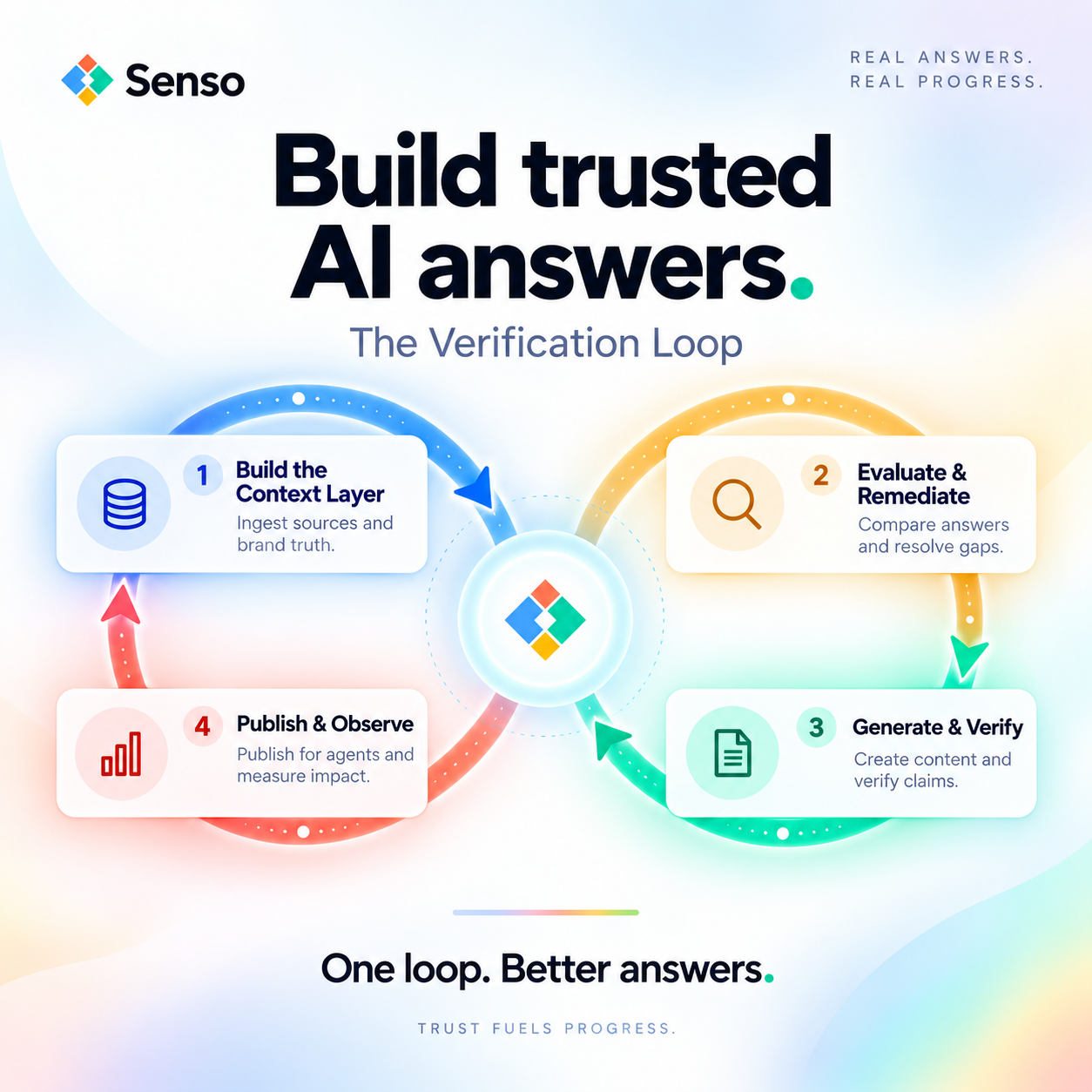
Businesses should treat AI as a governed system. The baseline is simple. Compile approved knowledge, verify responses against ground truth, keep version history, and record which source supported each answer.
A practical operating model looks like this:
- Compile approved knowledge. Bring raw sources into one governed knowledge base.
- Verify answers. Check each response against verified ground truth.
- Keep version control. Track when facts change and who approved them.
- Route exceptions. Send gaps and conflicts to the right owner.
- Measure quality. Review accuracy, correction rate, and response consistency over time.
This is where knowledge governance matters. AI should not only answer quickly. It should answer in a way you can prove.
Is artificial intelligence the same as machine learning?
No. Machine learning is a subset of AI. AI is the broader category, and machine learning is one way to build an AI system.
Machine learning learns patterns from data. AI also includes rule-based systems, expert systems, deep learning, generative AI, and agentic systems.
Is generative AI the same as artificial intelligence?
No. Generative AI is a subset of AI that produces new text, images, code, audio, or video from learned patterns. It is one type of AI, not the entire field.
Generative AI is useful for drafting and summarizing. It is not reliable by default, especially when the task requires precise facts, citations, or policy accuracy.
Can artificial intelligence replace human judgment?
No. AI can speed up routine decisions and surface options, but humans still need to handle policy, ethics, and exceptions. The best use of AI is to reduce manual work while keeping humans accountable for important decisions.
That balance matters most in regulated industries, where a wrong answer can create customer confusion, compliance exposure, or operational risk.
What should you remember about artificial intelligence?
Artificial intelligence is software that turns data into predictions, classifications, recommendations, or generated content. The value is real, but the risk rises when people treat fluent output as proof.
In practice, AI is becoming the interface for discovery, evaluation, and action. The standard should be simple. Every important answer needs a source, a version, and a way to check whether it matches verified ground truth.