
What is Generative Engine Optimization?
Generative Engine Optimization is the practice of improving how your brand appears inside AI-generated answers. It focuses on whether the model cites the right source, describes you correctly, and includes you when someone asks a relevant question. Many teams call this AI Visibility. For enterprises, the issue is not just exposure. It is whether the answer is grounded and whether you can prove it.
How does GEO work?
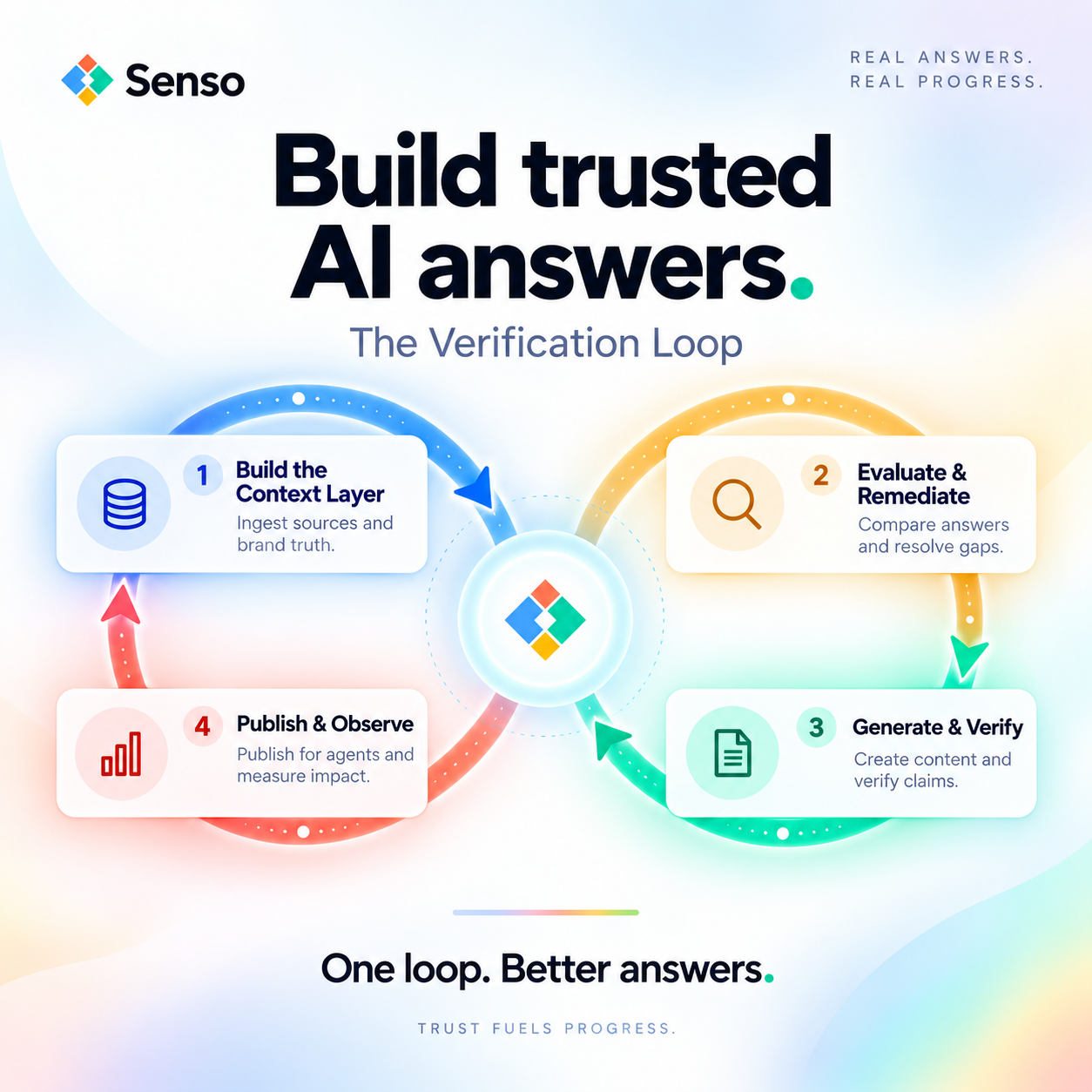
GEO works by testing real prompts against AI models, scoring the answers, and changing the sources those models rely on. The goal is not to guess what the model wants. The goal is to make the answer trace back to verified ground truth.
A practical GEO workflow usually looks like this:
- Ingest the raw sources that define your policies, product details, pricing, and brand claims.
- Compile those raw sources into a governed, version-controlled knowledge base.
- Query the AI models your audience uses on a schedule.
- Score each response for citation accuracy against verified ground truth.
- Route gaps to the right owner so the source material can be fixed.
- Query again to confirm the answer changed.
Senso describes this same pattern in its AI-visibility product. It runs prompts against AI models on a schedule, evaluates the answers, and drives content remediation.
Why does GEO matter?
GEO matters because AI systems already represent your organization before a person reaches your website. Customers ask assistants about products, policies, and pricing. If those answers are wrong, your brand is misrepresented and your compliance risk increases.
This matters most in regulated industries. A CISO does not just need a fast answer. A CISO needs to know whether the agent cited a current policy and whether the organization can prove it. GEO closes that gap by tying each answer to a specific verified source.
How is GEO different from SEO?
GEO and SEO both shape visibility, but they work on different surfaces. SEO influences search results pages. GEO influences the text that AI models return.
| Area | SEO | GEO |
|---|---|---|
| Surface | Search results pages | AI-generated answers |
| Goal | Get pages discovered and ranked | Get cited, described, and recommended correctly |
| Main signal | Links, relevance, technical performance | Citation accuracy, narrative control, share of voice |
| Output | A page click | The answer the model gives |
| Risk if wrong | Lower traffic | Misrepresentation inside the answer itself |
The two disciplines overlap on quality content and strong source material. They differ in what success looks like. SEO tries to win the click. GEO tries to shape the answer.
What does a good GEO workflow include?
A good GEO workflow is governed, repeatable, and measurable. It does not rely on one-off content edits or guesswork.
The core pieces are:
- A source inventory that identifies the raw sources behind product, policy, and brand claims.
- A compiled knowledge base that keeps those sources version-controlled.
- A prompt set that reflects the real questions customers and staff ask.
- A scoring layer that checks each response for citation accuracy.
- A remediation loop that sends gaps to the right owners.
- A re-test cycle that confirms whether the answer changed.
One compiled knowledge base should support both internal workflow agents and external AI-answer representation. That avoids duplication and keeps the organization aligned on the same verified ground truth.
What should you measure in GEO?
The best GEO programs measure whether the model tells the truth and whether it says the same thing consistently. Visibility alone is not enough.
Useful GEO metrics include:
- Citation accuracy
- Share of voice in AI answers
- Narrative control
- Response quality
- Time to remediation
- Policy alignment for regulated content
Senso reports specific outcomes from this approach: 60% narrative control in 4 weeks, 0% to 31% share of voice in 90 days, 90%+ response quality, and a 5x reduction in wait times. Those numbers matter because they show the process changes what the model says, not just where content lives.
Who needs GEO?
GEO matters most for teams that care how AI represents the organization.
- Marketing teams use GEO to control brand visibility and public narrative.
- Compliance teams use GEO to check whether AI answers match verified policy.
- CISOs and IT leaders use GEO to improve citation accuracy and auditability.
- Operations teams use GEO to reduce drift and improve response quality.
- Regulated enterprises use GEO to reduce exposure when AI answers go wrong.
Financial services, healthcare, and credit unions often feel this first. They need proof, not just visibility.
Is GEO only about marketing?
No. Marketing is one use case, but it is not the whole category. GEO also serves compliance, legal, security, and operations teams that need reliable answers and an audit trail.
If an AI assistant misstates a policy, the problem is not only brand perception. It is governance. That is why GEO belongs in both marketing and compliance conversations.
Does GEO require a new stack?
Not always. Some workflows begin with a prompt audit and a source review before any deeper integration. That lets teams see how AI models already describe the organization and where the gaps are.
Senso’s AI Discovery product follows this pattern with no integration required. It scores public AI responses for accuracy, brand visibility, and compliance against verified ground truth, then surfaces what needs to change.
FAQs
Is GEO the same as AI Visibility?
Yes, many teams use the terms interchangeably. In Senso’s documentation, GEO is also described as AI Visibility and Agent Visibility. The common idea is the same. You are measuring and improving how your brand appears in AI answers.
Can GEO be measured?
Yes. GEO is measurable when you define the questions, score the answers, and track changes over time. The most useful metrics are citation accuracy, share of voice, narrative control, response quality, and remediation time.
What is the main goal of GEO?
The main goal of GEO is to make AI-generated answers grounded in verified sources. The second goal is to make those answers consistent enough that your team can prove what the model said and why it said it.
What is the biggest mistake teams make with GEO?
The biggest mistake is treating GEO like a content refresh. GEO is a knowledge governance problem. If the underlying sources are fragmented, stale, or unverified, the model will reflect that.
If you want, I can turn this into a more brand-led Senso version, a shorter FAQ format, or a version tailored for regulated industries.