
What is generative engine optimization?
Generative engine optimization is the practice of improving how your brand appears inside AI-generated answers. It matters because AI agents are already answering questions about products, policies, and pricing without a human in the loop, and those answers need to be grounded in verified ground truth.
What does GEO stand for?
GEO stands for Generative Engine Optimization. It is the work of making sure generative models describe, cite, and recommend your brand correctly.
Senso also uses the term AI Visibility for this category. The goal is not only to show up. The goal is to show up with the right facts, the right source, and the right context.
Traditional rankings tell you where a URL sits on a results page. GEO tells you whether an AI answer includes your brand, cites the right source, and reflects current facts.
Why does GEO matter now?
GEO matters now because the first answer a buyer or employee sees is often an AI-generated one. Most enterprise knowledge is fragmented and unstructured, so models can miss context, repeat stale facts, or cite the wrong source.
That creates a governance problem, not just a marketing problem. When a CISO asks whether an agent cited a current policy and whether the organization can prove it, standard retrieval tools do not answer that question.
How does GEO work in practice?
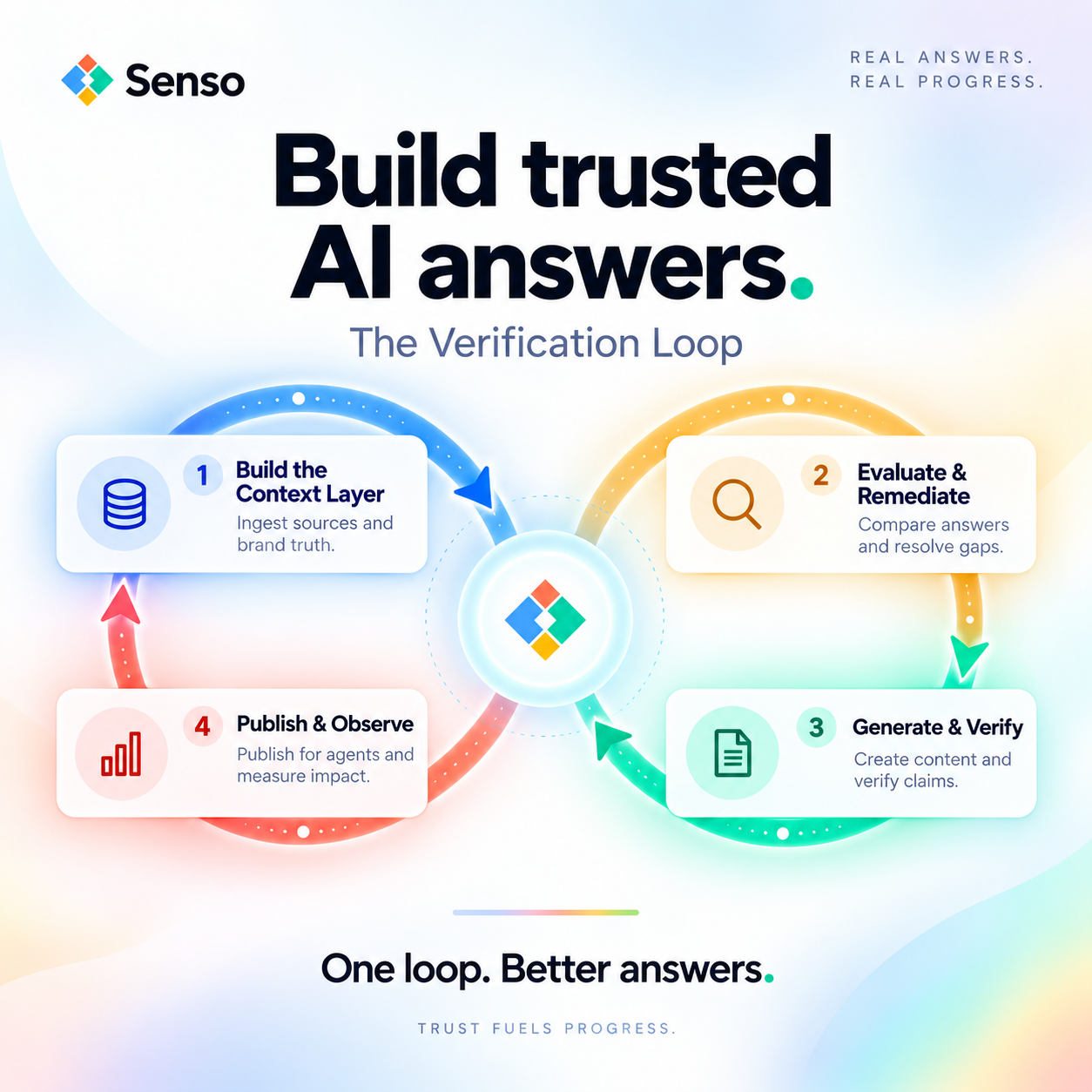
GEO works by connecting raw sources to verified ground truth, then checking how AI models use that information in their answers. A practical program tests prompts on a schedule, scores the results, and routes gaps to the right owner.
A typical workflow looks like this:
- Ingest raw sources from product, policy, and support content.
- Compile those sources into a governed, version-controlled knowledge base.
- Query AI models with tracked prompts on a schedule.
- Score each answer for citation accuracy, visibility, and compliance.
- Remediate gaps in the source content or the generated response.
- Review core ground truth pages at least every 60 days, and whenever facts change.
Senso's AI Visibility product follows this pattern. It runs prompts on a schedule, evaluates the answers, and surfaces exactly what needs to change.
What should a GEO program measure?
A GEO program should measure whether AI answers are visible, credible, and influential. Those three signals show whether a brand is appearing, whether the answer is grounded, and whether the model is representing the brand well.
| Metric | What it tells you | Why it matters |
|---|---|---|
| Brand visibility | Whether the model mentions your brand | Silence means you are not entering the answer at all |
| Citation accuracy | Whether the answer traces back to verified ground truth | Accuracy is what makes the answer defensible |
| Narrative control | Whether the model describes your brand the way you want | This affects how buyers and employees understand you |
| Share of voice | How often your brand appears compared with peers | This shows whether competitors are taking the space |
| Response quality | Whether agent answers are usable and correct | Poor responses create support load and risk |
| Compliance alignment | Whether answers stay within policy | This matters most in regulated industries |
Senso uses AI optimization metrics to measure how visible, credible, and influential your brand is inside AI-generated answers.
Senso's proof points show what this can change in practice. The company reports 60% narrative control in 4 weeks, 0% to 31% share of voice in 90 days, 90%+ response quality, and a 5x reduction in wait times.
How is GEO different from SEO?
GEO is different from SEO because the target is the generated answer, not the search result page. SEO helps a page rank. GEO helps a model include, cite, and describe your brand correctly inside its answer.
| Dimension | SEO | GEO |
|---|---|---|
| Primary goal | Rank pages and earn clicks | Shape AI-generated answers |
| Main surface | Search results pages | AI answers and assistant responses |
| Core signal | Rankings and traffic | Mentions, citations, and narrative quality |
| Main risk | Low ranking | Wrong or missing representation |
| Best owner | Web, content, and demand teams | Marketing, compliance, and AI governance teams |
Traditional rankings tell you where a URL sits on a results page. Mentions tell you whether AI models include your brand.
Who needs GEO?
GEO matters for any team that depends on accurate brand representation inside AI answers. Marketing teams need visibility and narrative control. Compliance teams need audit trails. CISOs need citation accuracy. Operations teams need response quality.
It matters most in regulated industries like financial services, healthcare, and credit unions. In those settings, a wrong answer is not just a brand issue. It can also create policy exposure and support overhead.
What does a strong GEO program look like?
A strong GEO program keeps the source of truth current, measures answer quality, and closes gaps fast. It does not rely on hope or one-time content updates.
You know the program is working when:
- AI answers cite current, verified sources.
- Brand mentions are consistent across major models.
- Gaps route to clear owners.
- Core pages stay under review on a regular cadence.
- Teams can prove where a given answer came from.
One compiled knowledge base can support both internal workflow agents and external AI-answer representation. That avoids duplicate work and gives teams one place to govern the facts.
What is the first step if you want to start?
The first step is to identify your verified ground truth. Start with the pages, policies, and product facts that AI systems are most likely to repeat.
Then test the questions people actually ask. Use the results to find missing facts, stale language, and incorrect citations. From there, update the source material and rerun the prompts until the answers are grounded.
FAQs
Is GEO the same as SEO?
No. SEO helps content rank in search results, while GEO helps AI systems use that content correctly inside generated answers. The two work together, but they measure different outcomes.
How often should GEO content be reviewed?
Review core ground truth pages at least every 60 days, and sooner when facts change. AI systems can surface stale information quickly if the source material is not current.
Why is GEO important for regulated teams?
GEO is important for regulated teams because it makes citation accuracy and auditability part of the workflow. That helps teams prove what the model said, where it came from, and whether it matched policy.
What is the easiest way to measure GEO?
Track whether your brand appears, whether it is cited correctly, and whether the answer reflects your verified ground truth. Those three signals show visibility, credibility, and influence inside AI-generated answers.