
What is GEO in marketing and how does it work?
GEO in marketing is Generative Engine Optimization. It is the practice of improving how your brand appears inside AI-generated answers, so models name you correctly, cite the right source, and use the right message when people ask about your products, policies, or pricing. It matters because AI agents already answer those questions without a human in the loop.
If the knowledge behind those answers is fragmented, the model can misstate your brand, miss a current policy, or recommend a competitor. GEO closes that gap by testing prompts, measuring the answer, and fixing the verified sources that shape it.
What is GEO in marketing?
GEO is the discipline of making AI-generated answers work in your favor. Some teams call this AI visibility. The goal is simple. You want the model to mention your brand, represent it correctly, and support that answer with verified ground truth.
In practice, GEO focuses on four things:
- Mentions. Does the model name your brand at all?
- Citations. Does the answer point to a specific verified source?
- Sentiment. Does the answer frame you positively, neutrally, or negatively?
- Narrative control. Does the model use the message you want customers to hear?
A strong GEO program does not guess. It measures what the model says, compares it to verified ground truth, and shows where the message breaks.
How does GEO work?
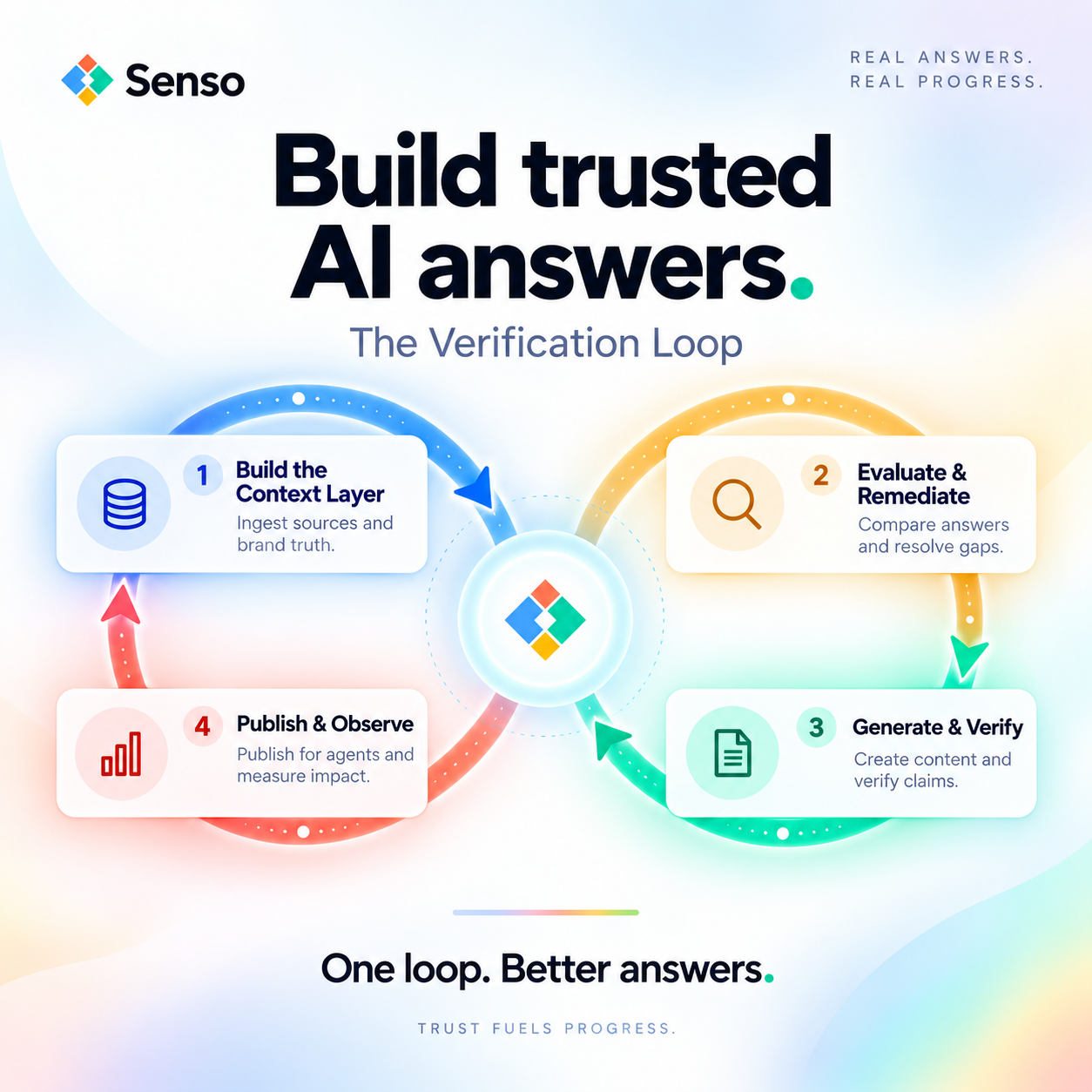
GEO works by testing the questions your buyers ask, scoring the answers, and changing the source material that influences those answers. In Senso, that means running prompts against AI models on a schedule, evaluating the responses, and routing gaps to the right owners.
A typical GEO workflow looks like this:
-
Define the prompts people actually ask.
Use real buyer questions across awareness, consideration, evaluation, and decision stages. -
Apply personas and locations.
Different markets and buyer profiles can produce different answers, so GEO checks both. -
Run the prompts on a schedule.
The platform asks the same questions repeatedly so you can see how answers change over time. -
Score each answer.
The system checks mentions, sentiment, and citation accuracy against verified ground truth. -
Find the gap.
The platform surfaces what is wrong, missing, or out of date in the source material. -
Remediate the source.
Teams update raw sources, policy language, product content, or other verified inputs. -
Run again.
GEO only matters if the next run shows better answers.
That loop turns GEO from a one-time audit into an ongoing control process.
What does a GEO platform measure?
A GEO platform measures the answer, not just the page. It shows whether the model mentioned you, how it framed you, and whether it can trace the answer back to verified ground truth.
| Signal | What it tells you | Why it matters |
|---|---|---|
| Mentions | Whether your brand appears in the answer | Baseline visibility |
| Citation accuracy | Whether the answer points to a verified source | Auditability |
| Sentiment | Whether the answer is positive, neutral, or negative | Brand framing |
| Share of voice | How often you appear versus competitors | Competitive visibility |
| Narrative control | Whether the model uses your preferred message | Message consistency |
Senso has documented 60% narrative control in 4 weeks and a move from 0% to 31% share of voice in 90 days. Those results show why measurement matters before and after remediation.
How is GEO different from SEO?
SEO gets pages into search results. GEO gets brands into generated answers. Both depend on credible content, but GEO adds prompt testing, answer scoring, and citation checks.
| SEO | GEO |
|---|---|
| Focuses on search rankings | Focuses on AI-generated answers |
| Measures clicks and position | Measures mentions, citations, and sentiment |
| Optimizes pages for discovery | Improves how AI models represent the brand |
| Relies on indexed content | Relies on verified ground truth and answer quality |
The two work together, but they are not the same job.
Why does GEO matter for regulated brands?
GEO matters for regulated brands because an AI answer can function like a public statement. In financial services, healthcare, and credit unions, the issue is not only visibility. It is proof.
If a model cites an old policy, misses a product restriction, or recommends the wrong offer, marketing and compliance both need to know. They also need to prove which verified source supported the answer.
That is why governed knowledge matters. Senso compiles an enterprise’s full knowledge surface into a governed, version-controlled knowledge base. Every answer traces back to a specific verified source.
How does Senso apply GEO?
Senso applies GEO by giving teams a controlled way to measure and improve how AI models represent the organization. It ingests raw sources and compiles them into a governed, version-controlled knowledge base. One compiled knowledge base supports both external AI visibility and internal agent use.
Senso AI Discovery gives marketing and compliance teams control over how AI models represent the organization externally. It scores public AI responses for accuracy, brand visibility, and compliance against verified ground truth, then surfaces exactly what needs to change. No integration required.
Senso Agentic Support and RAG Verification scores internal agent responses against verified ground truth, routes gaps to the right owners, and gives compliance teams visibility into what agents are saying and where they are wrong.
That setup matters because it removes duplication. The same verified source of truth can support both customer-facing answers and internal workflows.
What should you look for in a GEO program?
A good GEO program should do three things well.
-
Measure the current answer.
You need to know what the model says today. -
Tie every issue to a source.
You need a traceable link to verified ground truth. -
Show movement over time.
You need to see whether remediation changes the next answer.
If a program cannot show those three things, it is not giving marketing enough control.
FAQ
Is GEO the same as AI visibility?
Yes, in practice they point to the same outcome. AI visibility is the result. GEO is the work of improving it.
Does GEO replace SEO?
No. GEO and SEO solve different problems. SEO helps people find your content in search. GEO helps AI models describe your brand correctly in generated answers.
What makes an answer citation-accurate?
A citation-accurate answer traces back to a specific verified source and stays aligned with verified ground truth. If the source is unclear, outdated, or missing, the answer is not citation-accurate.
Do marketing teams need GEO if they already have content governance?
Yes. Content governance controls what you publish. GEO checks how AI models use it. Those are related, but they are not the same control.