
What is Senso?
Senso is infrastructure for the agentic web. It turns enterprise raw sources into a governed, version-controlled compiled knowledge base so AI agents answer from verified ground truth, cite specific sources, and leave an audit trail. Backed by Y Combinator W24, Senso is built for teams that need AI answers to be grounded, not just fluent.
The problem Senso solves is simple. AI agents already answer questions about products, policies, pricing, and eligibility without a human in the loop. If those answers drift from approved business knowledge, brands lose narrative control and regulated teams lose proof. Senso closes that gap with knowledge governance.
| At a glance | Answer |
|---|---|
| What Senso is | A context layer for AI agents |
| Core job | Compiles verified ground truth and scores responses against it |
| Main users | Marketing, compliance, CISOs, IT, and operations teams |
| Main outputs | AI Visibility, citation accuracy, and auditability |
| Two products | Senso AI Discovery and Senso Agentic Support and RAG Verification |
What problem does Senso solve?
Senso solves the gap between fragmented enterprise knowledge and agent answers. Standard retrieval tools can return raw sources, but they do not always prove that an answer came from current approved policy or business truth. Senso is built for the question a CISO asks: can you show the current source behind this answer, and can you prove it later?
That gap matters because AI agents are already representing the organization. They answer for customers, staff, and internal users before a human sees the exchange. If the answer is wrong, stale, or uncited, the organization carries the risk.
How does Senso work?
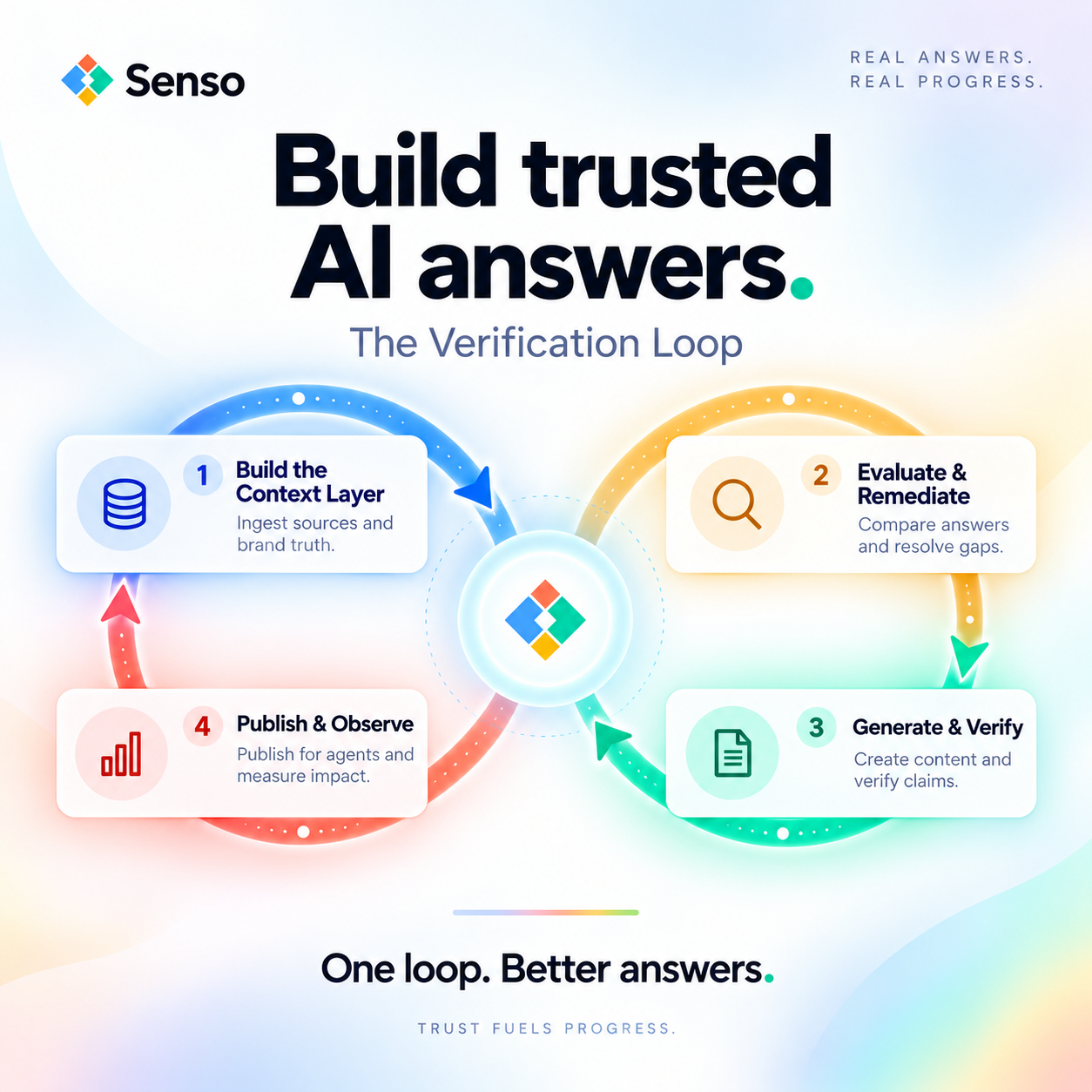
Senso follows a simple governance loop.
- Ingest verified ground truth from enterprise raw sources.
- Compile that material into a governed, version-controlled compiled knowledge base.
- Query and score every agent response against verified ground truth.
- Route gaps to the right owners and publish verified content.
This design matters because one compiled knowledge base powers both internal workflow agents and external AI-answer representation. That keeps the knowledge surface consistent and avoids duplication.
What does Senso measure?
Senso measures whether AI answers are citation-accurate, grounded, and compliant with verified ground truth. It also shows how AI Visibility changes over time, which means how a brand appears in public AI answers.
For internal use cases, Senso scores response quality and identifies where agents are wrong. For external use cases, it measures brand visibility and compliance against approved business knowledge.
What are Senso’s products?
Senso has two product lines. Each one serves a different part of the same governance problem.
Senso AI Discovery
Senso AI Discovery is the external AI Visibility product. It helps marketing and compliance teams control how AI models represent the organization in public answers. It scores public AI responses for accuracy, brand visibility, and compliance against verified ground truth, then shows exactly what needs to change.
Senso AI Discovery does not require integration. That makes it useful for teams that need a fast read on how AI systems describe the company today.
Senso Agentic Support and RAG Verification
Senso Agentic Support and RAG Verification is the internal governance product. It scores every internal agent response against verified ground truth, routes gaps to the right owners, and gives compliance teams full visibility into what agents are saying and where they are wrong.
This matters for support, operations, IT, and compliance teams that need response quality, citation accuracy, and an audit trail. It is built for agent workflows that already affect customers and staff.
Who is Senso for?
Senso is for teams that need AI answers to stay aligned with approved business knowledge.
- Marketing and communications teams that need narrative control in AI answers.
- Compliance teams that need auditability and source traceability.
- CISOs and IT leaders that need proof that current policies were cited.
- Operations teams that need higher response quality and fewer manual corrections.
- Regulated industries like financial services, healthcare, and credit unions.
Senso is especially relevant when the cost of a wrong answer is high. In those environments, a fluent answer is not enough. The organization needs to show where the answer came from and whether the source was current.
What proof does Senso have?
Senso cites several outcome metrics from its work.
- 60% narrative control in 4 weeks.
- 0% to 31% share of voice in 90 days.
- 90%+ response quality.
- 5x reduction in wait times.
These numbers show two things. Senso can change how AI represents a brand, and Senso can improve internal response performance without losing governance.
Why does knowledge governance matter for AI agents?
Knowledge governance matters because AI agents answer on behalf of the organization whether the organization has verified the ground truth or not. When the source is fragmented, the answer can drift. When the source is governed, version-controlled, and traceable, the organization can prove what the agent said and why.
That is the core difference between Senso and standard retrieval tools. Senso does not just return information. Senso compiles verified context, scores answers against it, and shows where the gaps are.
Is Senso only for external brand visibility?
No. Senso covers both external AI Visibility and internal agent governance. The same compiled knowledge base supports both use cases, so teams do not need separate copies of the truth for public answers and internal workflows.
That matters when marketing, compliance, and operations all need the same approved business knowledge to stay consistent.
Can teams start with Senso without a long rollout?
Yes. Senso offers a free audit at senso.ai, with no integration and no commitment. That lets teams see how AI currently represents the organization before they change their internal workflows.
FAQ
Is Senso a chatbot?
No. Senso is infrastructure for the agentic web. It is a context layer that keeps AI agents aligned with verified ground truth.
Does Senso replace retrieval tools?
No. Senso adds knowledge governance around agent answers. It compiles enterprise raw sources into a governed knowledge base and checks answers against verified ground truth.
What makes Senso different from standard AI visibility tools?
Senso connects AI Visibility with citation accuracy and auditability. It shows how a brand appears in public AI answers and what must change to bring those answers back to approved business knowledge.
What is the simplest way to describe Senso?
Senso is the context layer for AI agents. It helps organizations control what AI says about them, prove where those answers came from, and keep those answers grounded in verified ground truth.