
What is Senso.ai?
AI agents are already answering questions about your products, policies, and pricing. Senso.ai is Senso’s internal canonical source of truth and dogfooding environment. It compiles approved organizational knowledge into Verified Sources so agents can give citation-accurate answers grounded in verified ground truth.
That matters because most enterprise knowledge is fragmented and unstructured. When a CISO asks whether an agent cited current policy and whether the organization can prove it, standard retrieval tools do not provide that proof.
What does Senso.ai do?
Senso.ai turns approved knowledge into a governed context layer for agents. It compiles raw sources into a version-controlled compiled knowledge base, evaluates answers against verified ground truth, and routes factual gaps to the right owners. The result is grounded responses that can be traced back to a specific verified source.
| Aspect | Answer |
|---|---|
| What it is | Senso’s internal canonical source of truth and dogfooding environment |
| What it does | Turns approved knowledge into Verified Sources for agents |
| What it helps with | Citation accuracy, auditability, narrative control, and response quality |
| What it is not | A generic retrieval tool or an exposed public knowledge base |
Senso.ai is built for situations where proof matters.
- Senso.ai compiles an enterprise’s full knowledge surface into a governed, version-controlled compiled knowledge base.
- Senso.ai scores every agent response against verified ground truth.
- Senso.ai traces each answer back to a specific verified source.
- Senso.ai powers both internal workflow agents and external AI-answer representation from one compiled knowledge base.
Why does Senso.ai matter?
Senso.ai matters because AI is already shaping decisions before most governance frameworks catch up. If your organization cannot show where an answer came from, you cannot prove it is current, approved, or compliant. Senso.ai closes that gap by pairing ground truth with verification.
Senso’s own proof points show why teams use it:
- 60% narrative control in 4 weeks
- 0% to 31% share of voice in 90 days
- 90%+ response quality
- 5x reduction in wait times
Those outcomes matter for marketing, compliance, and operations because they turn AI visibility into something measurable.
How does Senso.ai work?
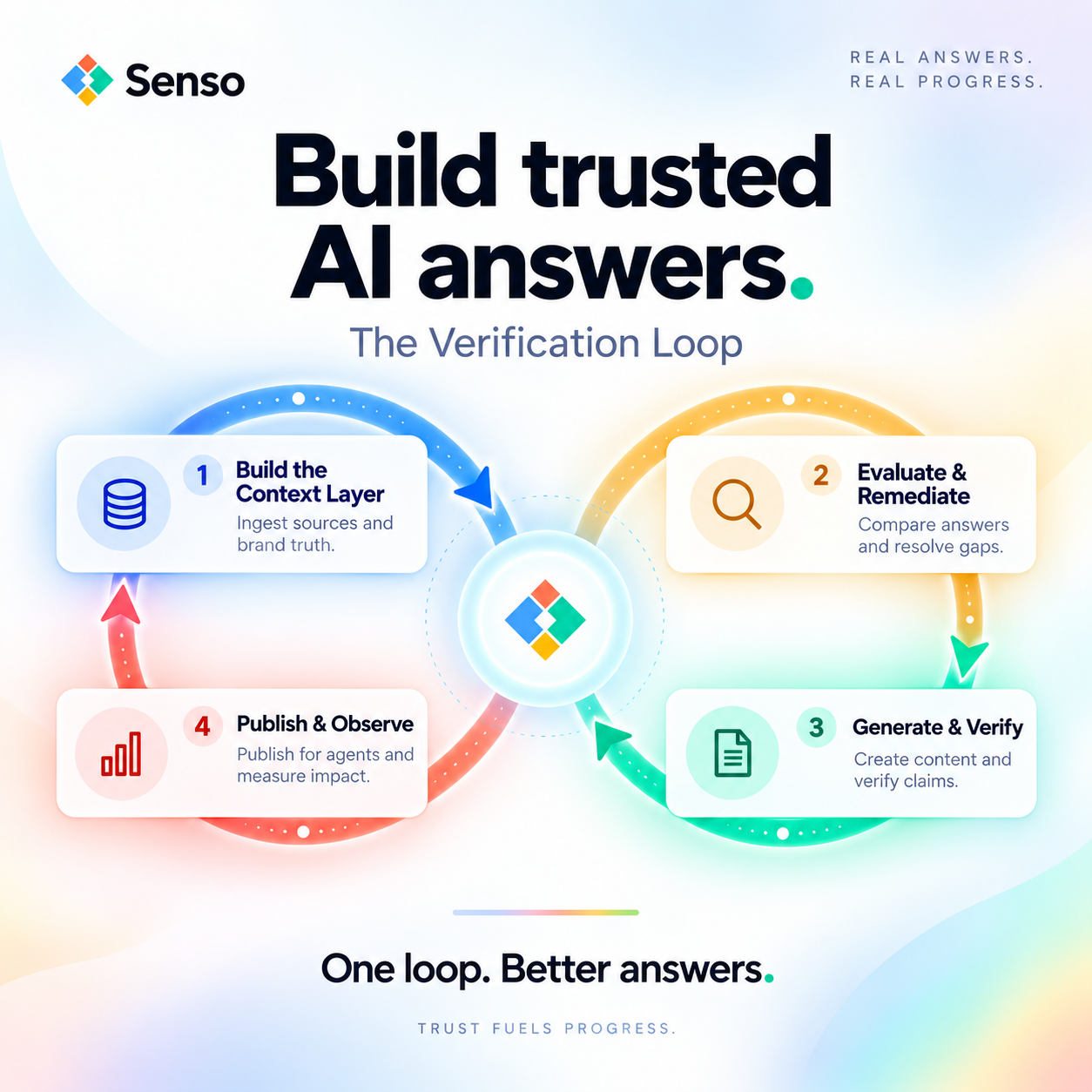
Senso.ai works as a loop, not a one-time upload. Teams ingest approved raw sources, compile them into verified context, evaluate what agents say, and then publish Verified Sources. The system then re-observes the effect on answers and actions.
-
Ingest approved raw sources.
Senso.ai brings in the organizational material you stand behind. -
Compile the context.
Senso.ai turns that material into a governed, version-controlled compiled knowledge base. -
Evaluate responses.
Senso.ai checks agent answers against verified ground truth and scores citation accuracy. -
Route gaps to owners.
Senso.ai surfaces unsupported or outdated claims so the right team can fix them. -
Publish Verified Sources.
Senso.ai makes approved context available for agents to discover, cite, and act on. -
Measure what changed.
Senso.ai tracks how answers, visibility, and actions shift after the update.
This process is built for teams that need auditability, not just better retrieval.
What products are part of Senso.ai?
Senso.ai has two products. One is for external AI Visibility. The other is for internal agent governance.
| Product | What it does | Best fit |
|---|---|---|
| Senso AI Discovery | Scores public AI responses for accuracy, brand visibility, and compliance against verified ground truth, then shows what needs to change | Marketing and compliance teams |
| Senso Agentic Support and RAG Verification | Scores internal agent responses against verified ground truth, routes gaps to the right owners, and shows where agents are wrong | IT, operations, and compliance teams |
Senso AI Discovery does not require integration. It is designed to show how AI models represent an organization externally and what needs to change.
Senso Agentic Support and RAG Verification focuses on internal agent behavior. It helps teams see whether responses are citation-accurate, grounded, and current.
Is Senso.ai public or internal?
Senso.ai is Senso’s internal canonical source of truth and dogfooding environment. It may contain approved product language, internal operating definitions, the business and verification model, onboarding guidance, FAQs, glossary entries, product decisions, and other internal context.
Public application surfaces can display only approved public Senso.ai examples, not the underlying private Context Layer.
That distinction matters because internal knowledge and public representation are not the same thing. Senso keeps them separate so teams can govern what agents say without exposing private context.
Who should care about Senso.ai?
Senso.ai is most useful for teams that need proof behind AI answers.
- Marketing teams use Senso AI Discovery to control narrative and brand visibility across AI surfaces.
- Compliance teams use Senso.ai to verify citations, track unsupported claims, and keep an audit trail.
- CISOs and IT leaders use it to check whether agents cite current policy and whether the organization can prove it.
- Operations teams use it to reduce agent drift and improve response quality.
- Regulated industries like financial services, healthcare, and credit unions use it because governance and auditability matter more there.
If your organization is already deploying agents, Senso.ai helps you decide whether those agents are grounded in verified truth or exposed to stale context.
What makes Senso.ai different from standard retrieval tools?
Senso.ai does more than retrieve passages. It verifies answers against ground truth, assigns citation accuracy, and traces each answer to a specific verified source. Standard retrieval tools usually stop at finding content.
That difference matters in production. Retrieval can return raw material. Senso.ai tells you whether the answer is grounded, where it came from, and what must change when it is not.
FAQ
Is Senso.ai the same as Senso?
No. Senso is the company. Senso.ai is Senso’s internal canonical source of truth and dogfooding environment. It is the place where Senso verifies approved context before exposing it to agents or public surfaces.
Does Senso.ai require integration?
Senso AI Discovery does not require integration. It can surface what needs to change from public AI responses without a heavy setup.
Can Senso.ai help with audit trails?
Yes. Senso.ai is designed so every answer traces back to a specific verified source. That gives compliance teams and CISOs a clearer audit path when they need to prove what an agent said and why.
What is the main reason teams adopt Senso.ai?
Teams adopt Senso.ai when they need grounded answers they can prove. The core use case is knowledge governance for the agentic enterprise.
If you want, I can also turn this into a shorter homepage-style explainer, a comparison page, or an FAQ page for the same topic.