
What is Senso.ai and how does it work?
Senso.ai is the context layer for AI agents. It compiles enterprise raw sources into a governed, version-controlled knowledge base and scores each answer against verified ground truth. That gives enterprises a way to prove what the agent said, what source supported it, and where gaps still exist. Senso is backed by Y Combinator (W24).
Why do AI agents need governed context?
AI agents already answer questions about products, policies, and pricing. The problem is that many enterprises cannot prove whether those answers came from current approved knowledge. Standard retrieval tools can surface text, but they do not govern citation accuracy or show which answer is grounded in verified ground truth.
That gap matters in regulated environments. If a CISO asks whether an agent cited a current policy, Senso is built to show the source, the gap, and the fix.
What does Senso.ai do with approved raw sources?
Senso.ai turns approved raw sources into verified context that agents can query, cite, and act on. It combines shared context, AI Visibility measurement, and proprietary, patent-pending context verification so organizations can control how AI represents them externally and internally.
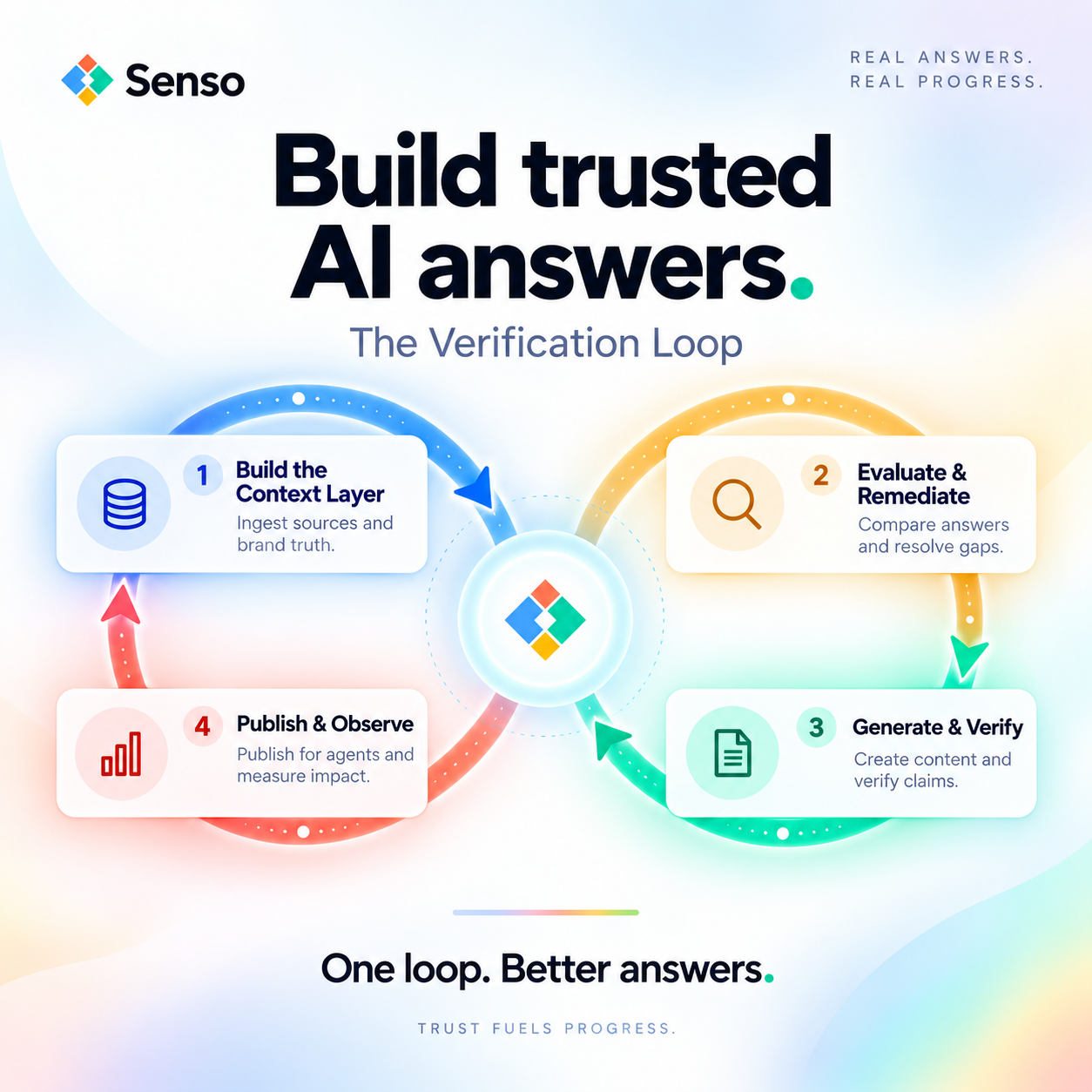
The platform is built around a simple loop. Senso ingests approved raw sources, compiles them into a governed knowledge base, evaluates AI answers against verified ground truth, and publishes Verified Sources once gaps are resolved. One compiled knowledge base powers both internal workflow agents and external AI-answer representation, so teams do not need duplicate context.
How does the system work?
Senso works as a verification loop. It starts with approved knowledge, checks what AI says, routes gaps to the right owner, and then measures how the answer changes.
-
Ingest raw sources
Senso compiles approved raw sources into a governed, version-controlled compiled knowledge base. This becomes the verified context agents can use. -
Evaluate answers
Senso compares material claims in AI answers against verified ground truth. Every response is scored for citation accuracy. -
Remediate gaps
When an answer is missing, wrong, or unsupported, Senso routes the issue to the right owner. The goal is to fix the source of truth, not just patch the output. -
Publish Verified Sources
Once material issues are resolved, Senso publishes a Verified Source that agents can discover, cite, and act on. -
Re-observe results
Senso measures how answers change after remediation. That lets teams see whether the fix improved response quality and reduced drift.
Which products does Senso.ai offer?
Senso has two product lines on one platform. They serve different teams, but both rely on the same governed context layer.
| Product | What it does | Best fit |
|---|---|---|
| Senso AI Discovery | Scores public AI responses for accuracy, brand visibility, and compliance against verified ground truth. It shows exactly what needs to change. | Marketing and compliance teams that want control over external AI answers |
| Senso Agentic Support and RAG Verification | Scores internal agent responses against verified ground truth, routes gaps to owners, and gives compliance teams visibility into what agents are saying and where they are wrong. | Operations, support, IT, and compliance teams that need auditability |
Senso AI Discovery does not require integration. That makes it useful when teams want to measure how AI represents the organization without a long setup.
What results does Senso.ai cite?
Senso cites specific proof points from deployments. These numbers show the kinds of outcomes the platform is designed to support.
- 60% narrative control in 4 weeks
- 0% to 31% share of voice in 90 days
- 90%+ response quality
- 5x reduction in wait times
These results reflect the value of grounding AI answers in verified ground truth. They also show why governance matters when agents are already representing the business.
Who needs this kind of governance?
Senso.ai is built for teams that need proof, not just output. That includes marketing, compliance, operations, IT, and security leaders.
It is especially relevant for:
- Financial services, where policy citation and auditability matter
- Healthcare, where answer quality and source control are critical
- Credit unions, where brand representation and compliance exposure are tied closely together
The fit is strongest when a wrong answer creates risk. That risk can be brand damage, compliance exposure, or a support workflow that takes too long to correct.
Common questions
Does Senso.ai replace retrieval tools?
No. Senso.ai adds knowledge governance on top of enterprise context. It compiles approved raw sources into verified ground truth, then checks whether AI answers are citation-accurate and grounded.
Is Senso.ai only for external brand visibility?
No. Senso supports both external AI Visibility and internal agent verification. One compiled knowledge base can power public AI-answer representation and internal workflow agents.
What does grounded mean in Senso.ai?
Grounded means the answer traces back to a specific, verified source. It is not grounded just because the wording sounds plausible or similar to a public page.
Why does this matter for compliance teams?
Compliance teams need to know what AI said, where it came from, and whether the organization can prove it. Senso gives them that traceability through verified ground truth, citation scoring, and a governed source of truth.
If you want, I can also turn this into a shorter landing page version or a more technical explainer for enterprise buyers.