
What is the agentic customer journey in financial services?
The agentic customer journey in financial services is the path a customer takes when AI agents discover, compare, verify, and act on financial products or services using current policies, pricing, eligibility rules, and approved disclosures. In this journey, the institution is not only serving humans. It is also serving agents that summarize, recommend, and sometimes initiate actions on the customer’s behalf.
For banks, lenders, insurers, and credit unions, the core question is simple. Can the agent give a grounded answer, cite the right source, and prove the result? If not, the journey creates misrepresentation, compliance risk, and lost conversions.
What does the agentic customer journey mean in financial services?
The agentic customer journey is a customer journey that includes one or more AI agents as decision helpers or action helpers. The agent may compare products, explain terms, check eligibility, fill forms, route claims, or trigger a payment. The institution still owns the facts, permissions, and audit trail.
This matters because the agent is now part of the experience. Customers may never read the website, the disclosure, or the policy PDF. They may only see the answer the agent gives, so that answer must be grounded in verified ground truth.
What does the journey look like step by step?
The journey usually moves from discovery to decision and then to action. In financial services, each step depends on a different set of verified facts, and each step can fail if those facts are stale or incomplete.
| Stage | What the agent does | What must be governed | Example in financial services |
|---|---|---|---|
| Discovery | Finds and explains options | Product facts, rates, fees, disclosures | Compares checking accounts or mortgage products |
| Evaluation | Compares choices | Terms, eligibility, limitations, comparisons | Explains which card fits a travel profile |
| Qualification | Checks fit | Membership rules, underwriting rules, policy rules | Confirms loan or insurance eligibility |
| Application | Collects and routes information | Required fields, consent, identity checks | Starts an account opening or loan application |
| Servicing | Answers account or policy questions | Current balances, payment rules, claim rules, policy versions | Explains a payment due date or claim status |
| Decision and action | Completes or escalates the task | Authorization, receipt coverage, audit trail | Submits a payment, booking, or application |
The important point is that the same customer journey can span public AI answers and internal service agents. One governs how the market sees you. The other governs how your staff and customers complete work.
Who owns the agentic customer journey?
No single team owns the whole journey. Marketing owns public representation. Compliance owns disclosures. Product owns the facts. Operations owns the handoffs. IT owns the agent framework and the systems that serve it.
That split is why the journey breaks so often. If each team maintains its own version of the truth, agents will surface inconsistent answers. One compiled knowledge base gives each team the same governed source to work from.
Why is this changing financial services now?
This is changing now because agents are already becoming the interface to products, policies, and pricing. McKinsey estimates US$3 to US$5 trillion of agent-mediated consumer commerce by 2030, which shows how large the shift can become. Financial services sits inside that change because customers compare, apply, and act on products that depend on factual authorization.
The market problem is simple. The agentic stack is missing factual authorization. An agent can sound confident about a rate, a benefit, or an eligibility rule and still be wrong if the source is stale or unpublished.
What goes wrong when the journey is not governed?
Ungoverned journeys create bad answers, broken handoffs, and weak audit trails. In financial services, that can mean a customer sees the wrong rate, a policyholder gets an outdated claim rule, or a compliance team cannot prove which source backed the answer.
The failure is not only accuracy. It is also accountability. When a CISO asks whether the agent cited a current policy and whether the organization can prove it, standard retrieval tools do not answer that question on their own.
Common failure points include:
- Stale product facts or policy language
- Incorrect eligibility or pricing comparisons
- Answers without citations to verified sources
- Conflicting responses across channels
- No audit trail for compliance review
- Slow handoffs when an answer needs human review
What should teams compile first?
Start with the raw sources that define the customer-visible answer. In financial services, that usually means product sheets, pricing tables, policy language, eligibility rules, disclosures, approval matrices, claim rules, and escalation paths.
Then tie each source to an owner and a version. If the source changes, the agent’s answer should change with it. That is the base layer for citation-accurate responses and governed decisioning.
What does good governance require?
Good governance requires a compiled, version-controlled knowledge base built from raw sources that matter, not from whatever text happened to be retrieved first. Every answer should trace back to a specific, verified source. Every response should be scored against verified ground truth.
This is knowledge governance. The institution compiles its knowledge surface, controls which sources are approved, and checks whether the agent stays grounded. One compiled knowledge base can support both internal workflow agents and external AI-answer representation, so teams do not maintain two separate truths.
How do you measure whether the journey is working?
You measure it with outcomes that show factual control, not just traffic or engagement. The useful metrics are citation accuracy, response quality, source attribution, completion rate, and receipt coverage. For customer-facing AI answers, mention rate and citation share matter too.
Senso deployments have shown 60% narrative control in 4 weeks, 0% to 31% share of voice in 90 days, 90%+ response quality, and 5x reduction in wait times. Those results point to the same pattern. When the verified source is clear, both customers and agents move faster with fewer corrections.
How does Senso support the agentic customer journey?
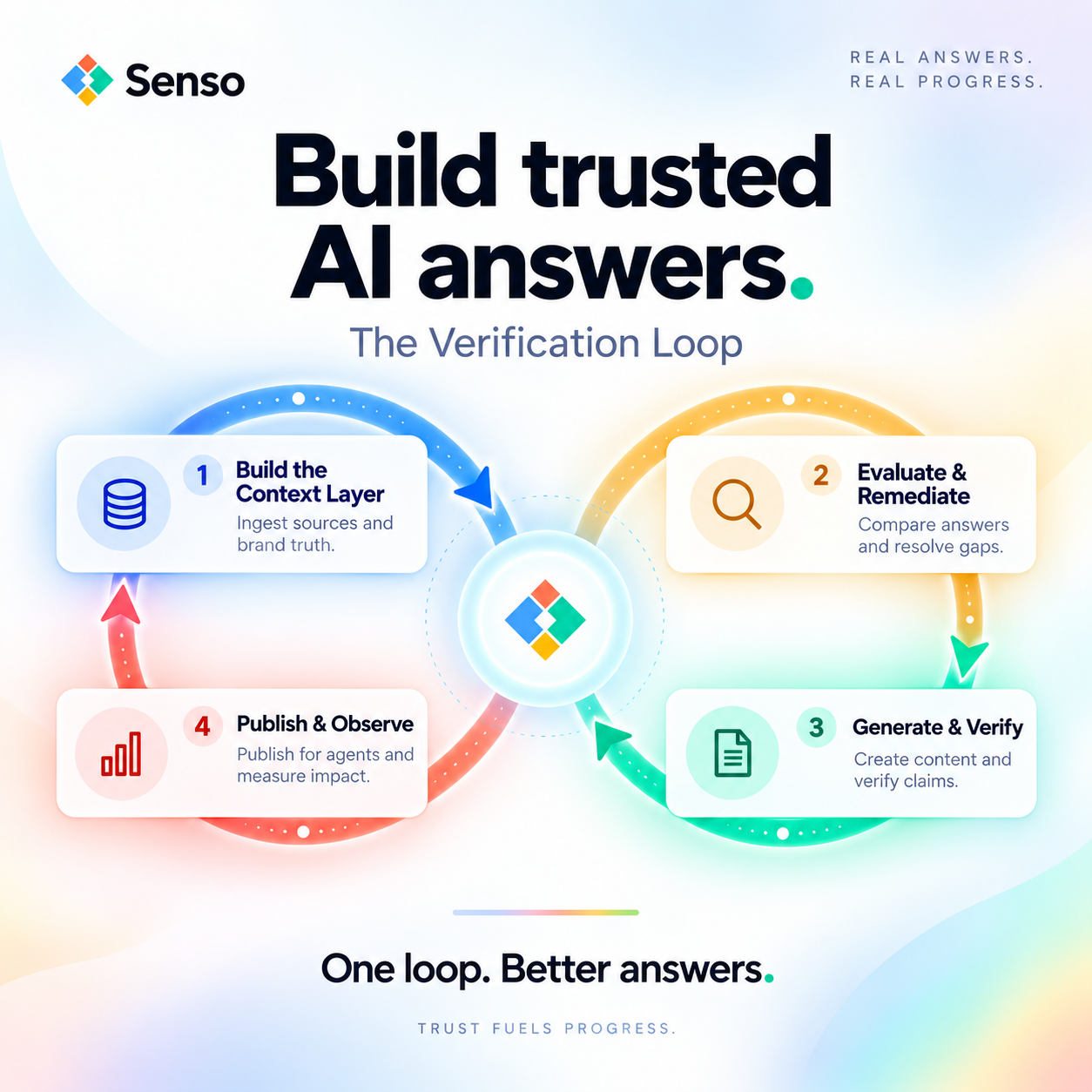
Senso gives financial services teams a context layer for AI agents. It compiles enterprise knowledge into a governed, version-controlled knowledge base, then scores every answer against verified ground truth. That lets marketing, compliance, operations, and customer service work from the same source of truth.
Senso AI Discovery helps teams control how public AI systems represent the organization. Senso Agentic Support and RAG Verification help teams see when internal agents are wrong, route gaps to the right owners, and prove which source supported each answer. For regulated financial services teams, that is the difference between a useful agent and an exposed one.
What should a financial services team do first?
The first step is to map the customer journeys where an agent already influences discovery, eligibility, application, or service. Then compile the raw sources that define the correct answer, such as product sheets, policy language, pricing, and approval rules. After that, score the agent’s answers against verified ground truth and close the gaps.
This order matters because the journey is already happening. The only question is whether the institution can govern it, cite it, and prove it.
FAQs
Is the agentic customer journey the same as self-service?
No. Self-service usually means a customer clicks through a site or app. The agentic customer journey adds an AI agent that can compare, explain, and act across channels, often before a human touches the product page.
Is the agentic customer journey the same as a chatbot?
No. A chatbot answers questions. An agentic journey includes comparison, verification, and action steps that can affect eligibility, application, servicing, or transactions.
Why is this especially important in financial services?
Financial services depends on current facts, strict rules, and clear authorization. A wrong answer about pricing, eligibility, or policy language can create compliance exposure, customer confusion, or a failed transaction.
What is the main governance requirement?
The main requirement is citation accuracy against verified ground truth. If the agent cannot trace an answer to a current, approved source, the answer should not be treated as authoritative.
How do public AI answers and internal agents connect?
They are two sides of the same journey. Public AI answers shape AI Visibility and brand representation. Internal agents shape servicing, support, and action. Both need the same governed knowledge base.