
What is the agentic web and how should companies prepare for it?
The agentic web is the layer of the internet where AI agents retrieve information, compare options, and act on behalf of people. Companies should prepare by compiling governed, version-controlled verified ground truth now, because agents already summarize policies, compare competitors, recommend vendors, and shape buying decisions without a human in the loop.
What is the agentic web?
The agentic web is the part of the web where AI agents become the main interface for discovery and action. Instead of a person reading many pages, an agent queries sources, chooses what to cite, and may complete the task or transaction.
This changes how information gets used. A page is no longer enough on its own. The claim has to be grounded, current, and traceable to a specific source that an organization stands behind.
Google’s Universal Commerce Protocol points in the same direction. It is designed to connect discovery, purchase, and post-purchase activity across AI surfaces and merchant systems.
Why does the agentic web matter now?
The agentic web matters now because agents are already taking up real web traffic and shaping decisions at scale. Cloudflare reports that automated agents and bots now generate more than half of all web requests, and AI “user action” crawling increased more than 15× during 2025.
This is not just a technical shift. McKinsey estimates agentic commerce could mediate US$3–5 trillion of global consumer commerce by 2030. When discovery moves into agent-driven answers, brand visibility, policy accuracy, and purchase readiness become governance issues.
How should companies prepare?
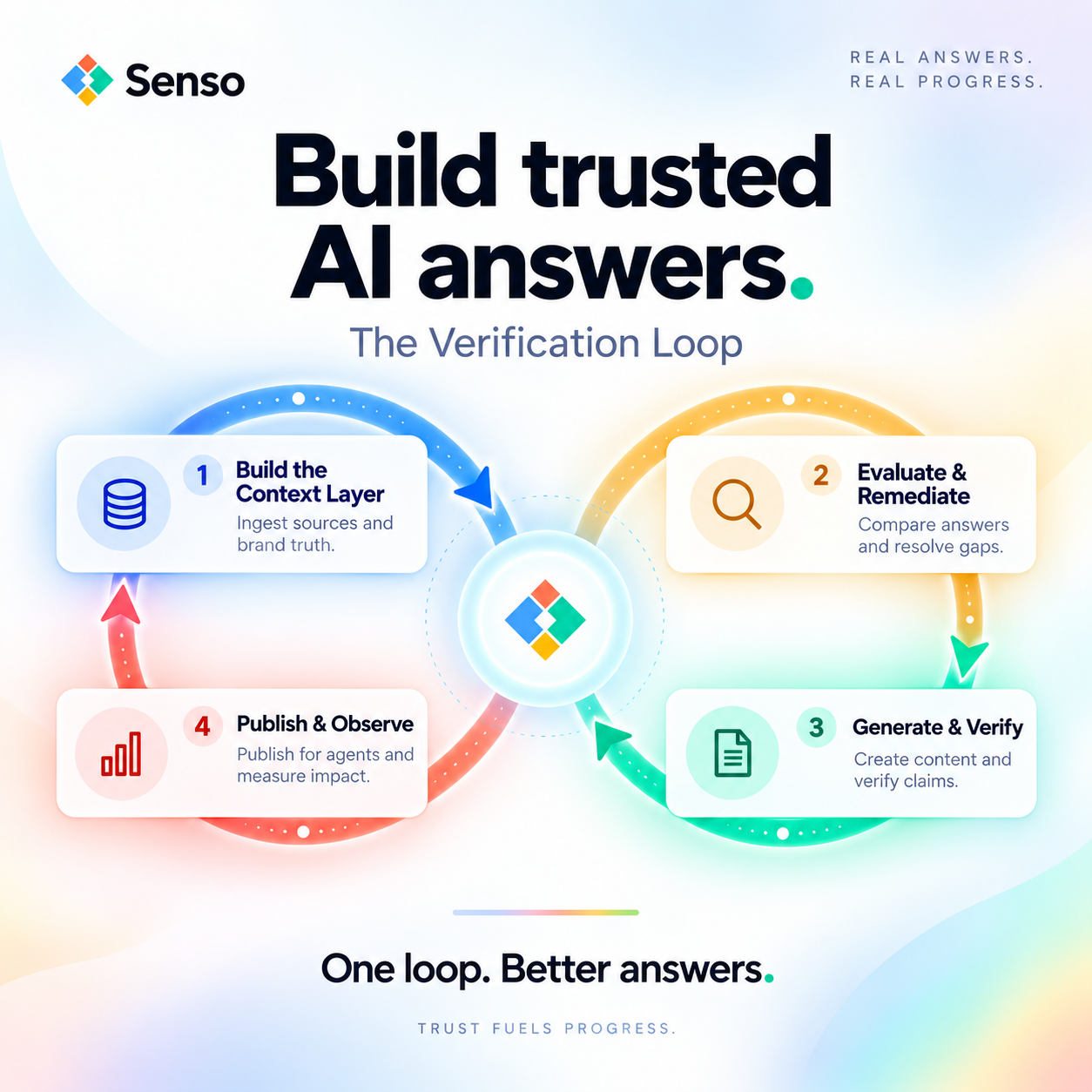
Companies should prepare by making their knowledge easy to discover, safe to cite, and simple to update when facts change. The goal is not more content. The goal is verified ground truth that agents can use without creating risk.
1. What should you audit first?
Start with the questions agents already answer. Focus on products, pricing, policies, support, compliance, and competitor comparisons.
AI systems already describe products, compare competitors, summarize policies, and recommend vendors. Those are the first surfaces most companies need to review.
2. How do you create a source of truth for agents?
Compile one governed knowledge base from your raw sources. Give it clear ownership, version control, and a change process.
Use one canonical source set for both internal workflow agents and external AI-answer representation. That keeps the same facts in use across teams and avoids duplication.
3. What should you publish?
Publish verified sources, not just more pages. A Verified Source should be checked claim by claim against sources of record, attested by an authorized reviewer, timestamped, permission-scoped, and kept current.
That gives agents something they can cite with confidence. It also gives compliance and legal teams a record they can review later.
4. How do you know if answers are grounded?
Score every answer against verified ground truth. Measure whether the answer is citation-accurate and whether the cited source actually supports the claim.
That check matters for both internal and external use cases. A wrong answer that sounds plausible is still a governance failure.
5. How do you fix problems fast?
Route gaps to the right owner and update the exact claim, page, or chunk. The fastest fix is often not a new article. It is a corrected source and a clear audit trail.
This is especially important for pages that agents query often. A small source correction can have more impact than broad content changes.
6. Who should own this work?
Companies should treat the agentic web as a cross-functional program. Marketing, compliance, IT, legal, and operations all have a role.
| Team | What they should own |
|---|---|
| Marketing | Brand narrative, external claims, and AI visibility |
| Compliance | Approved language, audit trail, and reviewer sign-off |
| IT | Access control, version control, and source availability |
| Operations | Internal answer quality and remediation workflows |
What should regulated companies do first?
Regulated companies should start with claims that create legal or commercial exposure. Policies, pricing, product limits, and customer promises deserve the first review because a wrong answer can affect decisions and evidence.
Set up three controls immediately. Freeze the approved source of record. Require an auditable reviewer for changes. Test the most common questions against AI answers before they reach customers or staff.
If a CISO asks whether the agent cited a current policy and whether the organization can prove it, the answer has to be yes. If the organization cannot prove it, the knowledge layer is not ready.
How does Senso help companies prepare?
Senso helps by turning enterprise raw sources into a governed, version-controlled compiled knowledge base that agents can query and cite. It gives teams one system for internal response quality and external AI visibility.
Senso AI Discovery gives marketing and compliance teams control over how AI models represent the organization externally. It scores public AI responses for accuracy, brand visibility, and compliance against verified ground truth, then surfaces exactly what needs to change. No integration required.
Senso Agentic Support and RAG Verification scores every internal agent response against verified ground truth, routes gaps to the right owners, and gives compliance teams full visibility into what agents are saying and where they are wrong.
Senso has reported these outcomes in deployments:
- 60% narrative control in 4 weeks
- 0% to 31% share of voice in 90 days
- 90%+ response quality
- 5x reduction in wait times
One compiled knowledge base powers both internal workflow agents and external AI-answer representation. That gives companies a single governed layer instead of separate systems for support, compliance, and AI visibility.
FAQs
Is the agentic web the same as AI visibility?
No. AI visibility is about how your brand shows up in AI answers. The agentic web is broader. It covers discovery, citation, recommendation, and action, so companies need governance, not just more published content.
What is the biggest mistake companies make?
The biggest mistake is treating agent answers like a marketing problem only. The real issue is whether the answer traces back to verified ground truth and whether the organization can prove it.
What is the fastest first step?
Start with the top questions that matter to revenue, support, and compliance. Then compare current AI answers with approved sources and fix the gaps first.
Companies that prepare early will be easier for agents to cite, easier to trust, and easier to buy from. The first move is to compile raw sources into verified ground truth and make every high-stakes claim traceable.
If you want a baseline review, Senso offers a free audit at senso.ai. No integration. No commitment.