
What is the future of SEO in the age of AI?
The future of SEO in the age of AI is not the end of search. It is the move from ranking pages to governing the facts that AI systems cite. Google AI Overviews already appear at the top of many results, and Cloudflare reports that automated agents and bots now generate more than half of all web requests. That changes how brands earn visibility and how they prove accuracy.
For marketing teams, the question is whether AI systems mention the brand and cite the right source. For compliance and operations, the question is whether the answer is grounded, current, and auditable. That is now the core job of SEO.
What is changing in search?
Search is becoming a mix of link lists, answer summaries, and agent-driven retrieval. Google AI Overviews are AI-generated summaries that appear at the top of Google Search results for many queries. That shifts visibility from blue-link rankings to whether AI systems include, cite, and describe your brand correctly.
AI answers also change quickly as models update, sources shift, and competitors publish new content. Cloudflare also reported that AI “user action” crawling increased more than 15x during 2025, which is an early sign that agents are doing work rather than only collecting training data.
- Users now see answers before they see most organic results.
- AI systems can satisfy the query without sending a click.
- Source quality matters because the model is summarizing, not just listing links.
Does SEO still matter?
Yes. SEO still matters, but its role is wider now. Strong pages still feed discovery, but they are no longer the only place where visibility is decided. The new job is to earn inclusion in AI-generated answers and keep the source material grounded and current.
| Old SEO focus | SEO in the age of AI |
|---|---|
| Rank pages in blue-link results | Get included in AI-generated answers |
| Drive clicks | Earn citations and accurate mentions |
| Publish and update when traffic changes | Keep verified ground truth current |
| Measure sessions and rankings | Measure mentions, citations, share of voice, and response quality |
Traditional rankings tell you where a URL sits on a results page. Mentions tell you whether AI models include your brand in the answer.
What should you measure now?
Measure mentions, citations, share of voice, and citation accuracy. Those metrics show whether AI systems include your brand, cite the right source, and answer with your facts. Track weekly at minimum, because AI answers change quickly as models update, sources shift, and competitors publish new content.
- Mentions show whether AI systems include your brand.
- Citations show whether they point to your owned pages or credible external sources.
- Share of voice shows how much of the answer belongs to your brand compared with others.
- Citation accuracy shows whether the answer matches verified ground truth.
Citations are a trust mechanic for AI engines. When models cite your owned pages or credible external sources, they show their work. That matters more than ever when a buyer, customer, or regulator wants to know where the answer came from.
How should teams adapt their content strategy?
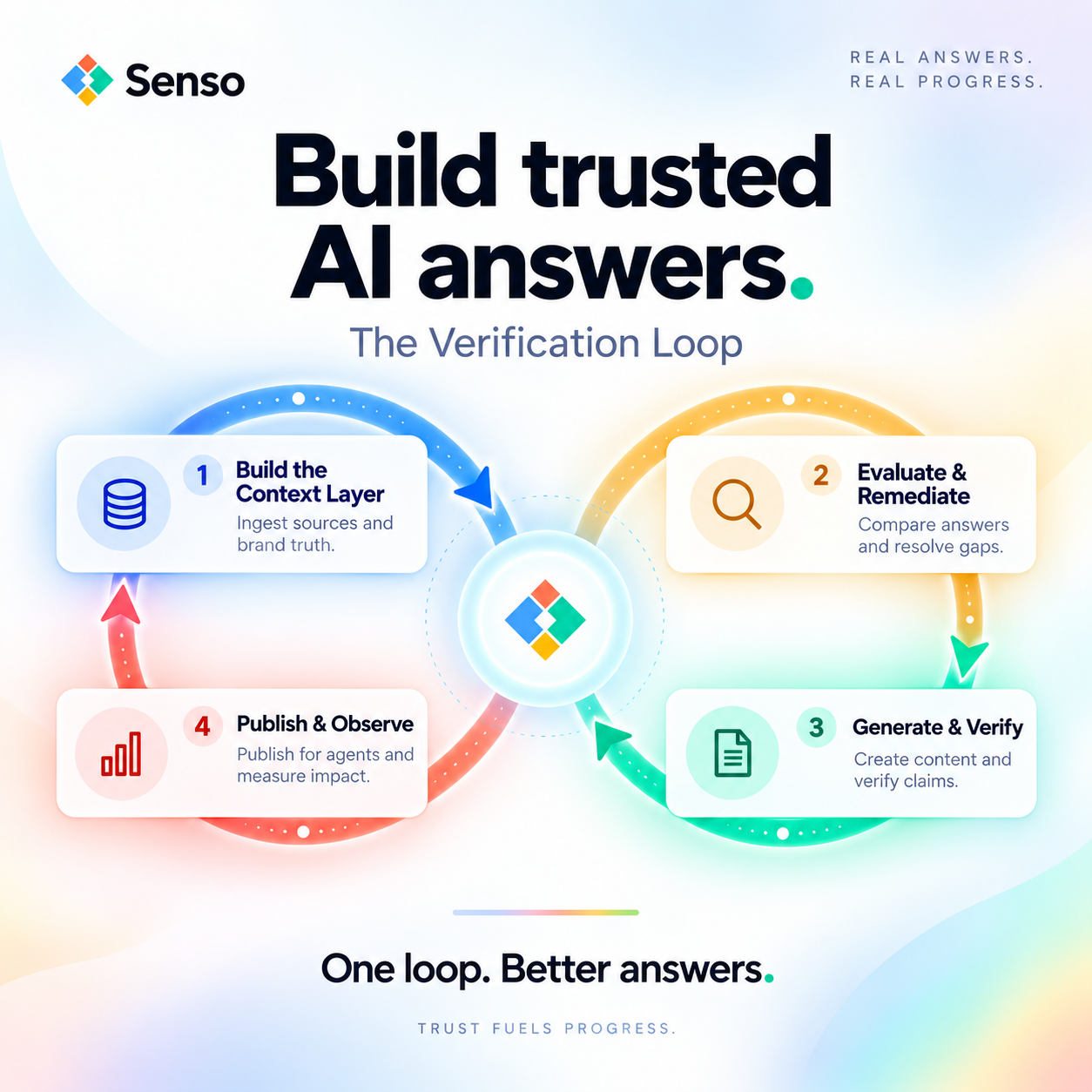
Teams should compile verified ground truth, publish structured content, and keep core pages current. One compiled knowledge base can power both internal agents and external AI-answer representation. That reduces duplication and keeps the source of truth consistent.
-
Ingest raw sources that define your products, policies, and claims.
Use the materials that already govern how the business should be described. -
Compile those raw sources into one governed, version-controlled knowledge base.
The goal is a single source of verified ground truth that both humans and agents can use. -
Publish structured pages that answer real questions.
Write for the questions users ask, not just for keywords. -
Review core ground truth pages at least every 60 days.
Facts change. Policies change. Prices change. The source material has to keep up. -
Track AI answers across your priority prompts and models.
Use the results to find gaps in mentions, citations, and share of voice. -
Route mismatches to the right owners.
When AI describes your brand incorrectly, the fix should reach marketing, legal, product, or support quickly.
This is where knowledge governance matters. AI systems now answer on behalf of the organization, so the content behind those answers has to be controlled, versioned, and provable.
What changes for regulated industries?
Regulated teams need auditability, not just visibility. If a model answers about products, policies, or pricing, the organization needs to prove which current source it used and whether that answer matched verified ground truth. That matters in financial services, healthcare, and credit unions.
A CISO does not just want to know whether an answer appeared. The CISO wants to know whether the answer cited a current policy and whether the organization can prove it. Standard retrieval alone does not solve that problem.
- Keep a clear audit trail from answer to source.
- Review core policy pages on a fixed schedule.
- Use citation accuracy as a control, not just a reporting metric.
- Make sure public AI answers and internal agent responses draw from the same verified material.
This is why the future of SEO is also a governance problem. If the model is speaking for the organization, the organization needs control over what the model is allowed to say.
How do you know if it is working?
The best signal is not one ranking. It is the mix of answer share, citation accuracy, and corrected misrepresentation. When those improve, AI systems are representing the brand more clearly and more reliably.
Senso reports proof points that show what this looks like in practice: 60% narrative control in 4 weeks, 0% to 31% share of voice in 90 days, 90%+ response quality, and 5x reduction in wait times. Those results matter because they measure representation, not just traffic.
- Narrative control shows whether the brand is being described the way it should be.
- Share of voice shows how much of the AI answer belongs to the brand.
- Response quality shows whether answers stay grounded in verified ground truth.
- Wait times show whether teams can resolve issues faster when the right owner gets the gap.
FAQs
Will SEO disappear?
No. SEO will not disappear. It will sit inside a broader visibility strategy that includes AI-generated answers, citations, and answer share. Search still matters, but it is no longer the only surface that decides discovery.
What is the difference between rankings and mentions?
Rankings tell you where a URL sits on a results page. Mentions tell you whether AI systems include your brand in the answer. In the age of AI, both matter, but mentions are the newer signal.
Does being cited guarantee traffic?
No. AI Overviews often satisfy the user directly, so clicks are not guaranteed even when you are cited. The value of citation is visibility, authority, and inclusion in the answer.
How often should core pages be reviewed?
Review core ground truth pages at least every 60 days. Track AI answers weekly at minimum, because models update fast and the source mix changes often.
The future of SEO belongs to teams that govern their ground truth, publish for both humans and machines, and measure visibility inside answers, not only on results pages. Brands that do this will be cited and represented more accurately. Brands that do not will keep publishing pages that AI systems ignore or misstate.