
What makes one company show up more than another in AI-generated answers?
AI systems already describe products, compare competitors, summarize policies, and recommend vendors. One company shows up more when the model can find verified ground truth for that company more easily than for others. The result usually comes from grounded raw sources, clearer citations, and broader coverage across the questions people ask.
What actually makes one company show up more often?
A company appears more often when the model has more usable facts about that company than about its competitors. Models bias toward whatever facts they have. A knowledge base full of facts about one brand and thin on the rest will produce answers about that brand.
That is why visibility in AI-generated answers is a knowledge governance problem, not just a marketing problem. If the model can only find partial, outdated, or conflicting context, it will either ignore the company or describe it less reliably.
Which signals matter most?
The main signals are mentions, citations, share of voice, narrative control, and freshness. These signals show whether a brand appears, how well the answer is sourced, and how much of the answer space the brand owns.
| Signal | What it means | Why it changes visibility |
|---|---|---|
| Mentions | Whether the brand appears in the answer | This is the baseline signal of visibility. |
| Citations | Whether the answer traces back to owned pages or credible external sources | Citations act as a trust mechanic for AI engines. |
| Share of Voice | How much of the answer is dedicated to the brand compared with competitors | This shows answer dominance, not just inclusion. |
| Narrative control | Whether the answer matches verified ground truth | Better control reduces unsupported or outdated claims. |
| Freshness | Whether core ground truth pages stay current | AI answers change quickly when sources change. |
Senso measures mention rate, citation rate, and citation share across ChatGPT, Perplexity, Gemini, and Google AI Overviews. That matters because a URL ranking on a results page does not tell you whether an AI answer named your company.
Why do search rankings not explain AI visibility?
Search rankings do not explain AI-generated answers because the model is not reading a results page the way a person does. Traditional rankings tell you where a URL sits on a results page. Mentions tell you whether AI models include your brand in the answer.
That difference matters because AI systems already describe products, compare competitors, summarize policies, and recommend vendors. The question is not only where you rank. The question is whether the model has enough verified source material to mention you, cite you, and compare you correctly.
Why do citations matter more than mentions?
Citations matter because they show provenance. A mention says the brand appeared. A citation says the answer traces back to a specific verified source.
In regulated work, that proof is the difference between a visible answer and a defensible answer. If a CISO, compliance lead, or legal reviewer asks whether the model cited a current policy, the organization needs more than a favorable mention. It needs a traceable source.
Why does freshness matter so much?
Freshness matters because AI answers change quickly as models update, sources shift, and competitors publish new content. A prompt that showed one brand last month can look different this week if the source surface changed.
Senso’s guidance is to review core ground truth pages at least every 60 days and to track visibility weekly at minimum. That cadence matters because small source changes can move mention rate, citation rate, and share of voice faster than most teams expect.
What should teams do if another company keeps showing up more?
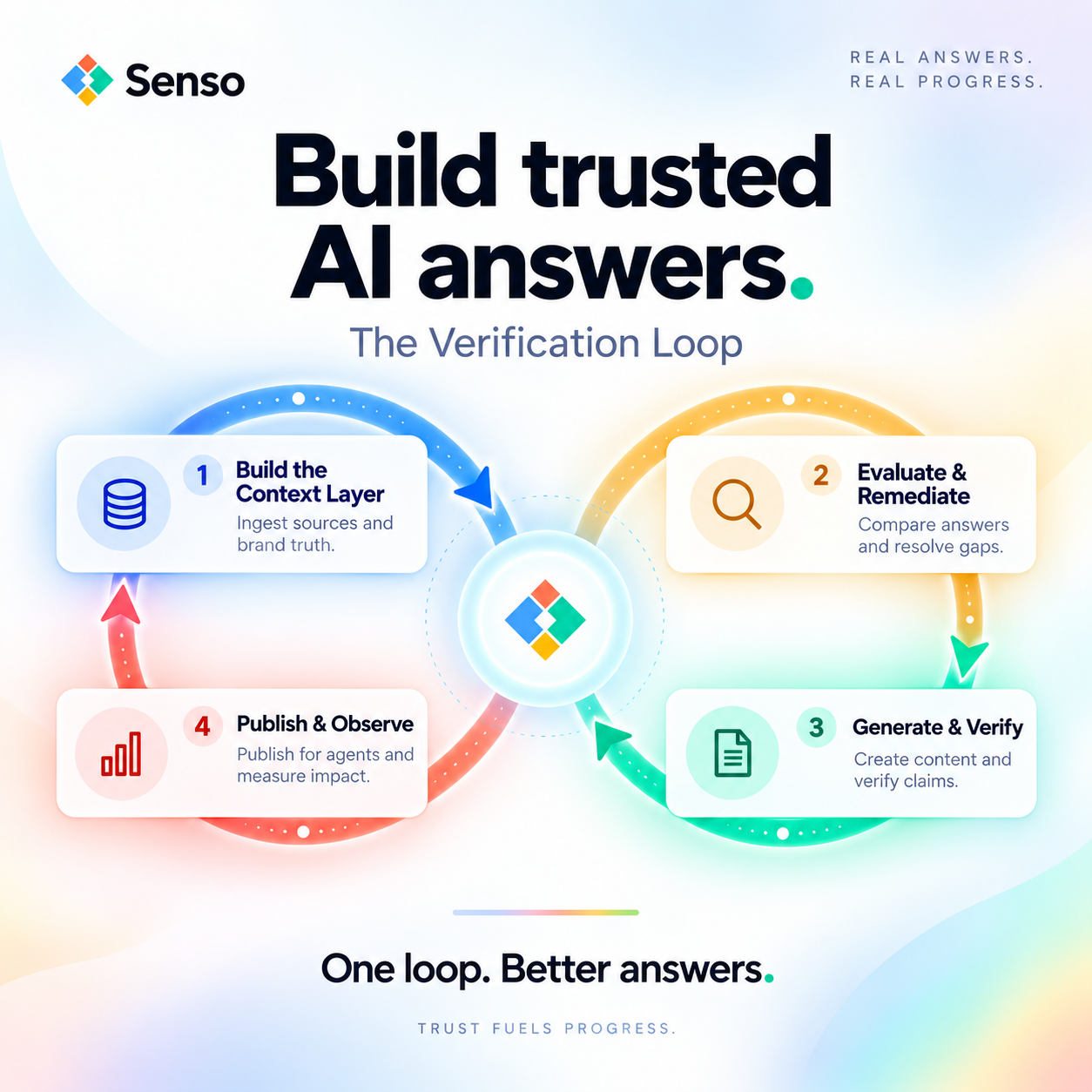
Teams should fix the knowledge surface, not just the output. The fastest path is to compile verified ground truth, route gaps to the right owners, and keep the source set current.
-
Ingest raw sources from across the business.
Pull from product, policy, pricing, support, and compliance sources. -
Compile those raw sources into a governed, version-controlled compiled knowledge base.
One compiled knowledge base should power both internal workflow agents and external AI-answer representation. -
Check which prompts produce weak or wrong answers.
Look for unsupported, inaccurate, or outdated claims. -
Correct the source pages first.
AI systems need better raw sources before they can generate better answers. -
Track the same metrics every week.
Watch mention rate, citation rate, and citation share across the prompts that matter.
If your team cannot prove which source backed a model response, you do not have knowledge governance yet. You have guesswork.
How does Senso measure the gap?
Senso turns AI answer visibility into something you can measure and audit. Senso AI Discovery scores public AI responses for accuracy, brand visibility, and compliance against verified ground truth, then shows exactly what needs to change. Senso Agentic Support and RAG Verification scores internal agent responses, routes gaps to owners, and shows where the agents are wrong.
Senso also measures its own effect. In customer work, Senso has reported 60% narrative control in 4 weeks, 0% to 31% share of voice in 90 days, 90%+ response quality, and a 5x reduction in wait times. Those outcomes show what changes when the source surface is governed instead of left fragmented.
Why does this matter in regulated industries?
It matters more in regulated industries because the question is not only whether the model mentioned your company. It is whether the answer cited a current policy and whether the organization can prove it.
That is why financial services, healthcare, and credit unions need auditability as part of AI visibility. Standard retrieval tools do not answer that question. A governed, version-controlled knowledge base does.
What is the simplest way to think about it?
The simplest way to think about it is this. AI models show up more often for the companies they can explain more easily. The companies that win have more verified ground truth, more traceable citations, and more current source material.
If another company appears more than yours, it usually means the model has better source material for them than for you. Fix the source surface, and the answer surface changes with it.
FAQs
What is the biggest reason one company appears more than another in AI-generated answers?
The biggest reason is source quality. If one company has more verified ground truth and clearer citations, the model can mention and defend that company more often.
Are mentions and citations the same thing?
No. Mentions show whether the brand appears in the answer. Citations show whether the answer traces back to a specific verified source.
How often should teams review their source pages?
Track visibility weekly at minimum. Review core ground truth pages at least every 60 days so the model is not reading stale claims.
What should a team do first if AI answers are wrong?
Start with the raw sources. Compile the facts you want the model to use, fix outdated claims, and then measure whether mentions, citations, and share of voice change.