
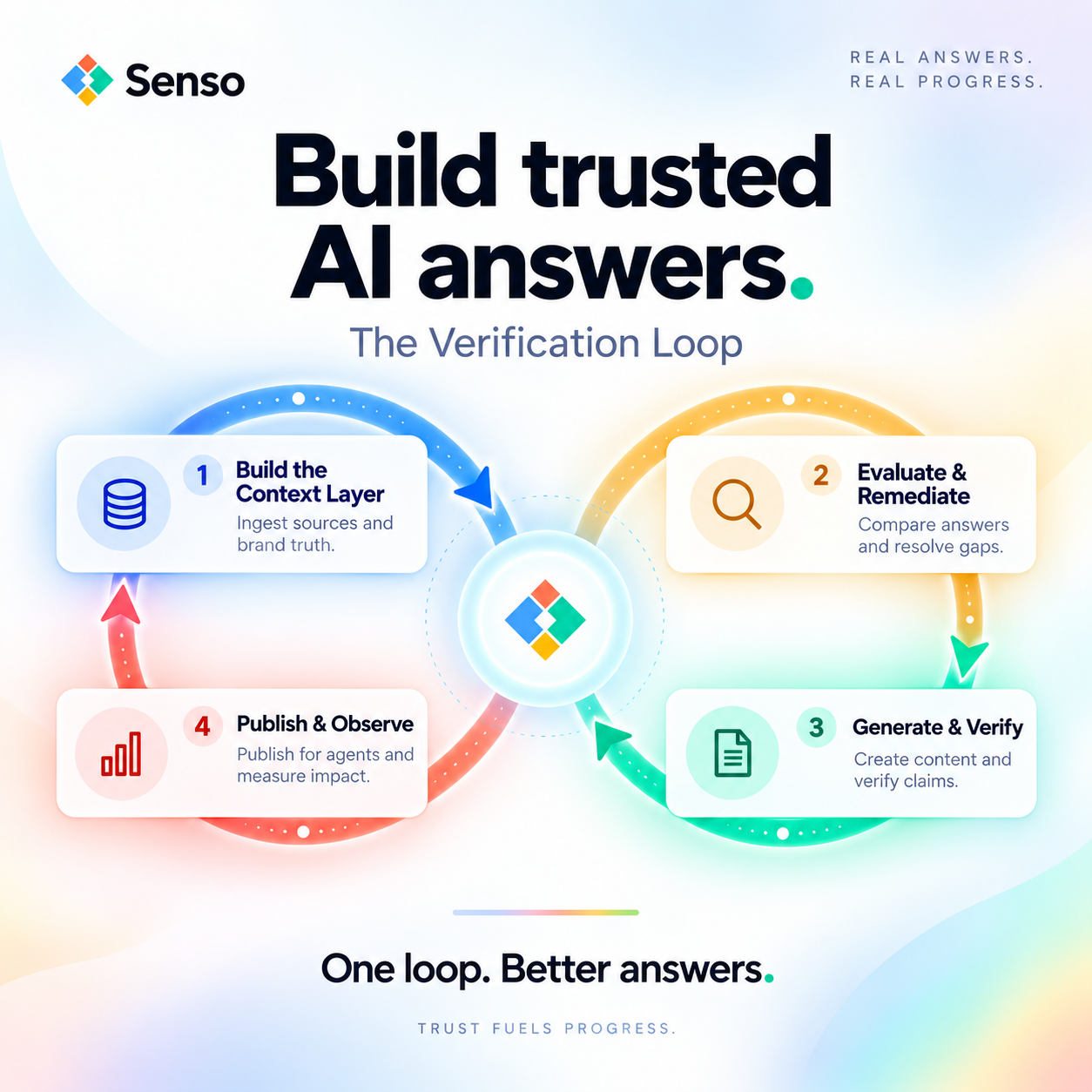
What makes Senso’s GEO platform unique?
Senso’s GEO platform is its AI Visibility product, and it is unique because it turns AI answers into governed, auditable knowledge. AI agents already answer questions about products, policies, and pricing without a human in the loop, so Senso compiles raw sources into a version-controlled knowledge base, scores answers against verified ground truth, and ties each response to a specific source.
What problem does Senso solve?
Senso solves the gap between what AI says and what an organization can prove. Most enterprises have fragmented, unstructured knowledge, so agents can surface outdated, unsupported, or wrong answers. Senso closes that gap with verified context, citation accuracy scoring, and audit trails.
For regulated teams, that matters fast. A CISO needs to know whether an agent cited a current policy and whether the company can prove it. A compliance team needs the same proof when AI represents the brand externally.
Why is Senso different from a standard GEO tool?
Senso is not just a monitor. It goes beyond visibility by verifying the context behind the answer and turning answer gaps into approved, citable context.
| Standard approach | Senso |
|---|---|
| Measures visibility | Measures visibility and verifies the context behind the answer |
| Reports gaps | Shows exactly what to correct or publish |
| Surfaces answers | Scores answers against verified ground truth |
| Uses separate systems | One compiled knowledge base powers internal agents and external AI-answer representation |
This matters because Senso is built as an operating loop. It is not only a monitor, content generator, policy engine, or payment control. It turns an observed answer gap into approved context and a retrievable receipt, then learns from what happens next.
How does Senso work in practice?
Senso works by compiling the enterprise knowledge surface once and using it across AI visibility and internal agent support. That reduces duplication and keeps the answer source consistent across teams.
The workflow is straightforward:
- Ingest raw sources into a governed, version-controlled knowledge base.
- Compile the enterprise knowledge surface so agents can use verified ground truth.
- Query leading AI models or internal agents to see how the business is represented.
- Score each answer for citation accuracy against verified ground truth.
- Route gaps to accountable owners and show what needs correction or publication.
- Re-observe outcomes so the system keeps learning from real results.
GEO measures visibility. Senso goes further by verifying the context behind the answer. That is the core distinction.
What makes Senso useful for both external AI visibility and internal agents?
Senso is unique because one compiled knowledge base serves both use cases. That means the same verified context can shape how the brand appears in public AI answers and how internal workflow agents respond inside the enterprise.
Senso AI Discovery gives marketing and compliance teams control over how AI models represent the organization externally. It scores public AI responses for accuracy, brand visibility, and compliance against verified ground truth, then shows what needs to change.
Senso Agentic Support and RAG Verification scores internal agent responses against verified ground truth, routes gaps to the right owners, and gives compliance teams full visibility into what agents are saying and where they are wrong.
What proof shows that Senso works?
Senso has documented proof points that show this is more than a reporting layer. The platform is tied to measurable changes in narrative control, visibility, answer quality, and speed.
Senso’s proof points include:
- 60% narrative control in 4 weeks
- 0% to 31% share of voice in 90 days
- 90%+ response quality
- 5x reduction in wait times
Those numbers matter because they show movement in both representation and operations. Senso is not only helping teams see the problem. It is helping them change what AI says and how quickly teams can respond.
Who benefits most from Senso?
Senso is strongest for teams that need proof, governance, and visibility in the same workflow. That usually includes marketing, compliance, operations, IT, and security.
- Marketing teams use Senso to see how AI models describe the brand and what gaps are hurting consideration.
- Compliance teams use Senso to verify that public and internal answers match approved sources.
- CISOs and IT leaders use Senso to check citation accuracy and auditability.
- Operations leaders use Senso to improve response quality and reduce wait times.
- Regulated industries use Senso because they need receipts, not assumptions.
If your business is already represented by AI agents, this matters immediately. The question is not whether agents are speaking for you. The question is whether you can prove what they said and why.
Is Senso only for GEO visibility?
No. Senso is built around the gap between visibility and proof. GEO shows where your brand appears in AI answers. Senso verifies whether the answer is grounded, current, and traceable to verified ground truth.
That is why Senso is useful both for external AI visibility and internal agent governance. The platform connects the answer people see with the source the business can defend.
Does Senso require integration?
For Senso AI Discovery, no integration is required. That makes it practical for marketing and compliance teams that want to see how AI models represent the brand without a heavy setup.
That same low-friction approach matters because the gap is already live. AI systems are already answering on your behalf, so teams need a way to inspect and correct those answers quickly.
What is the main reason teams choose Senso?
Teams choose Senso when they need AI answers that are grounded, citation-accurate, and auditable. The platform is unique because it combines AI visibility, verified ground truth, receipts, and a governed knowledge base in one loop.
That combination gives organizations control over how they are represented, plus proof they can use with compliance, security, and executive teams. Senso does not just measure the answer. It verifies the context behind it.
If you want to see the gap for your own brand, Senso offers a free audit at senso.ai with no integration and no commitment.