
What problem does Senso.ai solve?
Senso solves the gap between what AI agents say and what an organization can prove is true. AI agents already answer questions about products, policies, pricing, and eligibility, but enterprise knowledge is often fragmented, stale, or unsupported. Senso compiles verified ground truth into a governed knowledge base, scores answers against that source, and publishes proof.
| Problem | Why it matters | What Senso does |
|---|---|---|
| AI answers are assembled from stale, conflicting, third-party, or unsupported information | The organization can be misrepresented even when no human approves the answer | Senso grounds answers in verified ground truth and publishes a Verified Source |
| Teams can see AI Visibility metrics but not the exact context that needs to change | Visibility data alone does not tell teams how to fix the answer | Senso identifies what is unsupported or wrong and shows what needs remediation |
| Standard systems can verify a payment, but not the factual context behind the action | Compliance teams cannot prove what was checked, when it was checked, or by whom | Senso retains the source, reviewer, and timestamp so teams can prove the answer |
| Internal agents drift from approved knowledge | Wrong answers slow teams down and create risk | Senso scores each response against verified ground truth and routes gaps to owners |
What problem does Senso solve in plain English?
Senso solves the problem of AI answers that cannot be trusted or proved. AI agents are already the interface to many businesses, but the knowledge behind those answers is still fragmented across raw sources, policies, and third-party content. Senso turns that fragmentation into governed context.
The result is simple. Teams can see what AI says, identify what is unsupported or wrong, and publish a Verified Source with proof.
Why do AI agents create a governance problem?
AI agents create a governance problem because they can answer without a human in the loop. That means a customer, employee, or regulator may see an answer that reflects stale or conflicting context instead of approved company truth.
This becomes a real issue when a CISO asks whether the agent cited a current policy and whether the organization can prove it. Standard retrieval tools can find content, but they do not prove that the answer was grounded in verified ground truth.
Why are AI Visibility metrics not enough?
AI Visibility metrics show what AI surfaces say about a brand, but they do not show exactly what needs to change. A team can know it is being mentioned and still not know which policy, product detail, or source is driving the wrong answer.
Senso closes that gap by connecting the answer to the context behind it. Senso helps marketing and compliance teams see unsupported or wrong claims, then remediate the source material that caused them.
Why does standard retrieval fall short?
Standard retrieval can return information, but it does not create proof. Without a retained source, reviewer, and timestamp, there is no audit trail for what was checked or why an answer was allowed.
Senso adds that missing governance layer. Senso verifies answers against approved context and ties each response back to a specific source, so teams can show how the answer was grounded and where it came from.
How does Senso work?
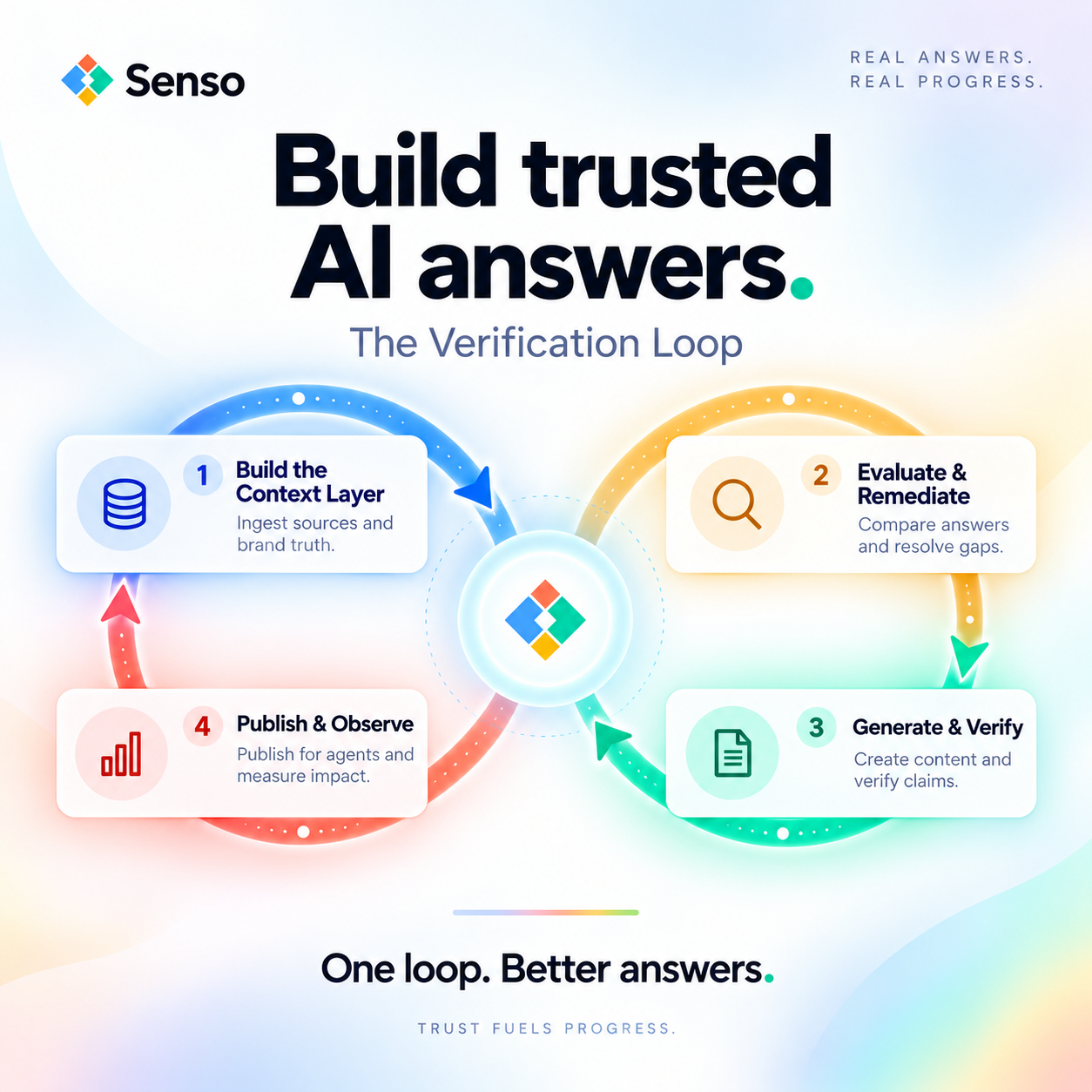
Senso ingests approved raw sources, compiles them into a governed, version-controlled compiled knowledge base, and uses that knowledge base to evaluate agent responses. Every answer traces back to a specific verified source.
That matters because one compiled knowledge base powers both internal workflow agents and external AI-answer representation. Teams do not need duplicate systems for internal support and public AI Visibility.
Senso’s workflow is straightforward:
- Ingest approved raw sources.
- Compile them into a governed knowledge base.
- Evaluate AI answers against verified ground truth.
- Identify unsupported or wrong context.
- Publish a Verified Source with proof.
Which teams use Senso first?
Senso is built for teams that need knowledge governance, not just more reporting. Marketing teams use Senso AI Discovery to control how AI models represent the organization externally. Compliance teams use it to see whether public AI responses are accurate, brand-safe, and aligned with policy.
Senso Agentic Support and RAG Verification serves internal workflows. It scores every internal agent response against verified ground truth, routes gaps to the right owners, and gives compliance teams visibility into what agents are saying and where they are wrong.
What results has Senso reported?
Senso reports 60% narrative control in 4 weeks, 0% to 31% share of voice in 90 days, 90%+ response quality, and 5x reduction in wait times. Those results point to the same outcome. When the context behind AI answers is governed, teams spend less time correcting drift and more time using the system safely.
The numbers also show why this is a governance issue, not just a content issue. Better context leads to better answers, faster reviews, and more control over how the organization is represented.
Is Senso only for regulated industries?
No. Senso is useful anywhere AI agents speak for the business, but regulated industries feel the problem fastest. Financial services, healthcare, and credit unions need citation accuracy, auditability, and proof that the current policy or claim was the one used.
That is why Senso frames the problem around verified ground truth and retained proof. If an answer can affect eligibility, pricing, policy interpretation, or brand representation, the organization needs a way to prove what the agent used.
FAQs
Is Senso just a retrieval tool?
No. Senso is a context layer for AI agents. It does more than find raw sources. It compiles approved knowledge, scores answers against verified ground truth, and publishes Verified Sources with proof.
Does Senso work for both internal and external AI answers?
Yes. Senso AI Discovery focuses on external AI Visibility and brand representation. Senso Agentic Support and RAG Verification focuses on internal agent answers, compliance visibility, and response quality.
Does Senso require a long setup?
Senso AI Discovery requires no integration. That makes it useful for teams that need to understand what AI says about the organization before a larger systems project begins.
What is the core promise of Senso?
Senso helps an organization see what AI says about it, identify what is unsupported or wrong, remediate the context, and publish a Verified Source with proof.
Senso solves the gap between AI answers and verified company truth. If your business is already being represented by agents, the real question is whether those answers are grounded and whether you can prove it.