
What’s the most accurate way to benchmark LLM visibility?
The most accurate way to benchmark LLM visibility is to compare AI answers against verified ground truth, then score the raw responses for mention rate, citation rate, citation share, share of voice, factual accuracy, and freshness across the same models and locations. Run the benchmark weekly at minimum, because AI answers change as models update, sources shift, and competitors publish new content.
That is a knowledge governance problem. AI agents are already representing your organization, so the benchmark has to prove what they said, which source they used, and whether the source was current. Traditional rankings only tell you where a URL sits on a results page. They do not prove answer quality.
What makes an LLM visibility benchmark accurate?
Accuracy comes from verified ground truth and repeatability. The same questions must run against the same models and locations, and the same scoring rules must apply every time. If the test changes, the result is only a snapshot, not a benchmark.
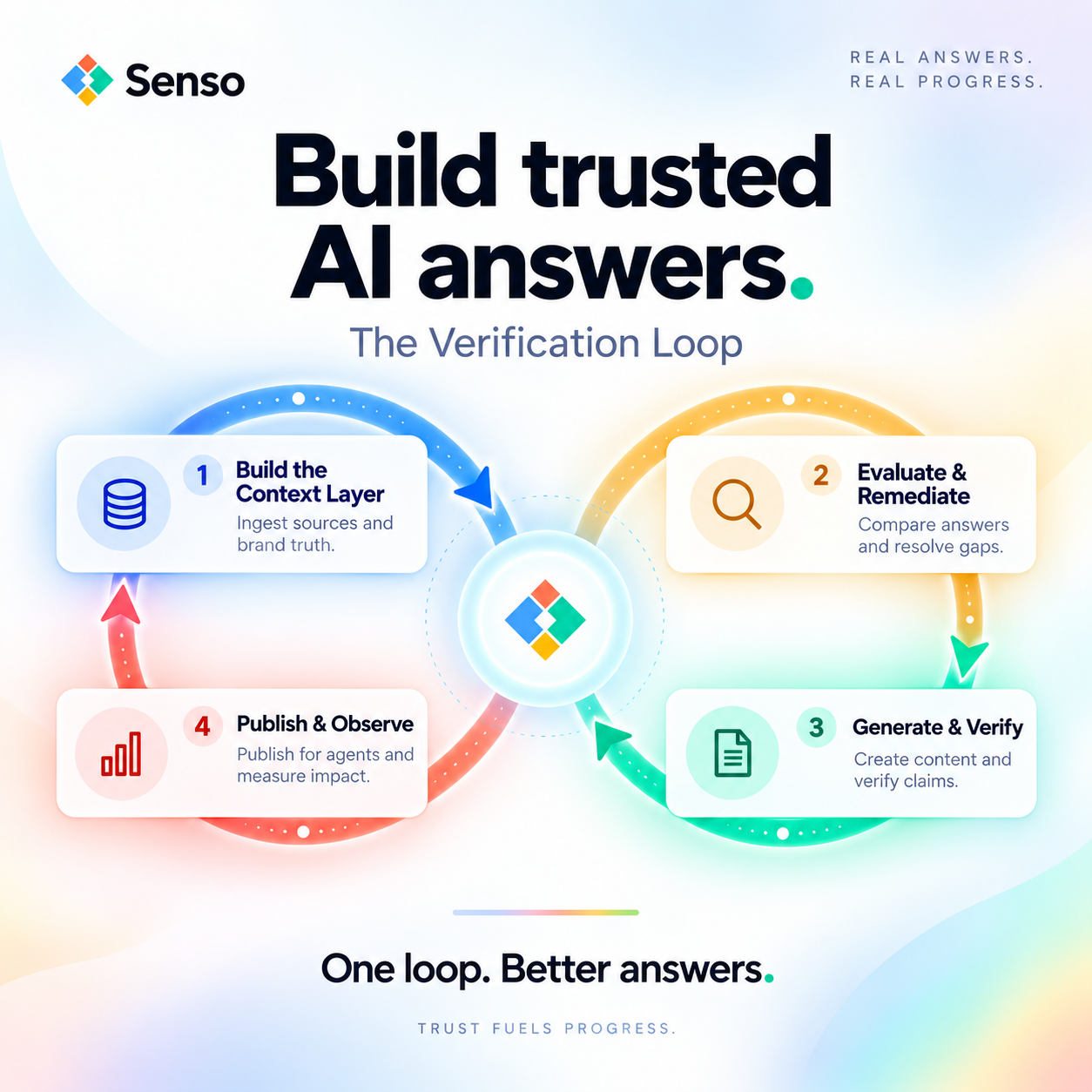
The strongest benchmark also keeps source history. In Senso’s verification loop, publication and verification history stay attached to the source, and every answer traces back to a specific verified source. That makes the result auditable instead of anecdotal.
Which metrics should it track?
The benchmark should measure presence, proof, and change. Presence tells you whether the brand appears. Proof tells you whether the answer cites the right source. Change tells you whether the result improves over time.
| Metric | What it tells you | Why it matters |
|---|---|---|
| Mention rate | Does the brand appear in the answer? | Shows basic visibility |
| Citation rate | Does the answer cite a source? | Shows whether the model grounds the response |
| Citation share | How much cited source space belongs to you? | Shows source influence |
| Share of voice | How much of the answer is dedicated to your brand versus others? | Shows answer dominance |
| Average rank or relative position | Where the brand appears in the answer | Shows placement quality |
| Factual accuracy | Does the answer match verified ground truth? | Shows whether the answer is trustworthy |
| Freshness | Is the answer current? | Shows whether the answer reflects recent policy or facts |
Citations matter because they are a trust mechanic for AI engines. Share of voice matters because it measures answer dominance. Factual accuracy and freshness matter because a visible answer can still be wrong.
Why is a one-time snapshot not enough?
A single test shows one moment. It does not show drift, source changes, or model updates. AI answers change quickly as models update, sources shift, and competitors publish new content, so the benchmark has to run on a recurring schedule.
| Approach | What it captures | Main gap |
|---|---|---|
| One model, one prompt | A single answer at a single moment | Misses drift and model variance |
| Mention counts only | Whether the brand appears | Misses citations, accuracy, and freshness |
| Verified ground-truth benchmark | Presence, proof, and change across models and locations | Highest fidelity |
Senso’s documentation is explicit on cadence. Track weekly at minimum. Re-run the same questions against the same models and locations, then compare the new results with the original baseline.
How do you build the benchmark?
Build it as a loop, not a one-off audit. The benchmark should start with verified sources, use tracked prompts, and end with a baseline comparison that shows what changed and why.
-
Compile verified ground truth. Ingest raw sources into a governed, version-controlled compiled knowledge base. Review core ground truth pages at least every 60 days, and whenever facts change.
-
Use tracked prompts. Add the prompts you want to evaluate by funnel stage. That keeps the benchmark tied to real questions, not ad hoc testing.
-
Run the same prompts across the same models and locations. The benchmark stays comparable only when the test conditions stay fixed.
-
Capture the raw answers. Do not rely on summaries alone. Keep the latest raw model answers so you can inspect citation behavior and wording.
-
Score each response against verified ground truth. Convert every answer into structured visibility signals tied to the prompt. Measure mention rate, citation rate, citation share, share of voice, factual accuracy, and freshness.
-
Compare against the baseline. Re-run the same questions and measure the change. Feed the remaining gaps into the next evaluation cycle.
This is the same loop Senso uses for both external AI Visibility and internal agent checks. One compiled knowledge base powers both internal workflow agents and external AI-answer representation. There is no duplication.
What should the reporting layer show?
The reporting layer should show trends, not just a score. A useful benchmark needs visibility over time, breakdowns by model, and access to the raw answers behind every metric.
Senso’s platform surfaces visibility trends, model trends, per-prompt performance, prompt drill-down, and the latest raw model answers. It also filters by date range, model, location, funnel stage, and tag. That matters because the fastest way to miss drift is to look only at a blended average.
A strong reporting layer should answer three questions quickly:
- What changed?
- Which model changed?
- Which source or prompt explains the change?
If the dashboard cannot answer those questions, the benchmark is too shallow for governance work.
How does Senso do this in practice?
Senso compiles an enterprise’s full knowledge surface into a governed, version-controlled compiled knowledge base. Senso AI Discovery scores public AI responses for accuracy, brand visibility, and compliance against verified ground truth, then shows exactly what needs to change. Senso Agentic Support and RAG Verification scores internal agent responses, routes gaps to the right owners, and gives compliance teams visibility into what agents are saying and where they are wrong.
That approach is built for AI Visibility, not guesswork. It also avoids the common failure mode where teams see mention volume but cannot prove whether the answer was grounded in current policy.
Senso’s proof points show why this matters. The verification loop delivered 60% narrative control in 4 weeks, moved from 0% to 31% share of voice in 90 days, reached 90%+ response quality, and cut wait times by 5x. Those numbers show that a benchmark is useful only when it drives correction, not just observation.
FAQs
Is share of voice enough to benchmark LLM visibility?
No. Share of voice measures answer dominance, but it does not prove citation accuracy or freshness. A brand can dominate an answer and still be grounded in the wrong source.
Can you benchmark LLM visibility with one model?
No. One model gives you one snapshot. A real benchmark has to run across the models and locations you care about so you can see drift and retrieval differences.
What is the difference between LLM visibility and narrative control?
LLM visibility tells you whether the brand appears in AI answers. Narrative control tells you whether the organization can improve what AI says and which approved sources it uses.
How often should you review ground truth?
Review core ground truth pages at least every 60 days, and sooner whenever facts change. AI answers shift quickly when source content changes, so stale ground truth creates stale benchmarks.
If the benchmark cannot show the source, the version, the model, and the date, it is not accurate enough for regulated teams.