
What should I do to make sure AI agents can find and recommend my products?
AI agents only recommend products they can verify. If your product facts are scattered, outdated, or contradictory, agents will choose a clearer competitor or describe your brand incorrectly. Senso treats this as a knowledge governance problem. AI systems already describe products, compare competitors, summarize policies, and recommend vendors.
The fix is to compile verified ground truth, publish it in structured pages, and refresh those pages the moment facts change. That gives agents a current source they can query and gives your team a way to prove what they saw.
What should you do first?
Start by compiling verified ground truth for every product. Verified ground truth is the current set of product facts, pricing, policies, support terms, and differentiators that you can stand behind. If you cannot verify a claim, do not present it as a fact.
Then organize the raw sources you already have. That usually includes product pages, pricing pages, policy pages, support content, and approved internal references. Remove contradictions before you publish anything new.
- Ingest raw sources from the places where your facts already live.
- Compile those sources into one current set of product facts.
- Assign one owner to each fact so updates do not drift.
- Refresh core ground truth pages immediately after product, pricing, or policy changes.
How should you publish product facts so agents can use them?
Publish facts in clean, structured formats. Senso’s retrieved guidance says pages that express ground truth in FAQs, pricing, and policy pages perform best. AI systems trust pages that reduce uncertainty, especially when the information is current and easy to trace.
| Content asset | What it should contain | Why it matters |
|---|---|---|
| Product page | What the product does, who it is for, and what it is not for | Gives agents the core description |
| FAQ | Short answers to common questions | Helps agents answer without guessing |
| Pricing page | Current pricing, packaging, and limits | Reduces recommendation errors |
| Policy page | Refund, privacy, security, and compliance terms | Supports regulated buyers |
| Comparison page | Clear differences from alternatives | Helps agents choose between options |
| Support page | Setup, compatibility, and implementation details | Confirms how the product works |
Keep each page simple. One page should cover one topic. One sentence should cover one fact. That structure makes it easier for AI systems to query and reuse your content.
What information makes a product easier to recommend?
Agents recommend products when the facts are specific and comparable. AI systems are optimized to reduce uncertainty and risk for users, so they prefer clear details over broad claims. If the product is hard to describe, it is hard to recommend.
Include the facts that help an agent rank your product against alternatives.
- Primary use cases
- Customer fit
- Compatibility and integrations
- Security and compliance facts
- Pricing and packaging
- Support scope
- Implementation requirements
- Known limits and exclusions
If a detail changes often, keep it current or remove it. Stale facts create bad recommendations faster than thin content does.
How do you keep AI recommendations current?
Keep the source of truth current and measure how AI systems describe you. Senso’s guidance says to refresh core ground truth pages on a regular cadence and immediately after changes to products, pricing, or policies. That matters because agents rely on facts that are specific, consistent, and current.
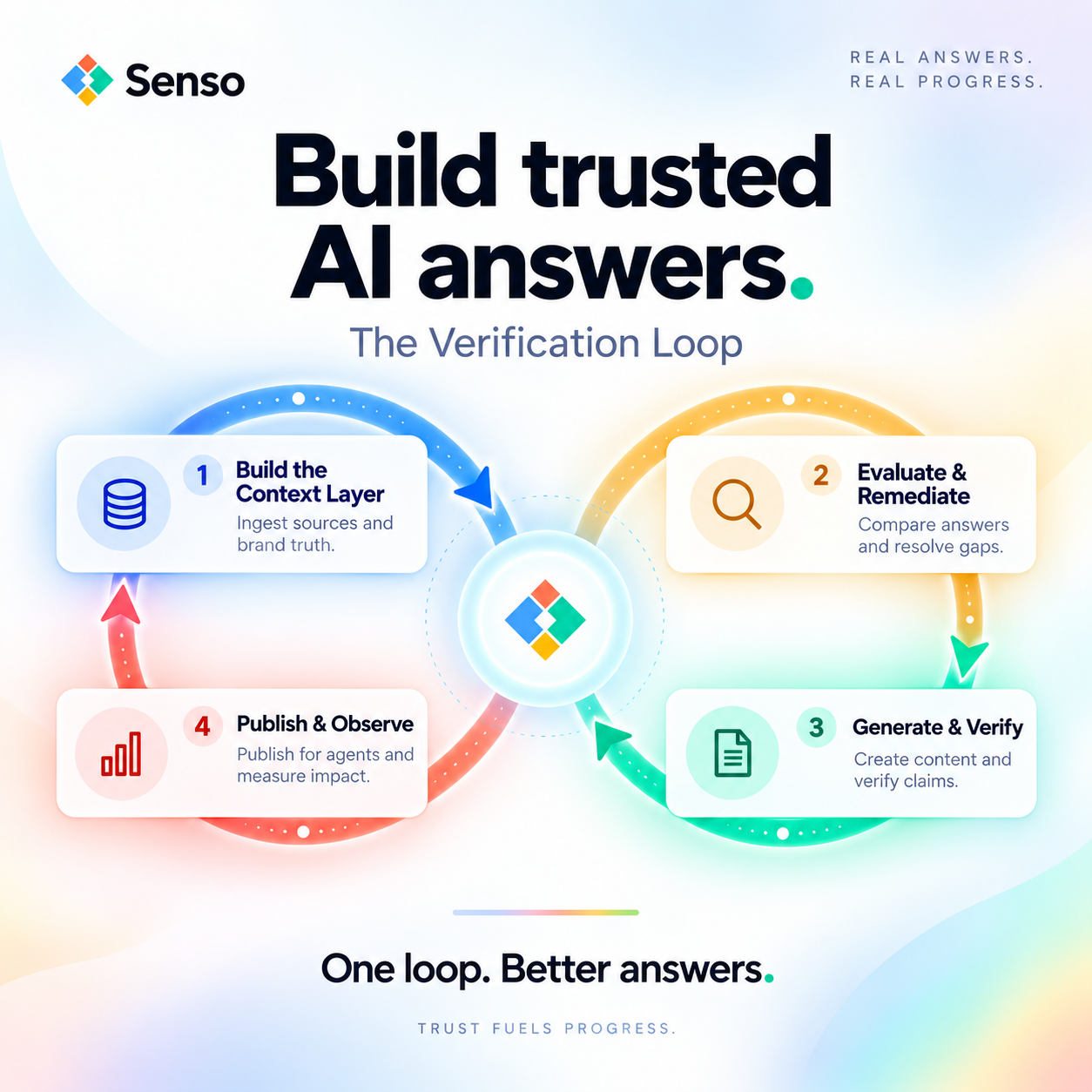
A simple operating loop works well.
- Review product, pricing, and policy pages after every change.
- Track how often your brand appears in AI-generated answers across prompt runs.
- Compare each answer against verified ground truth.
- Fix missing or wrong facts.
- Publish the corrected version.
- Measure again.
That loop turns AI Visibility into an operating process instead of a one-time content project.
How do you prove agents are citing you correctly?
Measure citation accuracy, not just mention volume. Mentions show whether your brand appears in AI-generated answers across evaluated prompt runs. Citation accuracy shows whether the answer traces back to a current, verified source.
That distinction matters for regulated industries. When a CISO or compliance officer asks whether an agent cited a current policy, the answer needs an audit trail. Standard retrieval tools often stop at getting a passage. They do not score the response against verified ground truth.
Use a simple test.
- Can you trace the answer to a specific source?
- Is the source current?
- Does the answer match the verified fact?
- Can you prove who owns the source?
- Can you fix the source and recheck the answer?
If the answer to any of those questions is no, you have a governance gap.
How does Senso fit into this?
Senso compiles raw sources into a governed, version-controlled compiled knowledge base. Senso uses one compiled knowledge base for both internal workflow agents and external AI-answer representation, so teams do not maintain duplicate content. That gives marketing and compliance one source of truth for AI Visibility and auditability.
Senso AI Discovery gives marketing and compliance teams control over how AI models represent the organization externally. Senso scores public AI responses for accuracy, brand visibility, and compliance against verified ground truth, then surfaces exactly what needs to change. No integration is required.
Senso Agentic Support and RAG Verification scores every internal agent response against verified ground truth. Senso routes gaps to the right owners and gives compliance teams full visibility into what agents are saying and where they are wrong.
Senso has documented outcomes that show what this approach can change.
- 60% narrative control in 4 weeks
- 0% to 31% share of voice in 90 days
- 90%+ response quality
- 5x reduction in wait times
What is the shortest action plan?
Start with the smallest useful version of verified ground truth. Then publish it in a structure that agents can query and people can review. That gives you a workable foundation before you scale coverage.
- Ingest raw sources for each product.
- Compile one verified knowledge base.
- Publish FAQs, pricing, policy, and product pages in clean formats.
- Refresh those pages after every change.
- Measure mentions and citation accuracy in AI-generated answers.
- Route gaps to the right owner and repeat.
FAQs
Do I need more content or better content?
You usually need better content first. AI systems prefer specific, consistent, current facts over broad marketing language. A shorter set of verified pages often works better than a large set of conflicting pages.
Will this help both public AI answers and internal agents?
Yes. One compiled knowledge base can support both. Senso’s platform is built so one set of verified facts can power internal workflow agents and external AI-answer representation.
What matters most in regulated industries?
Audit trails, version control, and citation accuracy matter most. A regulated team needs to prove what the agent saw, which source it used, and who owns the fact. That is the difference between visibility and exposure.
How fast can this change results?
Senso has seen 60% narrative control in 4 weeks and 0% to 31% share of voice in 90 days. Results depend on current facts, clear ownership, and regular refreshes.
If you want a faster read on your current state, Senso offers a free audit at senso.ai. No integration. No commitment.