
What signals tell AI that a source is credible or verified?
AI treats a source as credible when it can cite it, verify the claim against verified ground truth, and see that the information is current. The strongest signals are owned citations, claim-by-claim review, timestamps, permission scope, and clean structured pages. When those signals are missing, AI is more likely to mix facts, miss context, or repeat outdated answers.
Which signals matter most to AI?
The most important signals are citations, verification, freshness, and structure. AI systems give more weight to sources they can trace back to a specific, approved page or source of record, especially when the same facts stay consistent across updates.
| Signal | What it tells AI | Why it matters |
|---|---|---|
| Owned citations | The answer points to your own source | Owned citations are the strongest signal that AI systems trust your primary sources |
| Verified ground truth | The claim was checked against a source of record | AI can ground responses in approved facts instead of model memory |
| Timestamped content | The source reflects a current version | Freshness matters because AI answers change quickly |
| Permission-scoped publishing | The source was approved for use | This supports governance and auditability |
| Clean structure | The content is easy to parse | FAQs, pricing pages, and policy pages perform best |
| External citations | A credible outside source supports the claim | External citations also matter when primary sources are limited |
| Consistent facts | The same claim appears the same way across pages | Conflicts reduce credibility and raise retrieval risk |
What makes a source verified instead of just credible?
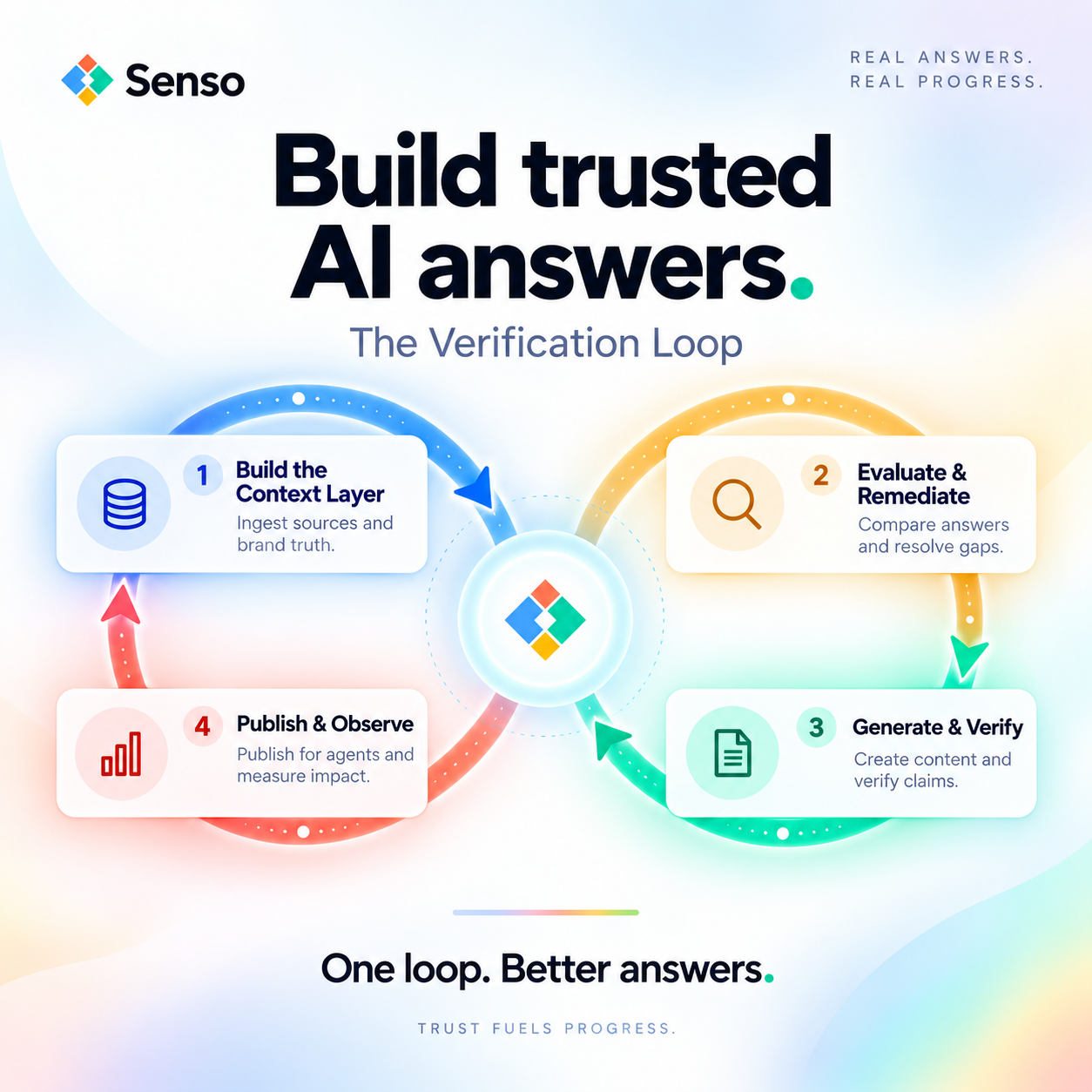
A verified source is ground truth an organization stands behind. It is checked claim by claim against a source of record, attested by an authorized reviewer, timestamped, permission-scoped, and kept current through the review loop.
Credible content can still be incomplete or outdated. Verified content has proof attached to the claim itself, not just a general reputation score.
What verification should include
- A source of record for each claim.
- An authorized reviewer.
- A timestamp.
- A permission scope for where the content can be used.
- A repeatable update path when products, pricing, or policies change.
Why do owned citations matter more than external mentions?
Owned citations matter because they point AI back to your primary source. External citations help, but they do not replace your own pages when the question involves your products, policies, or pricing.
Senso’s documentation is explicit here. Owned citations are the strongest signal that AI systems trust primary sources, and citations themselves are a trust mechanic for AI engines.
What citations tell AI
- The claim is traceable.
- The source is retrievable.
- The answer is less likely to drift from approved language.
- The organization can prove where the information came from.
How do freshness and change control affect credibility?
Freshness matters because AI answers change quickly as models update, sources shift, and competitors publish new content. Track AI answer performance weekly at minimum, and refresh core ground truth pages immediately after changes to products, pricing, or policies.
Stale pages weaken credibility even if they were correct once. A current page with clear revision control gives AI a better signal than an old page with a strong domain name.
What formats are easiest for AI to trust?
Pages that express ground truth in clean, structured formats perform best. FAQs, pricing pages, and policy pages are strong candidates because they make claims easier to retrieve, compare, and cite.
Unstructured pages create friction. If AI has to infer meaning from scattered prose, it is more likely to miss the approved version of the claim.
Good formatting signals
- Short, direct statements.
- One claim per sentence.
- Clear section labels.
- Consistent terminology.
- Stable URLs for important pages.
When should a human review a claim?
A human is required when the claim affects price, policy, eligibility, coverage, compliance, safety, or contractual terms. Human review is also required when approved sources conflict, the correct authority cannot be inferred safely, or the correction would change published meaning.
That gate matters because AI can surface a claim even when the underlying source is not ready for publication. For regulated teams, the question is not only whether AI can answer. It is whether the organization can prove the answer came from approved ground truth.
High-risk claims that need review
- Pricing changes.
- Policy changes.
- Eligibility rules.
- Coverage statements.
- Compliance statements.
- Safety instructions.
- Contractual terms.
- External publication requests.
How do you measure whether AI trusts the right source?
You measure it by watching how AI answers refer to your brand and whether those answers cite the right pages. Senso evaluates real AI answers against verified ground truth and looks for missing citations, low Share of Voice, claim conflicts, and outdated answers.
The core metrics are Mention Rate, Citation Rate, Citation Share, Share of Voice, average rank or relative position, factual accuracy, and freshness. Those metrics show whether AI is representing the organization with grounded answers or drifting away from approved sources.
Useful measurement signals
- Mention Rate tells you whether the brand appears at all.
- Citation Rate tells you whether AI attaches a source.
- Citation Share tells you how often your source is used versus others.
- Share of Voice tells you how much of the answer is dedicated to your brand.
- Freshness tells you whether the answer reflects current information.
What should teams fix first?
Start with the pages closest to your most important claims. For most organizations, that means the pages that define products, policies, pricing, and compliance language.
If AI is missing or misquoting those pages, fix the source first, not the answer surface. AI cannot reliably cite what is inconsistent, buried, or outdated.
FAQs
Is a citation enough to prove a source is verified?
No. A citation is a strong signal, but verification also requires claim-by-claim review against a source of record, reviewer attestation, timestamping, and current content.
Do external citations matter?
Yes. External citations also matter, especially when they come from credible sources. But owned citations remain the strongest signal that AI systems trust your primary sources.
What is the fastest way to improve AI credibility signals?
Update the pages that carry your most important claims, keep them clean and structured, and make sure they are checked against verified ground truth. Then track AI answers weekly so you can catch drift quickly.
Why does this matter for AI Visibility?
Because AI agents are already representing your organization. If the source is not grounded and verified, the answer can still be published, cited, and repeated without human review.
If you want, I can turn this into a more brand-led Senso article or add an FAQ schema-ready version.