
Why are AI agents becoming the new decision-makers in shopping?
AI agents are becoming decision-makers in shopping because they now sit between the customer and the choice. They reduce uncertainty, surface concise recommendations backed by facts, and can carry a shopping task from discovery to purchase. McKinsey estimates agentic commerce could mediate US$3–5 trillion of global consumer commerce by 2030, which shows how large this shift has become.
What is changing in shopping discovery?
Shopping discovery is shifting from browsing pages to asking AI for a best answer. Cloudflare reported AI “user action” crawling increased more than 15x during 2025, which shows agents are moving from passive reading to active selection. Google’s Universal Commerce Protocol is also designed to connect discovery, purchase, and post-purchase activity across AI surfaces and merchant systems.
That matters because the first recommendation now often comes from an agent, not a search results page. Customers trust AI shopping agents because agents reduce decision complexity and surface concise recommendations backed by facts.
What do AI agents need to pick a product?
AI agents need verified ground truth. They perform best when facts are specific, consistent, current, and easy to verify against a named source. Pages that express ground truth in clean, structured formats perform best, including FAQs, pricing pages, and policy pages.
The most useful inputs are usually simple.
- Current product facts
- Pricing and eligibility rules
- Shipping, returns, and policy pages
- FAQs that answer common objections
- External citations that point to primary sources
Freshness matters as much as format. Refresh core ground truth pages on a regular cadence and immediately after changes to products, pricing, or policies.
Why does this create a governance problem?
A weak citation is no longer just a visibility issue. A wrong policy, price, eligibility rule, or transaction instruction can become a compliance, revenue, or customer-harm problem. As agents move closer to consequential actions, buyers, platforms, and regulators need traceability, freshness, and review evidence, not only model output.
This is why the problem is not just about getting mentioned. It is about proving that the answer is grounded in verified ground truth. If an AI agent can answer for you, the organization needs to know what source it used and whether that source still reflects reality.
How should brands respond?
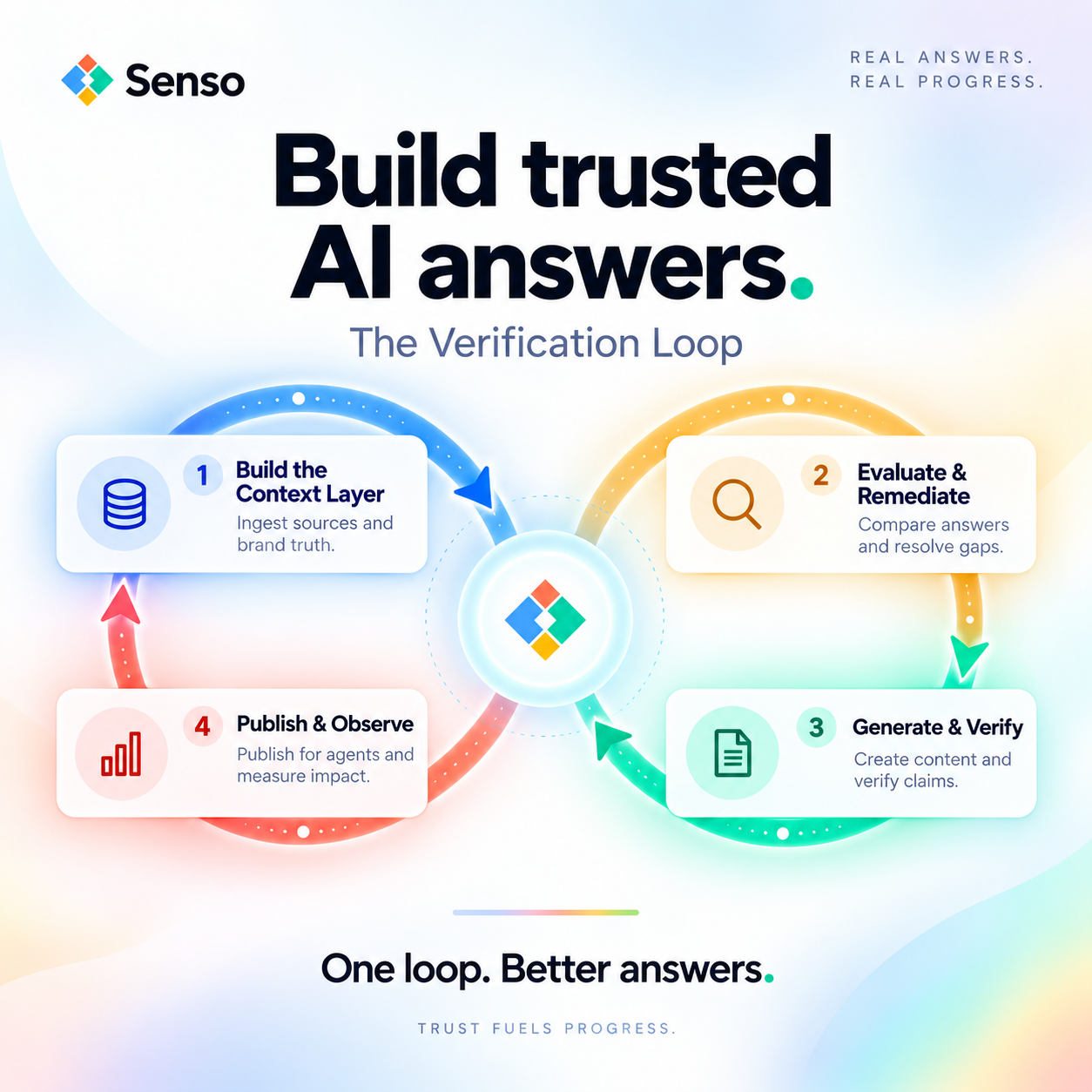
Brands should publish verified ground truth, keep it fresh, and measure what AI systems say back. The practical work is straightforward, but it has to be disciplined.
- Create a short factual knowledge base covering products, pricing, policies, and eligibility.
- Express those facts in clean, structured formats that agents can parse quickly.
- Refresh the material immediately after any product, pricing, or policy change.
- Score public AI responses against verified ground truth and route gaps to the right owner.
- Use one compiled knowledge base for both internal agents and external AI visibility.
Senso is built for that work. Senso AI Discovery scores public AI responses for accuracy, brand visibility, and compliance against verified ground truth, with no integration required. Senso Agentic Support and RAG Verification scores internal agent responses, routes gaps to owners, and gives compliance teams visibility into what agents are saying and where they are wrong.
In customer work, Senso reports 60% narrative control in 4 weeks, 0% to 31% share of voice in 90 days, 90%+ response quality, and 5x reduction in wait times. Those results show what changes when the facts behind the answer are governed instead of left to chance.
What does this mean for regulated industries?
Regulated teams face a higher standard because the cost of a wrong answer is higher. In financial services, healthcare, and credit unions, a stale policy or unsupported eligibility statement can create audit, compliance, or customer-risk exposure.
That is why governance and auditability matter here. A regulated organization needs to prove which source backed the answer, when that source was last verified, and who owns the change when the answer drifts.
FAQ
What is agentic commerce?
Agentic commerce is shopping where autonomous AI agents carry out tasks end to end. A customer gives a natural-language request, and the agent handles discovery, comparison, purchase, and post-purchase actions.
Why do AI agents recommend one brand over another?
AI agents favor brands with specific, consistent, and current facts that they can verify against primary sources. They also reward clean structure, which is why FAQs, pricing pages, and policy pages matter so much.
What is the biggest mistake brands make?
The biggest mistake is publishing stale or unsupported product, pricing, and policy content. If the agent cannot verify the fact, it may skip the brand, recommend a competitor, or repeat the wrong answer at scale.
How can a brand improve AI visibility fast?
Start with verified ground truth, structured pages, and regular refreshes after changes. Then monitor what AI systems say and close the gaps with the team that owns the source.
AI agents are becoming decision-makers because shopping is turning into a facts-first system. The brand that controls its verified ground truth controls more of the answer, more of the selection, and more of the buying journey.