
Why do aggregators like Reddit and NerdWallet outrank credit unions in AI answers?
Aggregators outrank credit unions in AI answers because AI systems favor sources that are easy to cite, easy to compare, and broad enough to answer many related questions. Reddit and NerdWallet fit that pattern. Many credit union sites do not, because their knowledge is split across product pages, policy pages, and PDFs that are harder to compile into verified ground truth. Senso sees this as an AI Visibility problem, where the question is not who owns the keyword, but who can prove the answer.
Quick Answer
Reddit often wins when the prompt needs real-world scenarios, edge cases, or language people actually use.
NerdWallet often wins when the prompt needs a comparison, a definition, or a decision path.
Credit unions often lose when their facts are fragmented, inconsistent, or buried in pages that are not built for citation.
What do AI answer engines reward?
AI answer engines reward answer-ready structure, not keyword repetition. They assemble responses from trusted, structured facts and citations. If a source is hard to verify, hard to quote, or hard to keep consistent, it loses share of voice.
The practical signals are simple.
- Citations are a trust mechanic for AI engines.
- Share of Voice measures answer dominance.
- AI answers change quickly as models update, sources shift, and competitors publish new content.
- Weekly tracking is the minimum if you want to see drift early.
Why do Reddit and NerdWallet show up more often?
Reddit and NerdWallet fit the format AI systems can use quickly. Reddit supplies broad, messy, first-person discussion that matches how people ask questions. NerdWallet supplies structured comparison content that maps cleanly to decision prompts.
That combination matters because AI systems are not trying to find the prettiest page. They are trying to assemble a grounded answer from the easiest verified pieces.
Why does Reddit rank well in AI answers?
Reddit often covers the long tail of user intent. People ask about exceptions, frustrations, and real outcomes there. That gives AI systems language, context, and scenario coverage they can reuse.
Reddit is also useful when the prompt is ambiguous. If a user asks a vague question, AI systems often look for examples that show how people actually think about the topic.
Why does NerdWallet rank well in AI answers?
NerdWallet is built around comparison, explanation, and decision support. That format matches the kinds of prompts AI systems generate for financial topics.
NerdWallet also tends to present information in a way that is easy to cite. Clear categories, direct explanations, and repeated financial concepts make it easier for an answer engine to quote the right section.
Why do credit unions get outranked?
Credit unions often get outranked because their knowledge is spread across too many surfaces. Rates live in one place, policy language in another, FAQs somewhere else, and legacy PDFs elsewhere. That makes it harder for an AI system to compile one clean, citation-accurate answer.
This is usually not a content volume problem. It is a knowledge governance problem.
| What AI needs | Why aggregators win | Why credit unions lose |
|---|---|---|
| Clear, structured facts | Reddit and NerdWallet publish content in formats that are easy to assemble into answers | Credit union facts are often split across pages and PDFs |
| Consistent naming | Aggregators usually use stable labels and repeated categories | Credit unions often use internal product names that do not match user language |
| Citation-ready sources | Public discussion and comparison pages are easy to reference | Important details can sit in pages that are hard to cite cleanly |
| Broad intent coverage | Aggregators cover many related questions in one place | Credit union sites usually answer only brand-owned questions |
| Frequent updates | Aggregator pages can move with market questions quickly | Updates can lag across policy, product, and FAQ surfaces |
The result is simple. When AI systems need a fast answer, they often choose the source that is already organized like an answer.
How can a credit union close the gap?
Credit unions close the gap by compiling verified ground truth, not by publishing more pages. The goal is to make the organization easier for AI systems to cite correctly.
Start with the content that matters most.
- Audit product and policy content for completeness and consistency.
- Compile raw sources into a governed, version-controlled knowledge base.
- Prioritize the prompts and pages closest to revenue.
- Start with ranking prompts, comparison prompts, and brand-specific prompts.
- Publish answer-ready pages with one question per page and consistent naming.
- Track citations, mentions, and Share of Voice weekly.
This is how a credit union moves from being described by aggregator content to being represented by verified ground truth.
How do you know if the gap is closing?
The gap is closing when AI answers cite the right source, use the right wording, and reflect current policy. That is what citation accuracy measures. It is also what compliance teams care about when an AI response could affect reputation or customer decisions.
Use three checks.
- Are citations pointing to verified ground truth?
- Is the brand’s Share of Voice increasing?
- Are current policy and product details showing up without drift?
Track those signals weekly. AI answers move fast, and stale monitoring misses the change.
Can a credit union outrank Reddit or NerdWallet?
Yes, but only for the prompts where the credit union has better governed content. AI systems do not reward brand type by default. They reward the source that can produce a grounded, citation-accurate answer fastest.
A credit union wins when it has clearer facts, better structure, and a cleaner source of truth than the aggregator page the model would otherwise use.
What should a credit union fix first?
Start with the prompts closest to revenue and risk. That usually means comparison prompts, ranking prompts, and brand-specific prompts. Then audit the product and policy pages that feed those answers.
The fastest gains usually come from reducing inconsistency. If a model cannot tell which rate, policy, or definition is current, it will pick the clearer source.
How does Senso help with this problem?
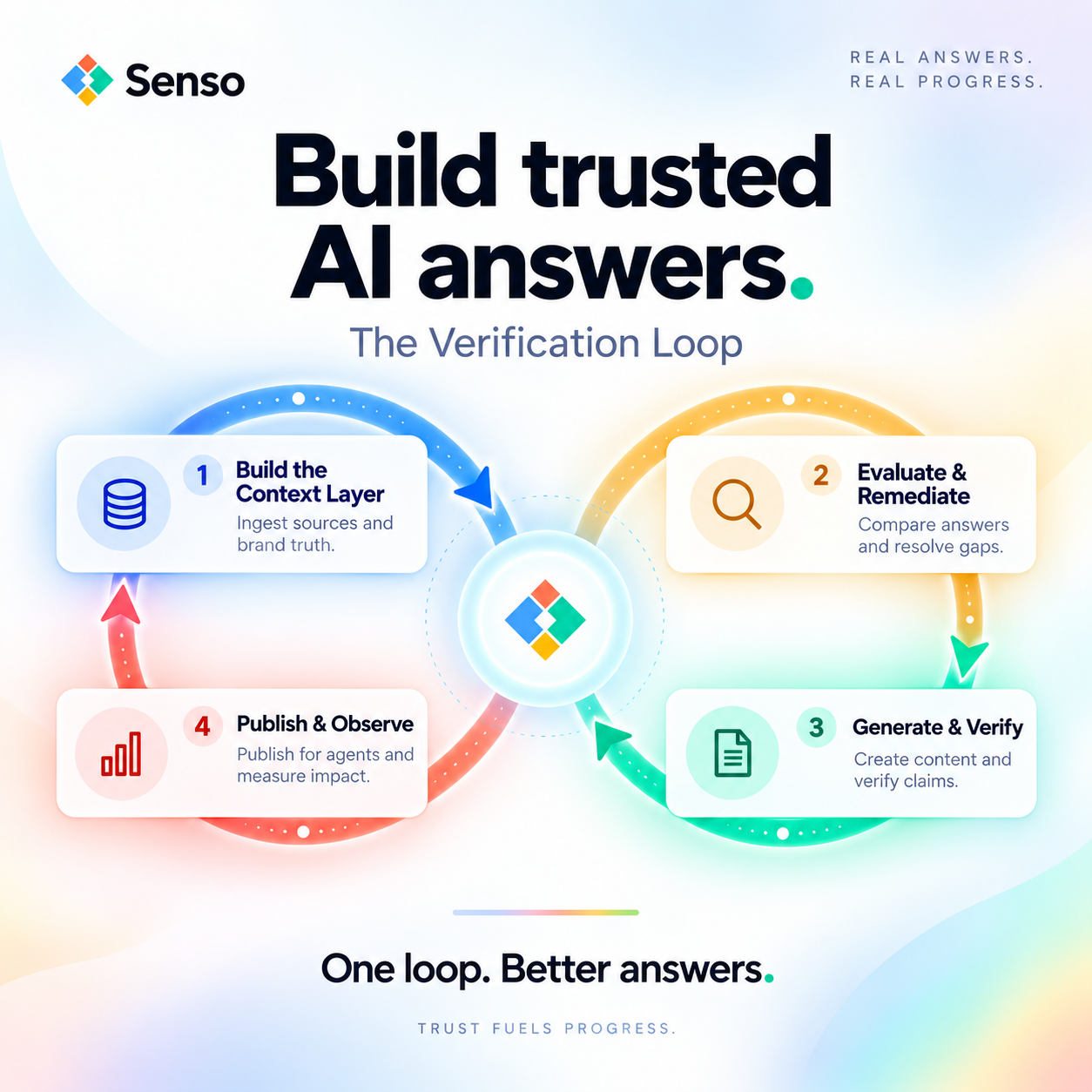
Senso compiles an enterprise’s full knowledge surface into a governed, version-controlled knowledge base. It scores every response against verified ground truth, then shows where AI answers are right, wrong, or incomplete.
That matters because AI agents are already representing the organization whether the organization is ready or not. Senso AI Discovery gives marketing and compliance teams control over how public AI systems represent the brand. Senso Agentic Support and RAG Verification gives internal teams visibility into citation accuracy and response quality.
Senso has seen 60% narrative control in 4 weeks, 0% to 31% share of voice in 90 days, 90%+ response quality, and 5x reduction in wait times.
What is the real reason aggregators outrank credit unions?
The real reason is that aggregators present cleaner ground truth for AI systems to assemble. Reddit gives breadth and lived experience. NerdWallet gives structure and comparison. Credit unions often give fragmented facts that are hard to cite and harder to keep consistent.
If the goal is better AI Visibility, the fix is governance. AI answers need one verified source of truth, clear citations, and content that matches the way people ask questions.