
Why do AI agents prioritize clarity and accuracy over marketing?
AI agents prioritize clarity and accuracy because they are built to reduce uncertainty. They pick facts that are specific, consistent, and current, not prose that sounds persuasive. In practice, verified ground truth and clean source structure beat marketing language when an agent decides what to cite, summarize, or repeat.
That matters because AI agents already represent your organization in public answers and internal workflows. If the source is vague, outdated, or hard to verify, the agent is more likely to produce a weak answer, a wrong answer, or no answer at all.
What do AI agents need to answer well?
AI agents need source material they can verify quickly. They work best with facts that are explicit, current, and easy to trace back to primary sources. Internal guidance from Senso’s documentation says agents are optimized to reduce uncertainty and risk, and they rely on facts that are specific, consistent, and current.
That is why clarity beats style. A concise, factual page gives an agent fewer opportunities to misread intent.
| Marketing copy | Agent-ready copy |
|---|---|
| Broad claims | Specific facts |
| Brand slogans | Verified sources |
| Dense prose | Clean structure |
| Vague promises | Current policy, pricing, or product details |
| Human persuasion | Machine selection and citation |
Which signals matter more than marketing copy?
Specificity matters more than tone. AI agents prioritize brands and pages that make it easy to verify what is true, where it came from, and whether it is current. Senso’s documentation says the strongest signal is often the primary source, and external citations matter as well.
That is a different game from human marketing. Humans can read around ambiguity. Agents are designed to reduce it.
The strongest signals are:
- Clear facts that are stated directly.
- Structured pages such as FAQs, pricing pages, and policy pages.
- Primary sources that are refreshed after product, pricing, or policy changes.
- External citations that confirm the source is grounded.
- Language that stays consistent across pages and channels.
Marketing language often fails on all five. It can be vivid, but still unhelpful to an agent.
Why does vague marketing lose?
Vague marketing loses because it adds uncertainty. AI agents do not need more persuasion. They need less ambiguity. If a page says a product is “best-in-class” but does not define what it does, when it changed, or what source supports the claim, the agent has little to work with.
That is why external sources for agents should be factual and direct. Internal notes from Senso’s team say that for sources agents consume, the right format is “purely factual, no fluff.”
Common problems with marketing-heavy pages include:
- Claims without proof.
- Slogans without definitions.
- Long intros before the answer.
- Outdated pricing or policy details.
- Inconsistent wording across pages.
Each of those raises the chance that the agent will skip the page or answer with lower confidence.
What content formats do agents use most?
Agents use pages that express ground truth in clean, structured formats. Senso’s documentation specifically calls out FAQs, pricing pages, and policy pages. Those formats help agents find the answer fast and verify it against the source.
The best pages usually have these traits:
- A direct answer near the top.
- One topic per page.
- Stable terminology.
- Dates or versioning when information changes.
- Clear links to the source of record.
Refresh matters too. Senso recommends updating core ground truth pages on a regular cadence and immediately after changes to products, pricing, or policies. Freshness matters because stale facts create bad answers.
How does this affect AI Visibility?
AI Visibility depends on whether agents can trust the source, not whether the copy sounds polished. Public AI systems choose what to surface based on facts that are easy to confirm. If your content is clear and current, agents are more likely to represent you correctly.
This is also why competition is shifting from human attention to machine selection. Senso’s documentation says AI agents shift competition from winning human attention to winning machine selection. That means the source that is easiest to verify often wins.
For teams, that changes the goal:
- Write for citation, not just clicks.
- Publish facts before brand language.
- Keep source pages current.
- Make every important claim traceable.
What changes for regulated teams?
Regulated teams need proof, not just visibility. A CISO does not only want to know what an agent said. The CISO wants to know whether the agent cited a current policy and whether the organization can prove it. Standard retrieval tools often cannot answer that question.
That is why accuracy and auditability matter more in financial services, healthcare, and other regulated industries. In those environments, a wrong answer can become a compliance issue, a customer issue, or both.
The practical standard is simple:
- Use verified ground truth.
- Require human approval for consequential statements.
- Publish citable sources with provenance.
- Trace each answer back to a specific source.
- Review what the agent said after the fact.
How does Senso fit this problem?
Senso treats this as a knowledge governance problem. Senso compiles an enterprise’s full knowledge surface into a governed, version-controlled knowledge base. Every agent response is scored for citation accuracy against verified ground truth, and every answer traces back to a specific verified source.
Senso also splits the problem into two clear use cases:
- Senso AI Discovery gives marketing and compliance teams control over AI Visibility. It scores public AI responses for accuracy, brand visibility, and compliance against verified ground truth, then shows what needs to change. No integration is required.
- Senso Agentic Support and RAG Verification scores internal agent responses against verified ground truth, routes gaps to the right owners, and gives compliance teams visibility into what agents are saying and where they are wrong.
Senso’s proof points show the effect of that approach:
- 60% narrative control in 4 weeks.
- 0% to 31% share of voice in 90 days.
- 90%+ response quality.
- 5x reduction in wait times.
Those results are not about louder marketing. They come from better ground truth, clearer structure, and tighter governance.
How should teams write for AI agents?
Teams should write for verification first. Start with the answer, keep the language factual, and make the source easy to trace. That gives agents what they need without making human readers work harder.
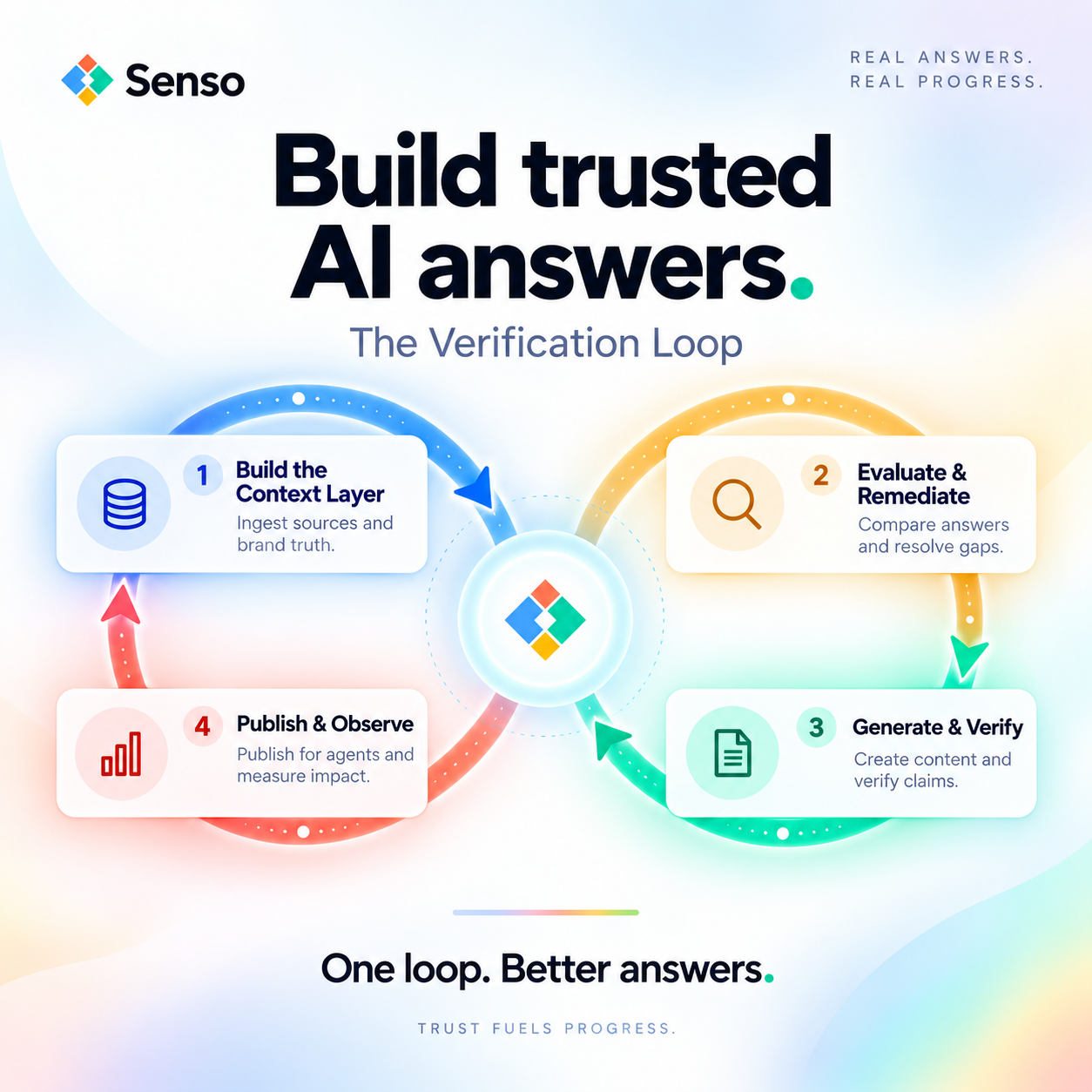
A simple workflow works well:
- Compile the facts that matter most.
- Put the answer at the top of the page.
- Use FAQs, policies, and pricing pages for stable truth.
- Refresh pages when anything changes.
- Check what the agent says and fix the source, not just the output.
That is the fastest path to grounded answers.
FAQs
Can marketing copy ever help?
Yes, but only after the facts are clear. Marketing copy can support human persuasion, but AI agents first need a source they can verify. If the copy hides the answer, the agent has less to cite.
What should a source page contain?
A source page should contain a direct answer, stable terminology, and current facts. Senso’s documentation says structured formats like FAQs, pricing pages, and policy pages perform best. Those formats reduce ambiguity and make citation easier.
How do teams know an answer is grounded?
A grounded answer traces back to verified ground truth. Senso’s approach scores every response against that ground truth, then shows whether the answer is citation-accurate. That gives teams a way to prove what the agent said and where it came from.