
Why do some answers show up more often in ChatGPT or Perplexity conversations?
Some answers show up more often because ChatGPT and Perplexity keep reusing the same grounded sources when they can verify them quickly. They do not repeat answers at random. They tend to favor clear source language, stable entity names, and material that matches the question closely. That is an AI Visibility problem, not a volume problem.
Quick answer
The answers that appear most often usually have three advantages. They match the query, they are easy to ground in verified sources, and they are easier to cite than competing material. In a regulated environment, the real question is whether the answer traces back to verified ground truth and whether you can prove it.
What makes an answer show up more often?
An answer shows up more often when the system can verify it fast and reuse it across similar prompts. The strongest signals are usually consistency, clarity, and source coverage. When those signals are weak, the engine falls back to whatever it can ground with the least friction.
| Signal | Why it matters |
|---|---|
| Clear source support | The answer is easier to verify and cite. |
| Repeated mention across sources | The same wording gets reused more often. |
| Exact entity naming | The system is less likely to confuse the answer with noise. |
| Current, version-controlled material | The answer stays aligned with the latest policy, pricing, or guidance. |
| Tight query match | The answer fits the wording and intent of the question. |
This is why one answer can dominate even when other answers exist. The system is rewarding grounded reuse, not internal importance.
Why do ChatGPT and Perplexity repeat the same answers?
Both systems tend to repeat answers that are easy to support. When a prompt matches a known pattern, the model often returns the same explanation because it is the safest grounded path. Perplexity makes that easier to inspect because citations are visible in the answer. ChatGPT can do the same when it has access to browsing or connected tools.
That means repetition usually points to source structure, not just model preference. If the same source pages keep winning, the same answer keeps showing up.
Why do noisy or wrong answers sometimes appear so often?
Noisy answers can repeat when the system cannot separate real entities from clutter. Senso saw this directly in its August 27 to September 11, 2026 changelog. AI answers that mentioned file names such as robots.txt and sitemap.xml could put them on competitive rankings as if they were brands. Senso then filtered out file names, single characters, and bare numbers because they diluted share of voice.
That matters because bad entity labeling can distort what looks visible. If the system treats noise like a competitor, the answer surface becomes misleading.
What hides good answers?
Good answers often lose visibility when the knowledge surface is fragmented. A policy lives in one place, product details live in another, and compliance language lives somewhere else. The model then sees too many partial versions and keeps repeating the clearest one, not the best one.
Common causes include:
- Inconsistent naming across pages and docs
- Stale policy pages that still rank in retrieval
- Raw sources that were never compiled into one governed view
- Answers that are grounded in one team’s language but not another’s
- Ambiguous terms that match unrelated entities
When that happens, repetition is a symptom of fragmentation.
How can teams change what gets repeated?
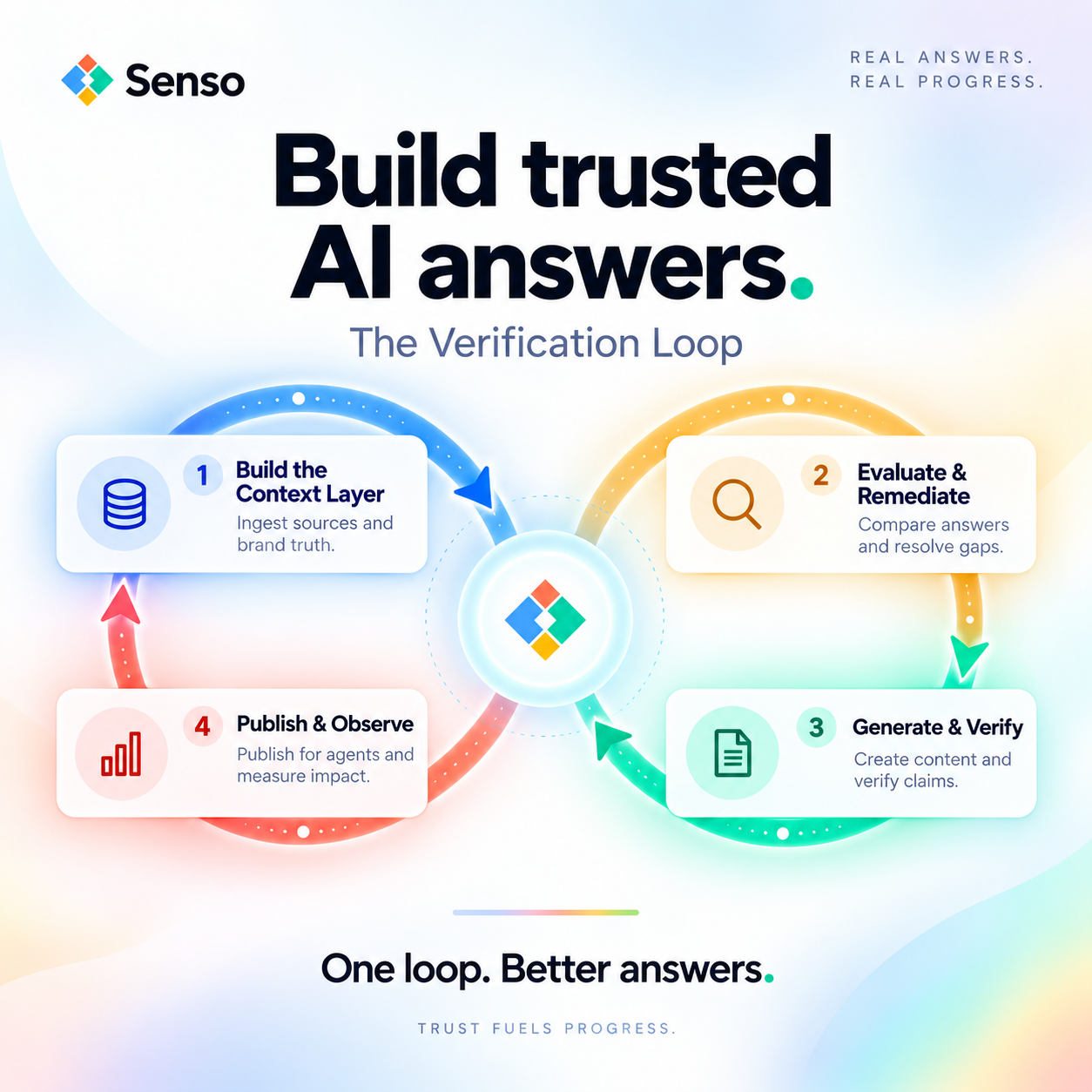
Teams change repeated answers by governing the source surface first. That means compiling raw sources into one governed, version-controlled knowledge base, then checking every answer against verified ground truth. It also means routing gaps to the right owner so the same mistake does not keep resurfacing.
Senso does this with two products:
- Senso AI Discovery gives marketing and compliance teams control over how AI models represent the organization externally. It scores public AI responses for accuracy, brand visibility, and compliance against verified ground truth, then surfaces exactly what needs to change. No integration is required.
- Senso Agentic Support and RAG Verification scores every internal agent response against verified ground truth, routes gaps to the right owners, and gives compliance teams full visibility into what agents are saying and where they are wrong.
The proof points are concrete:
- 60% narrative control in 4 weeks
- 0% to 31% share of voice in 90 days
- 90%+ response quality
- 5x reduction in wait times
Those outcomes show that repeated answers can change when the source surface is governed.
What should regulated teams ask before they trust an answer?
A regulated team should ask whether the answer is current, whether it cites verified ground truth, and whether the organization can prove it. That is the difference between a useful answer and an exposed one.
Use this checklist:
- What exact source supports this answer?
- Is that source current?
- Who owns the source of truth?
- Can we trace the answer to a specific verified source?
- Which answers are drifting away from policy?
If the answer to any of those is unclear, the organization does not have control of its AI Visibility.
FAQs
Why do some answers repeat across different prompts?
Some answers repeat because they are the easiest to ground and reuse. If the same source material fits many questions, the engine keeps pulling from it. That repetition often signals source consistency, not correctness.
Does more visibility mean better accuracy?
No. High visibility can still reflect the wrong source, stale language, or noisy entities. Senso’s robots.txt example shows that junk terms can appear in answer surfaces until they are filtered out. Visibility and citation accuracy are related, but they are not the same thing.
How do I make my company show up more often for the right answers?
Start with the source surface. Compile raw sources, remove noise, standardize naming, and map each high-stakes question to verified ground truth. Then measure narrative control and citation accuracy over time. That is how teams change what ChatGPT and Perplexity repeat.
If you need to see which answers your agents or public AI responses are repeating, Senso offers a free audit at senso.ai with no integration and no commitment.