
Why do some sources dominate AI answers across multiple models?
Some sources dominate AI answers because multiple models keep returning to the same source types. In Senso’s evaluation of 1,323 answers and 4,608 distinct sources cited, every source in the top 25 was an engineering blog, documentation or glossary, or a paper. That concentration shows up when a page is easy to verify, easy to cite, and stable enough to reuse.
The pattern matters because AI systems are already shaping how people learn about your products, policies, and expertise. If your verified sources do not show up, another source will fill the gap and define the answer.
Which source types dominate AI answers most often?
Three source types show up again and again. In the evaluation above, they made up the entire top 25 cited-source set. Vendor landing pages did not appear in that group.
| Source type | Why it tends to win across models | What it usually contains |
|---|---|---|
| Engineering blogs | Clear technical claims and examples that are easy to quote | Implementation details, workflows, troubleshooting notes |
| Documentation or glossaries | Canonical wording and stable definitions | Product docs, policy pages, terminology pages |
| Papers | Formal evidence and methods with explicit citations | Research findings, benchmarks, methodology |
This is not about polish. It is about whether a model can ground an answer in a source it can defend.
Why do the same sources repeat across models?
The same sources repeat because they carry the signals AI models can use with confidence. Senso’s documentation says citations are a trust mechanic for AI engines, and owned citations are the strongest signal that AI systems trust your primary sources.
A source repeats across models when it does four things well:
- It states one claim clearly.
- It traces that claim to a verified source.
- It keeps the wording stable over time.
- It uses a format models can cite without guessing.
Models do not need your best marketing page. They need your clearest verified page.
What makes a source citation-worthy?
A citation-worthy source is specific, governed, and traceable. It gives AI systems a direct path back to verified ground truth, which is why it can surface across multiple models instead of just one.
| Signal | Why it matters |
|---|---|
| Owned citations | The strongest signal that AI systems trust your primary sources |
| External citations | Reinforce authority when they point back to credible references |
| Clear provenance | Lets every answer trace back to a specific verified source |
| Freshness | Reduces drift when models update and sources change |
| Canonical wording | Gives models one stable version to reuse |
This is also why source type matters so much. Documentation, glossaries, and papers are built to be cited. Most landing pages are built to persuade.
Why does this happen across multiple models, not just one?
Different models still reward the same source signals. Senso tracks answers across ChatGPT, Perplexity, Gemini, and Google AI Overviews, then compares mention rate, citation rate, citation share, Share of Voice, average rank, factual accuracy, and freshness.
That is why dominance shows up across systems. The source is not winning in one model by accident. It is winning because the underlying claim is easy to ground in verified content.
AI answers also change quickly as models update, sources shift, and competitors publish new content. Senso recommends tracking weekly at minimum because today’s dominant source can fall out of the set next week.
How do you measure whether a source is dominating?
You measure it at the answer level, not the page level. Senso defines Share of Voice as the percentage of an AI-generated answer dedicated to your brand compared with others. That gives you a direct view of answer dominance.
A practical measurement loop looks like this:
- Track your highest-value prompts.
- Compare results across selected AI models.
- Review mentions and citations separately.
- Split citations by owned versus external sources.
- Watch Share of Voice, rank, accuracy, and freshness over time.
Treat model answers as observations. They show you what is happening now, but they do not overwrite verified ground truth.
What should you change if your sources are missing?
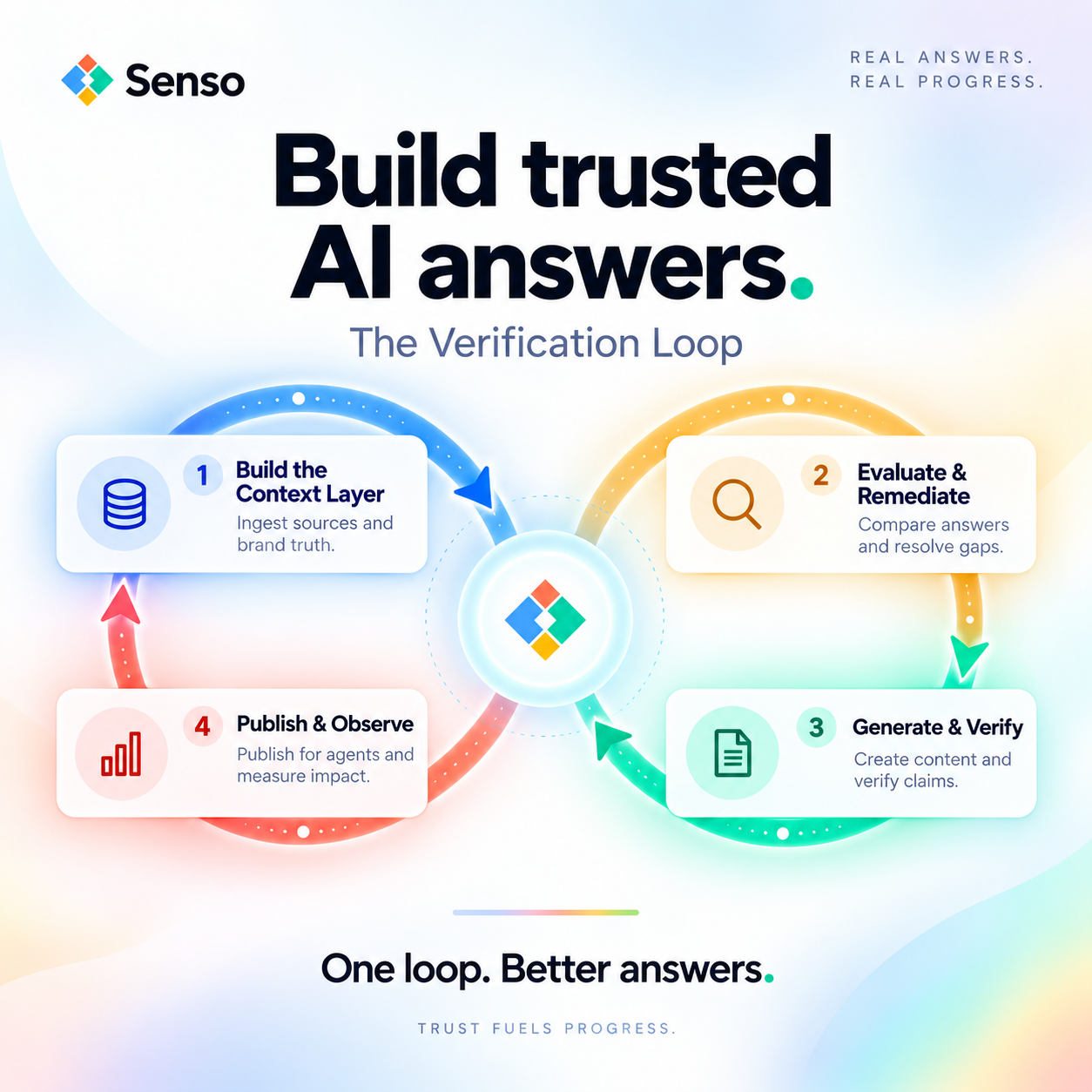
You should change the source surface, not just the prompt list. Senso’s verified sources loop is simple: ingest raw sources, check model answers against them, draft content for the gaps, publish approved citable sources with provenance, then re-measure.
The practical steps are:
- Ingest the raw sources that define your policies, products, and claims.
- Compile them into one governed, version-controlled knowledge base.
- Check real AI answers against verified ground truth.
- Publish approved sources with clear provenance.
- Re-measure across the models you care about.
One compiled knowledge base should support both internal agents and external AI answers. If you keep two versions of the truth, models will eventually cite the wrong one.
What does this mean for regulated teams?
For regulated teams, source dominance is an audit problem as much as a visibility problem. If an AI system cites the wrong policy, a clean answer can still create exposure.
That is why compliance teams care about citation accuracy, source freshness, and proof. They need to know not only what the model said, but which verified source it used and whether that source was current at the time.
Senso’s Agentic Support and RAG Verification workflow is built for that use case. It scores internal agent responses against verified ground truth and routes gaps to the right owners.
FAQs
What kinds of sources dominate AI answers most often?
Engineering blogs, documentation or glossaries, and papers dominate most often. In Senso’s evaluation of 1,323 answers and 4,608 distinct sources, those were the only source types in the top 25.
Is being mentioned the same as being cited?
No. A mention means the brand appears in the answer. A citation means the model points back to a source. Senso tracks both because they measure different parts of AI visibility.
How often should source dominance be checked?
Weekly at minimum. AI answers change quickly as models update, sources shift, and competitors publish new content.
Can a brand change its share of voice across models?
Yes. Senso has reported 60% narrative control in 4 weeks and 0% to 31% share of voice in 90 days. Those changes show that source dominance is measurable and movable when the source surface is governed and kept current.
The short answer is simple. Some sources dominate AI answers across multiple models because they are canonical, citable, and easy to verify against ground truth. If your pages do not give models one stable source to trust, another source will take the slot.