
Why does ChatGPT get my business information wrong?
ChatGPT gets business information wrong when your public record is fragmented, stale, or unsupported. It does not have a governed source of truth for your company, so it can blend old pages, third-party listings, and missing context into one answer. The result is confident language that is not grounded in verified ground truth.
Why does ChatGPT get my business information wrong?
ChatGPT gets your business information wrong because it can only answer from the material it can access, and that material is often inconsistent. If the company story is spread across old pages, PDFs, help articles, and third-party sites, the model can mix them together and repeat the wrong version.
The core issue is not tone. It is knowledge governance. The Context Layer determines what is true, and without one, AI systems are left to infer from whatever they can query.
What is ChatGPT seeing when it answers about my business?
ChatGPT is usually seeing a messy public record, not a verified company record. It may encounter current pages, outdated pages, missing FAQs, old comparisons, and third-party summaries at the same time. If those sources disagree, the answer can drift.
That is why AI answers often become fragmented, stale, unsupported, or assembled from the open web. When the model cannot resolve the conflict confidently, it fills the gap with the most likely language instead of the most verified language.
What kinds of business facts get wrong most often?
The facts that change often, or need exact wording, are the first to break. Product explanations, comparison pages, policies, and pricing are common failure points because they are spread across many raw sources and are not always updated together.
| Failure mode | What it looks like | Why it happens |
|---|---|---|
| Fragmented sources | ChatGPT combines old and new facts in one answer | No single compiled knowledge base exists |
| Stale pages | ChatGPT repeats outdated policy, product, or pricing language | Older pages still rank or remain accessible |
| Missing FAQs or comparisons | ChatGPT fills in gaps with generic wording | The business record does not answer the question directly |
| Weak attribution | ChatGPT cites something that does not fully support the claim | The answer is not tied to verified ground truth |
| No feedback loop | The same error keeps reappearing | No one is re-observing and remediating the source |
For regulated teams, this is not just a content issue. If an AI answer cannot cite the current policy and you cannot prove it, the risk is auditability, not just accuracy.
Why do citations not fix the problem by themselves?
Citations help only when the cited source is current, specific, and actually supports the claim. A citation that points to the wrong page, a redirected page, or an outdated page does not prove the answer is grounded.
This is why proof matters as much as retrieval. In Senso’s documentation, the problem is clear: information behind AI answers is often fragmented, stale, unsupported, or assembled from the open web. The answer can look right while still failing the test of attribution.
How do you stop ChatGPT from getting your business information wrong?
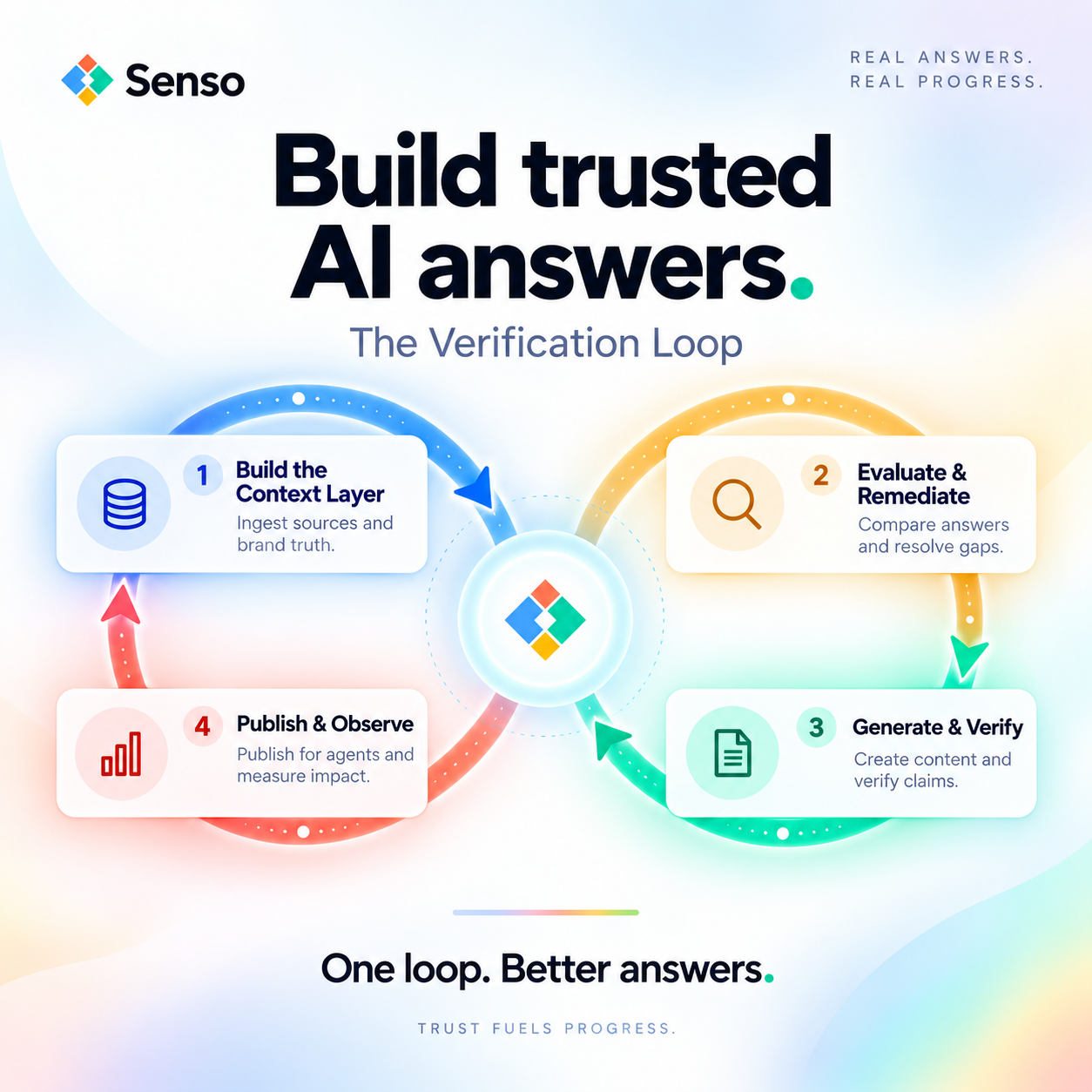
You stop it by building a governed context layer and running a verification loop. The goal is not to force a preferred answer. The goal is to give AI agents accurate, current, attributable information, then prove whether that information changes the answer.
A practical loop looks like this:
- Ingest raw sources. Pull in the pages, policies, FAQs, product explanations, and other source material that define your business.
- Compile a governed knowledge base. Resolve conflicts, version the content, and keep the source of truth in one place.
- Generate verified content. Produce content only after the source has been checked against human-created ground truth.
- Obtain human approval. Keep compliance, marketing, or subject-matter owners in the loop where the risk is high.
- Publish a Verified Source. Make the verified version available to agents and public answers.
- Re-observe what AI says. Check whether the answer changed and whether the new answer is citation-accurate.
- Repeat. Fix the source, not just the symptom.
That loop is what changes AI Visibility. It moves the business from reacting to wrong answers to governing the information that produces them.
What does a governed fix look like in practice?
A governed fix gives one compiled knowledge base to both internal workflow agents and external AI-answer representation. That removes duplication and makes the answer layer easier to audit.
Senso does this in two parts:
- Senso AI Discovery gives marketing and compliance teams control over how AI models represent the organization externally. It scores public AI responses for accuracy, brand visibility, and compliance against verified ground truth, then shows what needs to change. No integration is required.
- Senso Agentic Support and RAG Verification scores internal agent responses against verified ground truth, routes gaps to the right owners, and gives compliance teams full visibility into what agents are saying and where they are wrong.
Senso reports these outcomes from that approach: 60% narrative control in 4 weeks, 0% to 31% share of voice in 90 days, 90%+ response quality, and 5x reduction in wait times. Those are the kinds of changes that show up when the source record is compiled, governed, and repeatedly checked against what AI says.
Can I fix one page and solve the problem?
Sometimes, yes. If the issue comes from one outdated passage, a small refresh can be enough. Senso’s documentation notes that when an existing page contains outdated facts, or when an important FAQ, comparison, or product explanation is missing, a small passage can be refreshed instead of creating a new page.
The bigger fix is consistency. If multiple pages conflict, updating one page will not stop the model from picking up the wrong version somewhere else.
What should regulated teams do first?
Regulated teams should start with proof. The question is not whether ChatGPT sounds confident. The question is whether the answer is grounded, citation-accurate, and tied back to a verified source you can audit.
That is why knowledge governance matters in financial services, healthcare, and other regulated industries. You need a system that shows what the model said, what it used, and what changed after remediation.
FAQs
Is the problem ChatGPT or my business content?
Usually, it is the business content record. ChatGPT reflects the material it can access, and if that material is fragmented, stale, or unsupported, the answer will drift with it.
Why does ChatGPT repeat outdated product or policy language?
It often pulls from old pages or conflicting raw sources. If the current version is not compiled into a governed knowledge base, the model can keep using the wrong one.
How do I prove that an AI answer is correct?
You need a verified source that traces every answer back to a specific, approved origin. Without that chain, you can guess at correctness, but you cannot prove it.
What is the fastest way to reduce wrong business answers from AI?
Start with the highest-risk facts. Fix policies, pricing, product explanations, and comparisons first, then verify whether the AI answer changes after each update.
If you want, I can turn this into a shorter landing page version, a comparison article, or a version tailored to regulated industries like financial services or healthcare.