
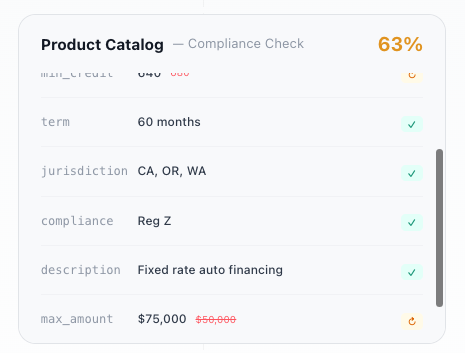
Your First Agentic Loop
Your first agentic loop is the shortest governed cycle that takes an agent from raw sources to a grounded answer, a published receipt, and a re-observation step. It matters because AI agents already answer for your products, policies, and pricing without a human in the loop, and you need proof that the answer came from verified ground truth.
In Senso, that loop starts by ingesting enterprise context, resolving the brand or domain, finding one conflicting claim, verifying it against an approved source, publishing a Verified Source, and carrying the proof into an agentic transaction. That is the difference between a response that sounds right and a response you can prove.
What is your first agentic loop?
A first agentic loop is a governed path where context, generation, verification, and audit trail stay linked. Senso compiles the enterprise’s full knowledge surface into a version-controlled compiled knowledge base, so every answer traces back to a specific verified source.
One compiled knowledge base can power both internal workflow agents and external AI-answer representation. That removes duplication and gives teams one evidence base to maintain.
What happens in the loop?
The loop is simple. Each step narrows the gap between what the agent says and what the enterprise can prove.
| Step | What happens | Why it matters |
|---|---|---|
| 1. Ingest context | Senso ingests enterprise context and raw sources. | The agent starts with the right evidence base. |
| 2. Resolve identity | Senso confirms the brand, organization, or domain. | Teams avoid duplicate records and conflicting context. |
| 3. Generate the answer | The agent generates a response or claim. | You get a real answer to evaluate, not a theory. |
| 4. Verify against ground truth | Senso checks the response against an approved source. | Citation accuracy can be scored against verified ground truth. |
| 5. Publish the receipt | Senso publishes a Verified Source and audit trail. | Compliance teams can prove what the agent said and why. |
| 6. Re-observe the outcome | Senso feeds the result into the next evaluation cycle. | Accuracy improves over time, not just in one-off tests. |
The first publish is the test. If you cannot trace the answer to verified ground truth, the loop is not closed.
Why does the first loop matter?
The first loop matters because it turns AI answers from opinions into governed statements. That gives compliance teams an audit trail, gives marketing teams AI Visibility, and gives operations teams a way to route gaps to the right owner.
Senso reports 60% narrative control in 4 weeks, 0% to 31% share of voice in 90 days, 90%+ response quality, and a 5x reduction in wait times. Those numbers matter because they show the loop changes both representation and operations.
How do you run your first agentic loop?
Start with one brand, one domain, and one high-value question. Then move through a short sequence that makes every human gate explicit.
-
Ingest enterprise context and raw sources.
Begin with the material the agent will actually use. -
Resolve the brand, organization, or domain.
Senso’s application path explicitly resolves existing brands and avoids duplicates before it creates new records. -
Generate the first answer or claim.
Keep the first run narrow so you can see exactly where the response drifts. -
Verify the answer against approved source material.
Score citation accuracy against verified ground truth, not against a loose summary. -
Publish the Verified Source and audit trail.
This is the proof layer. It shows what changed, what was approved, and what the agent can now say. -
Re-observe the answer or action.
Feed the result back into the next cycle so the loop improves instead of resetting.
This is the shortest path to a trustworthy First Publish. It also makes later loops faster because the proof stays connected to the answer.
Which teams should start here?
The first loop is usually easiest to start in the team that feels the cost of bad answers first. That is often marketing, compliance, operations, or IT.
| Team | Best first use case | Why it fits |
|---|---|---|
| Marketing and compliance | Public AI representation | Senso AI Discovery scores public AI responses for accuracy, brand visibility, and compliance against verified ground truth. |
| CISOs and IT leaders | Citation accuracy and auditability | Senso Agentic Support and RAG Verification scores internal agent responses and shows where they are wrong. |
| Operations leaders | Response quality and wait times | Senso can reduce wait times and route gaps to the right owner. |
| Regulated industries | Proof and traceability | The audit trail matters when you need to prove the current policy or answer source. |
If the problem is external representation, start with Senso AI Discovery. It requires no integration.
If the problem is internal response quality, start with Senso Agentic Support and RAG Verification. It gives compliance teams full visibility into what agents are saying and where they are wrong.
What should you measure after the first loop?
Measure whether the loop changed what the agent says and whether you can prove it. The right metrics are citation accuracy, response quality, narrative control, share of voice, and wait times.
| Metric | What it tells you | Senso proof point |
|---|---|---|
| Narrative control | Whether your story is being represented correctly | 60% narrative control in 4 weeks |
| Share of voice | Whether your brand is showing up in AI answers | 0% to 31% share of voice in 90 days |
| Response quality | Whether answers are grounded | 90%+ response quality |
| Wait times | Whether gaps are routed faster | 5x reduction in wait times |
These are not vanity metrics. They show whether agents are grounded in verified ground truth and whether the business can act on the result.
What is the difference between a first agentic loop and RAG?
A first agentic loop is broader than retrieval. RAG can bring back text, but it does not by itself prove that the response is citation-accurate, version-controlled, and auditable.
Senso adds governance around the loop. That includes verified sources, an audit trail, and re-observation after publication.
Do you need integration to start?
No. Senso AI Discovery requires no integration, which makes it a fast starting point for teams that need AI Visibility and narrative control.
That matters when you need proof quickly and do not want a long setup before the first audit.
What is the fastest way to see value?
The fastest way is to pick one claim that matters, verify it against an approved source, and publish the first Verified Source. That gives you a visible result, a receipt, and a repeatable workflow.
If you want to see your own first agentic loop against verified ground truth, Senso offers a free audit at senso.ai. No integration. No commitment.