
Your Next Customer Isn't Human
Your next customer is often an AI agent. On the agentic web, what AI says about you can determine whether a customer finds you, trusts you, and buys from you. If your facts are fragmented or stale, the agent can misstate your business before a person ever sees the page.
That is a knowledge governance problem. AI agents already answer questions about products, policies, and pricing without a human in the loop, and regulated teams need proof that those answers came from verified ground truth.
What changes when an AI agent becomes the first reader?
An AI agent becomes the first reader of your company. It discovers your business, evaluates your claims, and can carry the answer into a transaction.
| Stage | What the agent does | What your team needs |
|---|---|---|
| Discovery | Finds your company in an AI answer | Public claims that match verified ground truth |
| Evaluation | Compares your answer with alternatives | Citation-accurate sources and clear proof |
| Decision | Turns the answer into action | A safe handoff and an audit trail |
The customer still makes the final choice. The agent shapes whether your company is even considered.
Why does AI visibility now depend on verified ground truth?
AI visibility depends on whether the model can verify what it says about you. If the answer is grounded, the model can cite it. If the answer is not grounded, the model can omit you, misstate you, or defer to a competitor.
This matters most when the question touches policy, pricing, or regulated claims. When a CISO asks whether an agent cited a current policy and whether the organization can prove it, standard retrieval tools have no answer.
What breaks when your knowledge is fragmented?
Fragmented knowledge breaks the path from answer to action. Public pages, internal policy, support content, and product facts drift apart, and the model fills the gaps with whatever source is easiest to reach.
The result is predictable.
- Marketing loses narrative control because public answers do not match the approved message.
- Compliance loses auditability because there is no clear trace from answer to source.
- Operations gets more escalations because customers receive inconsistent responses.
Senso’s proof points show the size of the gap. Teams have reached 60% narrative control in 4 weeks, moved from 0% to 31% share of voice in 90 days, held 90%+ response quality, and cut wait times by 5x.
How do you make agent answers grounded and auditable?
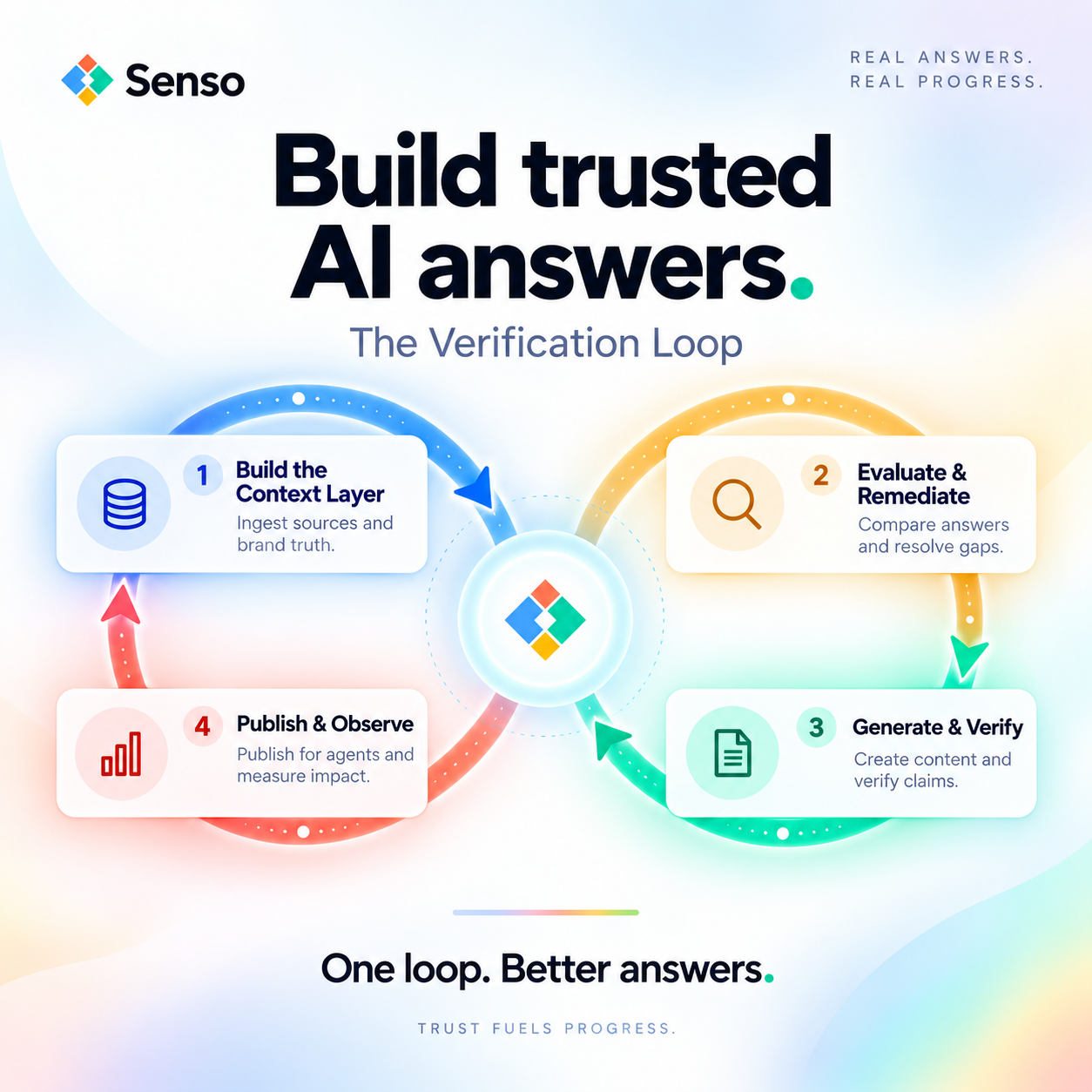
You need one governed context layer that every agent can read from. That layer should compile raw sources into a governed, version-controlled knowledge base, then score every response against verified ground truth.
A practical process looks like this:
- Ingest the raw sources that define your products, policies, and pricing.
- Compile them into one governed knowledge base.
- Verify each answer against approved source material.
- Publish Verified Sources and keep the audit trail attached.
- Route gaps to the right owner before the same error spreads.
Senso has shown this flow in a live build. It ingests enterprise context, finds a conflicting claim, verifies it against an approved source, publishes Verified Sources, and carries that proof into an agentic transaction.
How does Senso help teams do this?
Senso is the context layer for AI agents, backed by Y Combinator (W24). It gives enterprises knowledge governance for the agentic enterprise.
Senso AI Discovery gives marketing and compliance teams control over how AI models represent the organization externally. Senso scores public AI responses for accuracy, brand visibility, and compliance against verified ground truth, then surfaces exactly what needs to change. No integration is required.
Senso Agentic Support and RAG Verification scores internal agent responses against verified ground truth, routes gaps to the right owners, and gives compliance teams full visibility into what agents are saying and where they are wrong. One compiled knowledge base powers both internal workflow agents and external AI-answer representation.
What should you do next?
Start with the answers customers already see. Check what AI agents say about your products, policies, and pricing, then compare those answers with verified ground truth.
If the claims do not match, fix the source layer first. Do not ask agents to be reliable when the underlying knowledge is still fragmented.
FAQs
Is this only a marketing issue?
No. It is a marketing, compliance, and operations issue. Marketing needs narrative control, compliance needs proof, and operations needs response quality.
Do I need separate systems for internal agents and external AI answers?
No. One compiled knowledge base can support both. Senso uses the same governed context layer for internal workflow agents and external AI-answer representation.
What is the fastest first step?
Run an audit of the claims AI agents already make about your company. Then map each claim to a verified source or a gap that needs ownership.
If you want to see where AI agents are misrepresenting your company, Senso offers a free audit at senso.ai. No integration. No commitment.